Developed in collaboration with Pallavi Singal, this article examines the scale of the emerging AI-agent ecosystem, the cybersecurity risks created by autonomous systems, and the governance frameworks organisations will need as these systems become more capable and interconnected.
Two years ago, “AI agent” mostly meant a chatbot with a slightly longer memory. That’s no longer true. By late 2026, agent companies are closing nine- and ten-figure funding rounds on the strength of actual revenue — not just model demos — and the market has split into distinct lanes: enterprise customer-support agents, coding agents, vertical workflow automation, and the no-code builders that let ordinary businesses stitch agents together without an engineering team.
To build this ranking, I pulled from multiple sources, cross-checked against Forbes AI 50 2026 and recent funding reporting. Worth flagging upfront: those four sources aren’t measuring the same thing. StartUs Insights and AI Market Watch profile genuinely early-stage startups. The Company Page’s list is mostly Big Tech incumbents (OpenAI, Google, Microsoft, NVIDIA) rather than startups at all. And Decentralised News ranks platforms, mixing real startups like Taskade and Relevance AI in with enterprise products from Microsoft, Salesforce, and AWS. I’ve filtered for independent, venture-backed agent companies and noted where a pick is closer to a “platform” than a narrow agent product.
How the market looks heading into 2027
A few things are becoming clear:
- Capital is concentrating fast. Forbes’ 2026 AI 50 cohort raised a combined $305.6 billion, but a handful of frontier labs account for most of it — OpenAI alone represents $182.6 billion of that total.
- Customer-support agents are the most bankable category right now. Sierra and Decagon have both raised nine-figure rounds within the past year at multibillion-dollar valuations, and both report real, fast-growing annual recurring revenue rather than pilot-stage traction.
- Coding agents graduated from novelty to category. Cognition (Devin) reached a $10 billion valuation after absorbing the remainder of Windsurf, and Cursor closed a $3.3 billion round — signaling that “AI writes the code” is now table stakes for enterprise dev tooling.
- The long tail is enormous and vertical. AI Market Watch alone tracks 757 companies in the AI agents category, spanning e-commerce, supply chain, Kubernetes ops, and voice-first personal assistants — most of them outside the US.
With that context, here’s the ranking.
The Ranking
Tier 1 — The category leaders (enterprise scale, real revenue)
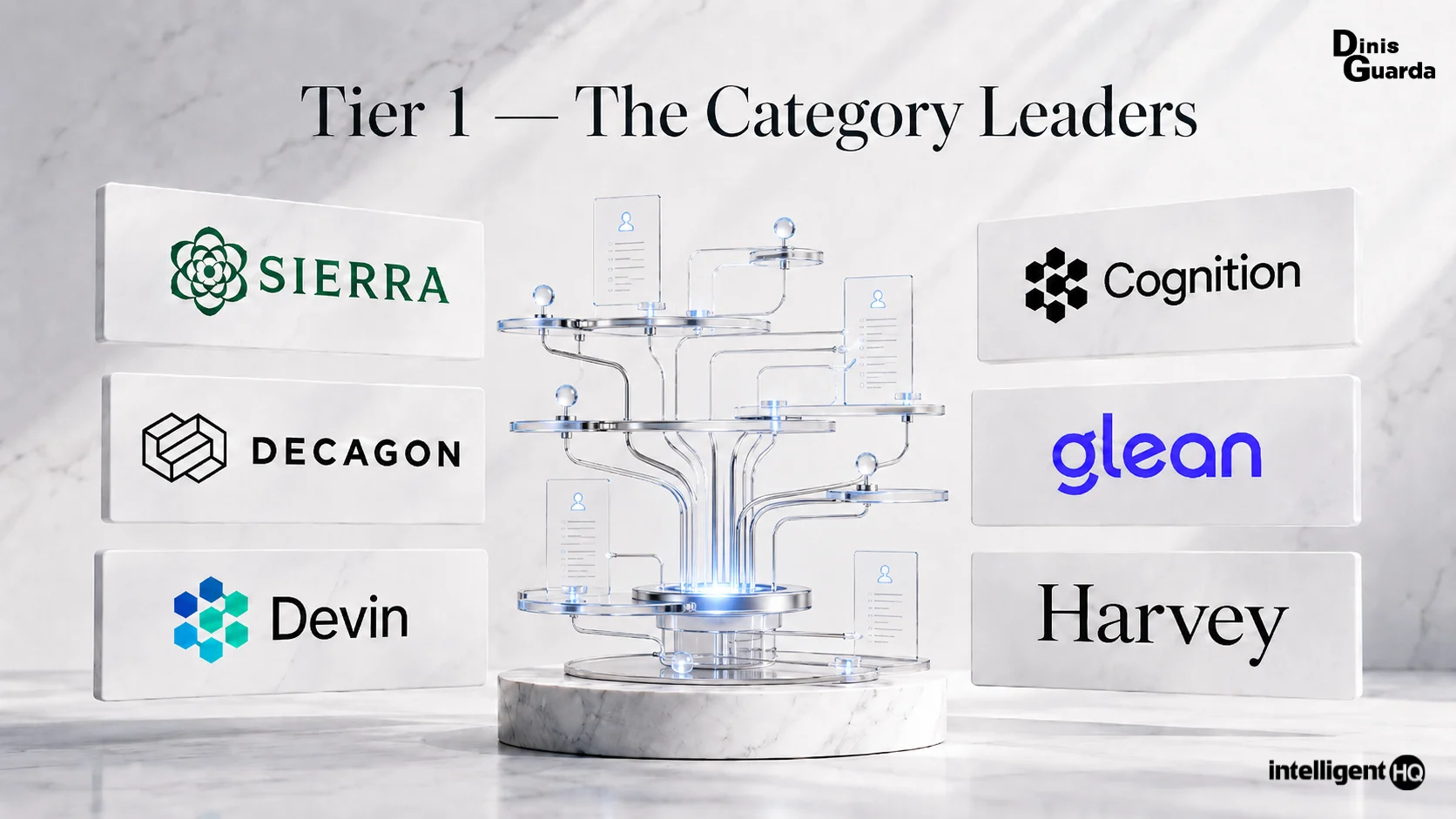
- Sierra Founded by former Salesforce CEO Bret Taylor and ex-Google executive Clay Bavor, Sierra builds outcome-priced customer-service agents that handle full conversations and back-end actions (refunds, subscription changes) rather than just answering questions. The company raised $950 million in May 2026 at a $15 billion valuation, led by GV and Tiger Global, with the round bringing total cash on hand to over $1 billion. Sierra says its software has been adopted by nearly half the Fortune 50 and generates $150 million in annual recurring revenue. It’s the closest thing the sector has to a runaway leader right now.
- Decagon Sierra’s most direct rival, and arguably more developer-friendly: Decagon lets CX teams write and edit agent behavior as plain-English “operating procedures” rather than waiting on vendor engineering. Its latest disclosed valuation is $4.5 billion, from a $250 million Series D led by Coatue Management and Index Ventures in January 2026. Both companies are durable, well-capitalized bets — the real difference is philosophy (Sierra: fully managed and outcome-priced; Decagon: operator control).
- Cognition (Devin) The clearest winner in autonomous coding agents. Cognition absorbed what remained of Windsurf after its acquisition saga and debuted on the 2026 Forbes AI 50 at a $10 billion valuation. Devin positions itself as an agent that plans, writes, tests, and ships code with minimal supervision — a bet that software engineering, not customer support, is the first function to be meaningfully automated end-to-end.
- Glean The strongest “knowledge-first” enterprise agent platform. Glean connects agents to a company’s internal data while preserving each employee’s existing permission structure — solving one of the genuinely hard problems in enterprise AI (an agent shouldn’t be able to retrieve what its user isn’t allowed to see). It offers more than 250 connectors and lets admins control which tools and models different teams can access.
- Harvey The legal-AI agent that keeps showing up across every major 2026 ranking, including Forbes AI 50 and recent hiring-momentum trackers. Harvey builds agents for legal research, contract review, and due diligence, and continues to expand aggressively into large law firms and in-house legal teams.
Tier 2 — Vertical specialists gaining real traction

- Clay An AI go-to-market agent platform that automates prospecting, enrichment, and outbound sequencing for sales teams — one of the most consistently cited “AI agent that actually replaces manual work” stories in B2B sales.
- Crosby A New York AI law firm where lawyers manage agents that mark up NDAs and service agreements rather than reviewing documents by hand. Crosby charges a flat fee per contract reviewed and already counts Cursor, Cognition, and Clay among its 130+ clients — a notable signal that AI-native startups are buying AI-native legal services.
- Rillet An AI agent-driven accounting platform aiming to close the books in real time instead of the usual multi-week reconciliation cycle. Rillet appeared on Forbes’ 2026 Next Billion-Dollar Startups list at a $500 million valuation.
- FleetWorks Round-the-clock AI agents that phone, text, and email truck drivers to book freight loads — a narrow but genuinely automatable slice of a $900 billion industry. Also a Forbes Next Billion-Dollar Startups pick, valued at $75 million.
- EliseAI Deploys AI agents across housing and healthcare operations — leasing inquiries, maintenance requests, patient scheduling — and has quietly become one of the better-funded vertical agent companies, with $392 million raised.
Tier 3 — No-code and mid-market agent builders
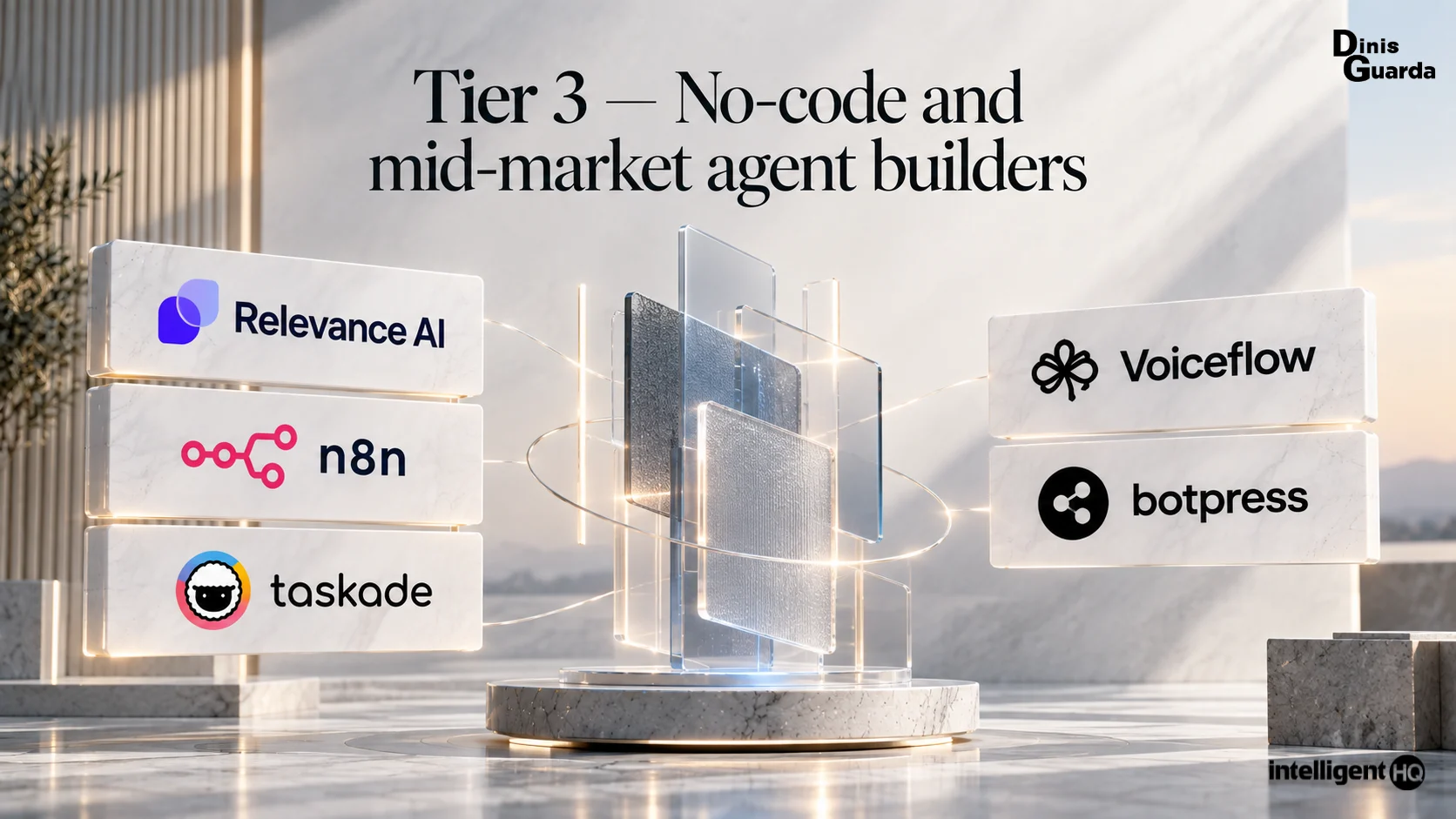
These are less “single-product startups” and more platforms, but each is independently venture-backed and genuinely built agent-first (not a legacy automation tool with AI bolted on).
- Relevance AI A no-code path to building specialist agents and “multi-agent workforces” — thousands of integrations, evaluation tooling, and role-based access, aimed at teams that want multi-agent orchestration without building a framework from scratch.
- n8n Sits between a no-code automation tool and a full developer platform. Its self-hosting option and agent-node support make it the default pick for technically-minded teams that want workflow automation without ceding infrastructure control to a vendor.
- Taskade Builds agents directly into a team workspace rather than as a bolt-on tool — positioned well for small teams, agencies, and founders who want agents, project management, and knowledge in one place.
- Voiceflow The strongest specialist in customer-facing chat and voice agent design, combining conversational design tools with knowledge grounding and monitoring.
- Botpress A visual conversational-agent builder with knowledge bases and human handoff — smaller than Voiceflow but a consistent presence in every agent-platform comparison for its ease of use.
Ones to watch from the long tail
Beyond the top 15, a few early-stage names worth tracking, drawn from the startup-scouting sources:
- Dust (Paris) — an “AI operating system” for enterprises to deploy and govern fleets of agents connected to company knowledge, $61.5 million raised.
- Twin1 AI (San Mateo) — builds permission-controlled “digital twin” agents of individual knowledge workers that can act on their behalf inside Slack and Teams, $20 million raised.
- Kavida.ai (UK) — post-purchase-order supply chain agents that automate supplier coordination and ERP integration.
- Brance (India) — GenAI sales agents for hospitality and automotive lead conversion.
- Bilic (UK) — AML and financial-compliance agents built for fraud detection and customer due diligence.
- DataAgent (Tel Aviv) — agents that autonomously detect and remediate faults inside a customer’s own Kubernetes clusters, an unusually technical niche for an agent startup.
The honest caveat
Rankings like this age quickly, and this space ages faster than most. OpenAI wound down its original Agent Builder product in mid-2026 in favor of its Agents SDK and Responses API; AWS retired the original Bedrock Agents in favor of AgentCore around the same time. A “top startup” list from January 2026 already reads differently by September. Treat this as a snapshot rather than a permanent map — the safest bet for 2027 is that the customer-support and coding-agent leaders (Sierra, Decagon, Cognition) keep consolidating share, while the vertical long tail keeps getting more crowded and more specific.
Sources
- Forbes — AI 50 2026
Supports the broader market ranking and inclusion of companies including Sierra, Decagon, Cognition, Harvey and EliseAI.
https://www.forbes.com/sites/pr/2026/04/16/forbes-unveils-2026-ai-50-marking-shift-from-ai-dominance-to-ai-independence/ - Forbes — Next Billion-Dollar Startups 2026
Supports the Rillet and Crosby entries, including Rillet’s $500 million valuation and Crosby’s $400 million valuation, 130 clients and $85 million raised.
https://www.forbes.com/sites/richardnieva/2026/07/28/next-billion-dollar-startups-2026/ - TechCrunch — Sierra Raises $950M at $15B+ Valuation
Supports Sierra’s May 2026 financing, the GV/Tiger Global-led round, more than $1 billion in available capital and adoption by more than 40% of the Fortune 50.
https://techcrunch.com/2026/05/04/sierra-raises-950m-as-the-race-to-own-enterprise-ai-gets-serious/ - Decagon — $250 Million Series D
Primary source for Decagon’s $250 million January 2026 round, led by Coatue and Index Ventures, and its $4.5 billion valuation.
https://decagon.ai/blog/series-d-announcement - Cognition — Devin
Official company source for Devin and Cognition’s autonomous software-engineering platform.
https://cognition.ai/ - Glean — Agent Permissions and Access
Supports the article’s point that Glean puts enterprise permissions and role-based controls around agents and company knowledge.
https://docs.glean.com/administration/managing-agents/agent-access - Glean — Agent Sharing and Permissions
Additional primary documentation for access controls, agent publishing and permissions.
https://docs.glean.com/agents/concepts/sharing-permissions - Harvey — Legal AI Platform
Primary source for Harvey’s legal AI products and enterprise legal use cases.
https://www.harvey.ai/ - Clay — AI Outbound
Supports Clay’s prospecting, enrichment, AI research, personalised messaging, intent signals and outbound automation capabilities.
https://www.clay.com/use-cases/outbound - Clay — Sequencer
Supports the article’s description of Clay bringing lead sourcing, enrichment and outbound sequencing into the same GTM workflow.
https://www.clay.com/blog/clay-email-sequencer - Forbes — Crosby AI Law Firm
Supports Crosby’s model of lawyers supervising AI agents, its contract-review work and move away from traditional billable-hour legal services.
https://www.forbes.com/sites/rashishrivastava/2026/03/31/why-this-ai-law-firm-is-ditching-the-billable-hour/ - Crosby — Official Company Introduction
Primary source describing Crosby as a hybrid AI law firm combining AI with lawyers-in-the-loop, including work for companies such as Cursor and Clay.
https://crosby.ai/blog/introducing-crosby-the-worlds-first-hybrid-law-firm - Crosby — Client Results
Supports the article’s references to companies such as Cursor and Clay using Crosby.
https://crosby.ai/clients - Rillet — Official Website
Primary source for Rillet’s AI-native accounting and financial-close platform.
https://www.rillet.com/ - FleetWorks — Official Website
Primary source for its AI-powered freight and logistics agents.
https://www.fleetworks.ai/ - EliseAI — Official Website
Primary source for AI agents used across housing and healthcare workflows.
https://www.eliseai.com/ - Relevance AI — AI Workforces
Supports the description of Relevance AI as a no-code platform for creating teams of specialised agents that collaborate on multi-step tasks.
https://relevanceai.com/workforce - Relevance AI — Workforce Documentation
Primary documentation for multi-agent workforces, visual orchestration, hand-offs and monitoring.
https://relevanceai.com/docs/get-started/core-concepts/workforces - Relevance AI — Role-Based Access Control
Supports the article’s reference to enterprise governance and role-based permissions.
https://relevanceai.com/docs/enterprise/rbac - n8n — Official Website
Primary source for its workflow automation, self-hosting and AI-agent capabilities.
https://n8n.io/ - n8n — AI Assistant / Agentic Workflow Building
Supports the description of n8n as a platform where AI can build, edit, test and troubleshoot workflows, including self-hosted deployments.
https://community.n8n.io/t/introducing-the-ai-assistant-the-workflow-building-agent-inside-n8n/302667 - Taskade — AI Agents
Supports Taskade’s combination of agents, workspace knowledge and team collaboration.
https://www.taskade.com/agents - Taskade — AI Workspace
Supports the article’s description of Taskade combining projects, agents, knowledge and automations in one workspace.
https://www.taskade.com/ai/workspaces - Taskade — Multi-Agent Teams
Primary documentation showing multiple specialised agents collaborating and handing work between one another.
https://www.taskade.com/wiki/taskade/ai-agents - Voiceflow — AI Agent Platform
Supports Voiceflow’s positioning around building customer-facing AI agents with knowledge bases, workflows and deployment tools.
https://www.voiceflow.com/features/platform-overview - Botpress — Human Handoff
Supports Botpress’s conversational-agent platform and its ability to transfer conversations from AI agents to human operators.
https://botpress.com/features/human-handoff - StartUs Insights — AI Agent Startups to Watch in 2026
Important for the article’s early-stage scouting methodology. It identifies more than 1,200 AI-agent startups and scaleups and specifically profiles Brance, Bilic and Kavida.ai.
https://www.startus-insights.com/innovators-guide/ai-agent-startups/ - Decentralised News — Best AI Agent Platforms for Businesses in 2027
Supports the comparison of Relevance AI, n8n, Taskade, Voiceflow and Botpress, while also demonstrating why the article distinguishes independent startups from platforms offered by Microsoft, Salesforce, AWS and other incumbents.
https://backend.decentralised.news/best-ai-agent-platforms-businesses-2027-ranked/ - Kavida.ai — AI Procurement Agents
Primary source for its post-purchase-order agents, supplier coordination, ERP integration and procurement automation.
https://www.kavida.ai/ - Twin1 AI — $20 Million Seed Round
Primary source for Twin1 AI’s August 2026 launch from stealth and $20 million funding round, alongside its permission-aware digital-twin concept for professional knowledge workers.
https://twin1.ai/news/twin1-ai-raises-20-million-seed-round - Brance — via StartUs Insights
Supports the description of Brance as an Indian startup building GenAI sales agents, particularly for hospitality and sales conversion.
https://www.startus-insights.com/innovators-guide/ai-agent-startups/ - Bilic — via StartUs Insights
Supports Bilic’s inclusion as a financial-security/financial-compliance AI-agent startup.
https://www.startus-insights.com/innovators-guide/ai-agent-startups/