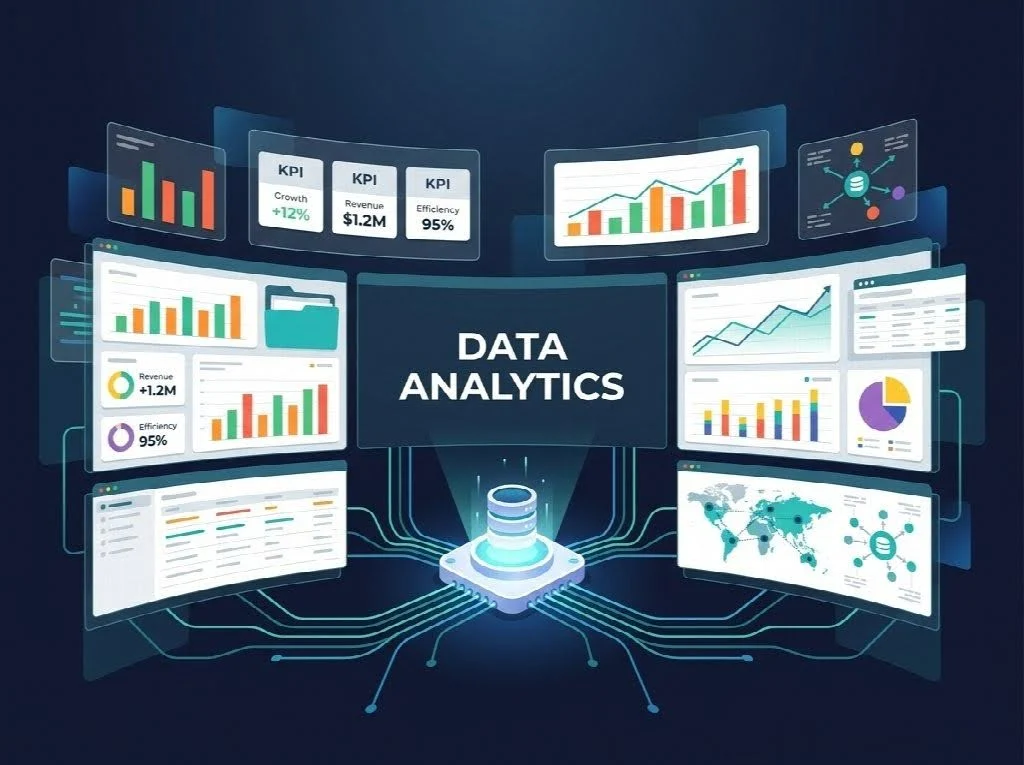
Artificial intelligence and advanced analytics have become priorities for companies across almost every industry. Organizations are investing in predictive models, generative AI, business intelligence platforms, automation, and increasingly sophisticated reporting systems.
But many of these initiatives run into the same problem long before the technology itself becomes a limitation: the underlying data is not ready.
Customer information is scattered across several platforms. Financial and operational systems use different definitions. Reports rely on manually prepared spreadsheets. Historical records contain gaps or duplicates. Teams cannot always agree on which system contains the correct version of a particular metric.
In this environment, introducing a more powerful analytics platform or an AI model does not solve the fundamental issue. It simply places a more advanced layer on top of an unreliable foundation.
This is why data management increasingly needs to come before AI and advanced analytics. The ability to collect, integrate, structure, govern, and maintain reliable data determines how much value a company can ultimately get from the technologies built on top of it.
The Real Problem Is Often Below the Analytics Layer
When companies want better insights, the most visible solution is usually a new analytics tool.
A business may introduce a BI platform because reporting takes too long, or begin experimenting with AI because teams want faster forecasting, automated analysis, or more intelligent internal processes.
Yet the problem is often not the dashboard or the model.
Consider a company where sales works in a CRM, finance relies on an ERP platform, marketing operates several automation and advertising systems, and operations maintains its own internal applications. Each platform may contain valid information, but the records are created for different purposes and updated according to different processes.
A customer may have one identifier in the CRM and another in the billing system. Revenue may be defined differently by sales and finance. Product categories may not match between an e-commerce platform and an internal reporting database.
Individually, these inconsistencies may appear minor. Once information from all these systems is used together, however, they can fundamentally affect the results.
Analytics built on inconsistent definitions produces inconsistent reporting. AI models trained on incomplete or poorly structured historical data reproduce those weaknesses in their predictions. Automated workflows can propagate errors much faster than manual processes ever did.
The first question therefore should not be, “Which AI or BI platform should we implement?”
It should be, “Can we trust the data that platform will use?”
More Data Does Not Mean Better Data
Businesses today rarely suffer from a lack of information. The challenge is turning what they already have into data that can be used consistently.
A growing number of systems often means a growing number of data silos. As organizations expand, acquire new technologies, enter new markets, or introduce new products, information becomes distributed across applications that were never necessarily designed to work together.
The result is a familiar situation: several departments report on the same part of the business but produce different numbers.
This can happen even with seemingly straightforward metrics.
Sales may consider revenue to be the total value of signed contracts. Finance may report recognized revenue. A subscription platform may calculate monthly recurring revenue according to its own rules. Management may then compare these numbers without realizing that each represents a different business definition.
The issue cannot be solved simply by moving all of those figures into the same dashboard. A common reporting interface does not create a common understanding of the data.
Before analytics can become reliable, organizations need to define what important business entities and metrics actually mean, identify which systems are authoritative, and establish consistent rules for how information is transformed.
That is the less visible side of data management, but it is often where the greatest improvement in reporting quality begins.
What a Reliable Data Foundation Actually Looks Like
A reliable data foundation does not necessarily mean putting every piece of company information into one enormous database.
Modern data environments are usually more complex than that. A business may use operational databases, a cloud data warehouse, a data lake, specialized SaaS platforms, streaming infrastructure, and external data sources at the same time.
The objective is not physical centralization for its own sake. It is consistency.
Critical information should be accessible, traceable to its source, governed appropriately, and represented in a way that different business systems can understand. Teams should know where important data originates, who owns it, how frequently it is updated, and what transformations take place before it reaches a report or an analytical model.
This is also where integration architecture becomes essential.
APIs, ETL and ELT pipelines, event streams, and other integration mechanisms allow information to move between systems without relying on repetitive manual work. But moving data is only part of the job. Reliable pipelines also need monitoring, validation, error handling, and clear transformation logic.
Otherwise, companies simply automate the movement of unreliable information.
A strong data foundation therefore combines engineering with governance. Technical infrastructure determines how data is collected and processed, while governance determines what that data means, how it should be used, and who is responsible for its quality.
Data Quality Is a Business Issue, Not Just a Technical One
Data quality problems are often first discovered by technical teams, but their consequences rarely stay within IT.
An incorrect customer record can affect a sales conversation. Duplicate profiles can distort marketing attribution. Missing transaction data can influence financial forecasting. Inconsistent inventory information can affect purchasing decisions. Outdated operational data can make performance reports misleading.
Once these errors enter analytical systems, they may be difficult for end users to see.
A polished dashboard can make unreliable information look authoritative. An AI-generated recommendation may sound convincing even when it is based on incomplete data. The sophistication of the interface can therefore make data quality problems more dangerous rather than less important.
For that reason, organizations are moving from occasional data-cleaning projects toward continuous data quality management.
Instead of fixing records only after a reporting issue appears, companies can introduce validation during ingestion, monitor unusual changes in datasets, detect duplicates, track schema changes, reconcile critical figures between systems, and assign clear ownership when problems occur.
The goal is not perfect data. Few organizations can realistically achieve that.
The goal is to understand whether the data is reliable enough for the decision or process that depends on it.
A dataset used for an internal exploratory report may tolerate some limitations. The same level of uncertainty may be unacceptable if the data is used by an automated credit decision, compliance process, demand forecast, or AI system interacting directly with customers.
Why Business Intelligence Depends on Data Architecture
Business intelligence is often described as a way to give decision-makers easier access to information. In practice, the quality of BI depends heavily on what happens before information reaches the dashboard.
If analysts repeatedly need to download files from several platforms, adjust formats, manually combine spreadsheets, and resolve differences between systems, the reporting process is already signaling a broader architecture problem.
A properly designed analytical environment changes this workflow.
Data from operational systems can be integrated and transformed before it reaches the reporting layer. Common business definitions can be applied consistently. Historical information can be retained for comparison, while access controls determine which users are able to see particular datasets.
As a result, analysts spend less time assembling reports and more time interpreting them.
This also makes self-service analytics more realistic. Giving business users access to dashboards is useful only when the underlying metrics are sufficiently consistent that people do not need an analyst to explain why every report contains a different number.
In that sense, BI maturity is closely connected to data maturity.
Visualization is the final layer. The difficult work happens underneath it.
AI Makes Data Management More Important
The current wave of AI adoption has made the quality of corporate data even more consequential.
Traditional reporting often includes human review. An analyst notices an unusual number, investigates it, and may correct the problem before the information reaches management.
Automated AI systems do not necessarily provide the same safeguard.
Machine learning models learn patterns from historical datasets. If those datasets contain missing information, biased samples, inconsistent classifications, or duplicated entities, the model learns from those imperfections.
Production systems introduce another challenge. The structure of live data may gradually diverge from the information used during model development. Source applications change, business processes evolve, new customer segments appear, and definitions are updated. Without monitoring and data governance, model performance can decline even when the model itself has not changed.
Generative AI creates a related set of requirements.
Enterprise AI applications increasingly need access to company-specific information through knowledge bases, retrieval systems, APIs, databases, or internal documents. The usefulness of the AI depends on whether that information is accurate, current, accessible, and properly governed.
If several versions of a company policy exist, an AI assistant needs to know which one is authoritative. If customer information is distributed across multiple systems, an AI-enabled support tool needs a reliable way to identify the same customer across those systems. If confidential data is involved, access controls must continue to apply even when the information is being retrieved through an AI interface.
AI therefore does not reduce the need for traditional data disciplines. It raises the stakes.
Metadata, lineage, access management, data quality, consistent terminology, and clearly defined ownership become part of AI readiness.
A Better Starting Point for Data and AI Initiatives
Companies do not necessarily need to redesign their entire data architecture before starting an AI or analytics project.
But they do need to understand the data required for the specific business problem they are trying to solve.
A useful starting point is to identify the decision or process the organization wants to improve. It might be revenue forecasting, churn prediction, automated reporting, customer segmentation, supply chain visibility, or an internal AI assistant.
From there, the company can work backwards.
What information is needed? Where does it currently live? How reliable is it? Which system should be considered authoritative? Are historical records sufficient? Can entities such as customers or products be matched consistently across systems? Who is allowed to access the information? How often does it change?
These questions usually reveal the actual scope of the data work required.
In some cases, the solution may involve integrating only a few critical sources. In others, it may require a broader data platform, new pipelines, governance processes, or significant improvements to data quality.
This use-case-driven approach is usually more effective than attempting to “centralize all data” before the business knows what it intends to do with it.
It also helps organizations prioritize investment.
Not every dataset has equal business value, and not every inconsistency needs to be solved immediately. Companies can focus engineering and governance efforts on the information that supports the most important analytical and operational use cases.
For organizations that do not have all of these capabilities internally, external data management and analytics expertise can help assess existing systems, design data architectures, build integration and processing pipelines, and prepare business data for BI, automation, and AI use cases.
The important point is that the work begins with the data problem rather than with a particular technology.
From AI Experiments to Reliable Business Systems
It has become relatively easy to build an AI proof of concept.
Cloud platforms, pre-trained models, APIs, and modern development tools allow teams to demonstrate a new use case in weeks or even days.
Moving that experiment into production is different.
A production system must work with real customers, real transactions, changing source data, security requirements, access controls, and existing business processes. It must continue working after the initial project team moves on.
This is often where weaknesses in data infrastructure become visible.
A model may perform well on a manually prepared dataset but struggle when connected to live operational systems. An AI assistant may give useful answers during a controlled demonstration but become unreliable when the underlying knowledge base contains outdated or conflicting information.
The gap between an AI demo and an operational AI capability is therefore not only a model-engineering problem.
It is also a data engineering and data management problem.
Organizations that address this early are better positioned to turn experiments into systems that can actually be trusted and scaled.
Final Thoughts
Companies understandably want to move quickly with analytics and AI. The technologies are advancing rapidly, competitors are experimenting with new use cases, and executives increasingly expect data-driven decision-making across the organization.
But speed at the application layer cannot compensate for weaknesses underneath it.
Advanced analytics requires consistent metrics. Machine learning requires reliable historical data. Generative AI needs trusted and accessible knowledge. Automation depends on accurate information moving between systems.
All of these capabilities ultimately depend on the same foundation.
Effective data management makes business information easier to integrate, understand, govern, and trust. It reduces the gap between what exists in operational systems and what decision-makers see in reports, models, or AI applications.
The companies that benefit most from AI will not necessarily be those that collect the largest amount of data or adopt the greatest number of new tools.
They will be the ones that can turn their existing data into a reliable business asset first.