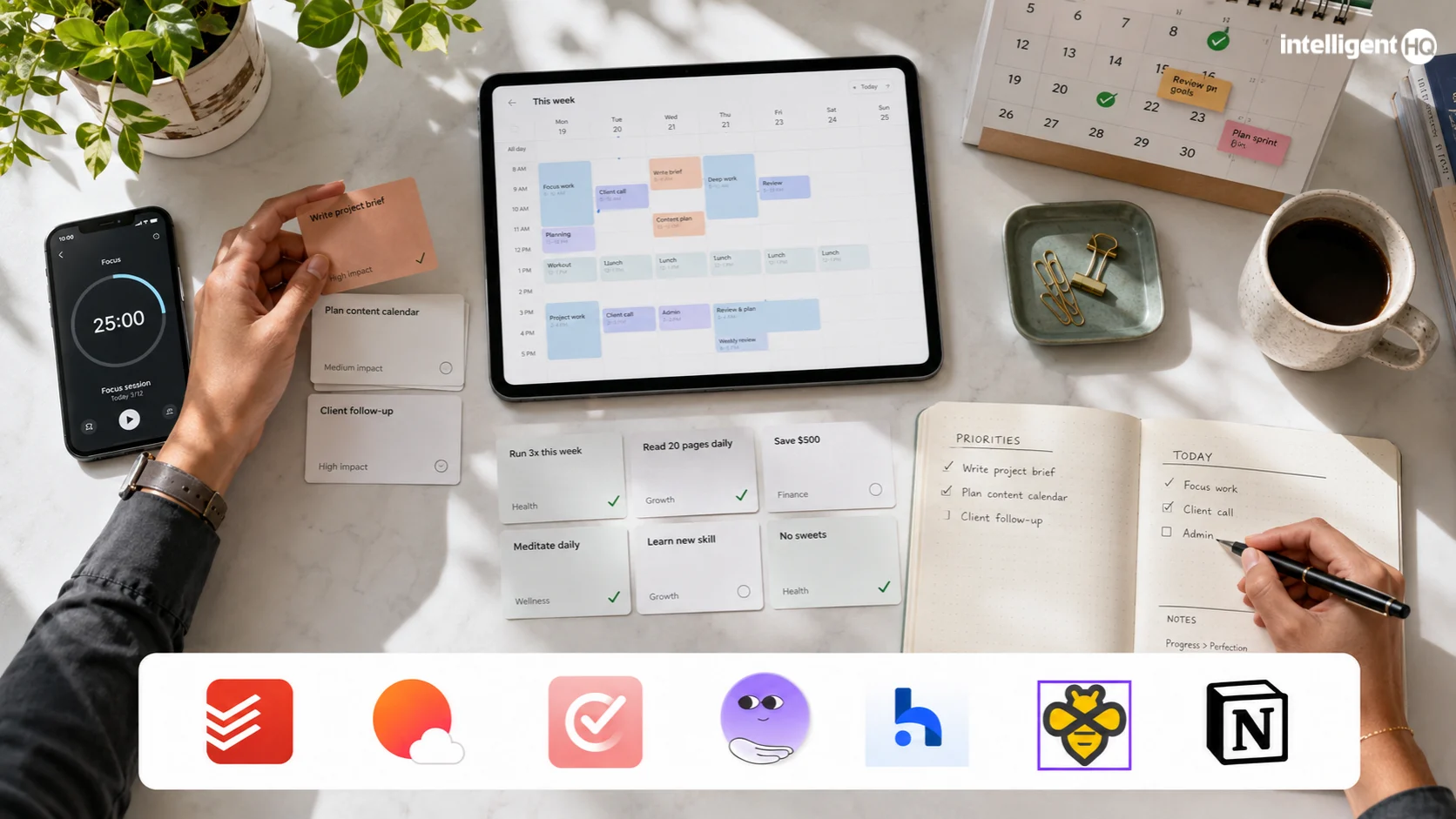
Productivity apps can organise almost anything. The harder question is whether they help users follow through.
A polished dashboard may store goals, habits and tasks without changing behaviour. Effective personal-growth tools close the gap between intention and action: they clarify the next step, reserve time for it, reduce friction and provide evidence of progress.
This guide compares seven productivity apps using the IntelligentHQ Follow-Through Framework: a practical editorial model based on five functions:
- Capture: Record an intention before it is forgotten.
- Clarify: Convert a broad goal into a defined action.
- Commit: Attach the action to a time, cue or consequence.
- Complete: Support focused execution.
- Close: Review what happened and adjust the plan.
The best app is therefore not necessarily the one with the most features. It is the one that strengthens the stage where a person’s follow-through repeatedly breaks.
Read More: Growth Navigate
Best productivity apps for personal growth at a glance
| App | Best for | Primary follow-through mechanism | Main limitation |
|---|---|---|---|
| Todoist | Flexible task management | Recurring tasks, priorities and reminders | Lists can grow without time commitments |
| Sunsama | Realistic daily planning | Workload review and timeboxing | Requires regular planning sessions |
| Structured | Visual day planning | Tasks and events on one timeline | Less suitable for complex projects |
| Tiimo | Routines and executive-function support | Visual schedules, timers and task breakdown | Limited for advanced project management |
| Habitify | Building consistent habits | Reminders, tracking and progress patterns | Not designed for multi-stage projects |
| Beeminder | High-stakes accountability | Measurable commitments with financial consequences | Excessive for low-priority goals |
| Notion | Personal-growth systems and reflection | Connected goals, projects, notes and reviews | Customisation can become procrastination |
1. Todoist: Best overall for turning goals into actions
Todoist is the strongest general-purpose choice for people who need to capture responsibilities quickly and convert them into manageable tasks.
Its Quick Add system accepts natural-language dates, while projects, priorities, labels, subtasks and recurring deadlines help turn broad ambitions into repeatable actions. A goal such as “improve my Spanish” can become a recurring 20-minute practice task, a weekly conversation and a monthly progress review.
Todoist is particularly effective during the capture and clarify stages. However, a due date is not the same as reserved time. Users who continually postpone tasks may need to combine Todoist with calendar blocking.
Best for: Managing personal projects, learning goals and recurring responsibilities.
Watch out for: Treating the inbox as permanent storage rather than deciding what to do next.
2. Sunsama: Best for realistic daily planning
Sunsama focuses on the transition from an abstract task list to a believable daily schedule.
Its guided planning process asks users to review unfinished work, select priorities, estimate task duration and compare the planned workload with their available capacity. Tasks can then be placed into calendar blocks. Daily shutdowns and weekly objectives support reflection as well as planning.
This approach addresses a common productivity failure: scheduling according to ambition rather than available time. A plan containing 12 hours of work does not become achievable because it is displayed attractively.
Sunsama is therefore strongest in the commit stage of the framework. It helps users decide when work will happen and what must be postponed.
Best for: Professionals balancing work, learning and personal-development goals.
Watch out for: Spending too much time planning minor tasks.
3. Structured: Best visual day planner
Structured combines tasks and calendar events in a single visual timeline. This makes the passage of time more concrete than a conventional to-do list.
Users can assign durations, import calendar appointments and see how routines fit around fixed commitments. Weekly and monthly views support forward planning, while notifications and widgets keep the immediate next action visible.
Structured is useful for people who understand plans more easily when they can see the shape of the day. It also reveals unrealistic assumptions: a task cannot occupy the same hour as a meeting simply because both appear on different lists.
Best for: Students, visual planners and users who want a straightforward daily schedule.
Watch out for: Using a detailed timeline when a simple recurring reminder would be sufficient.
4. Tiimo: Best for visual routines and executive-function support
Tiimo is a visual planner developed with neurodivergent users in mind, although its tools can support anyone who struggles with starting, sequencing or switching between tasks.
Its visual schedule, focus timer and widgets keep the next activity visible. Its AI planning feature can turn a written or spoken brain dump into smaller steps, suggest time estimates and organise them into a realistic plan. Mood check-ins can also help users examine how energy and emotional patterns affect routines.
Tiimo’s strength is reducing the cognitive work required between deciding and starting. It supports clarification, commitment and completion without presenting the day as a dense project-management system.
Best for: Visual routines, ADHD-friendly planning and breaking intimidating tasks into steps.
Watch out for: Depending on automatically generated plans without checking whether the suggested sequence is realistic.
5. Habitify: Best for measuring personal habits
Habitify is designed for actions that need repetition rather than conventional project management. Users can schedule habits, receive reminders, record completion and examine patterns across days, weeks and longer periods.
Built-in notes and mood tracking add context to the numbers. This matters because a missed habit does not automatically reveal why it was missed. Recording sleep, workload, location or emotional state can expose conditions that help or obstruct consistency.
Habitify works best when the tracked behaviour is specific. “Become healthier” is difficult to record; “walk for 20 minutes after lunch” creates a clear decision.
Research has found that monitoring progress can improve goal attainment, particularly when results are recorded and reviewed. Tracking should nevertheless inform improvement—not create guilt about an imperfect streak.
Best for: Exercise, reading, writing, mindfulness and other repeatable behaviours.
Watch out for: Tracking too many habits simultaneously.
6. Beeminder: Best for accountability with consequences
Beeminder combines quantitative goal tracking with a commitment contract. Users define a measurable trajectory, report progress manually or through an integration, and risk a financial charge if they move off course.
This makes the cost of postponement immediate. A vague intention to write more could become a commitment to produce a defined number of words each week. Progress appears against Beeminder’s “Bright Red Line,” making the required pace visible.
The model can be powerful when the user genuinely wants an outcome but repeatedly avoids the necessary behaviour. It should not be used to force uncertain, unsafe or externally imposed goals. Financial pressure is also unsuitable for users who respond to setbacks with anxiety or excessive self-criticism.
Best for: Clearly measurable goals with persistent procrastination.
Watch out for: Creating stakes before testing whether the target itself is reasonable.
7. Notion: Best for building a personal-growth system
Notion can connect long-term goals, active projects, individual tasks, notes and reviews inside a custom workspace. Database views allow the same information to appear as a list, board, calendar or timeline.
This makes it valuable for development areas that require both action and reflection. A learning dashboard, for example, could connect a yearly objective to courses, reading notes, practice tasks and monthly assessments.
Its flexibility is also its central risk. Users can spend hours designing templates, changing icons and restructuring databases without completing the work the system is meant to support. Start with one goals page, one task database and one weekly review. Add complexity only when an observable problem requires it.
IntelligentHQ’s broader guide to the best apps and online tools for self-improvement provides additional options for learning, wellbeing and personal development.
Best for: Connected goals, knowledge management and structured reflection.
Watch out for: Confusing system design with personal progress.
How to choose the right productivity app
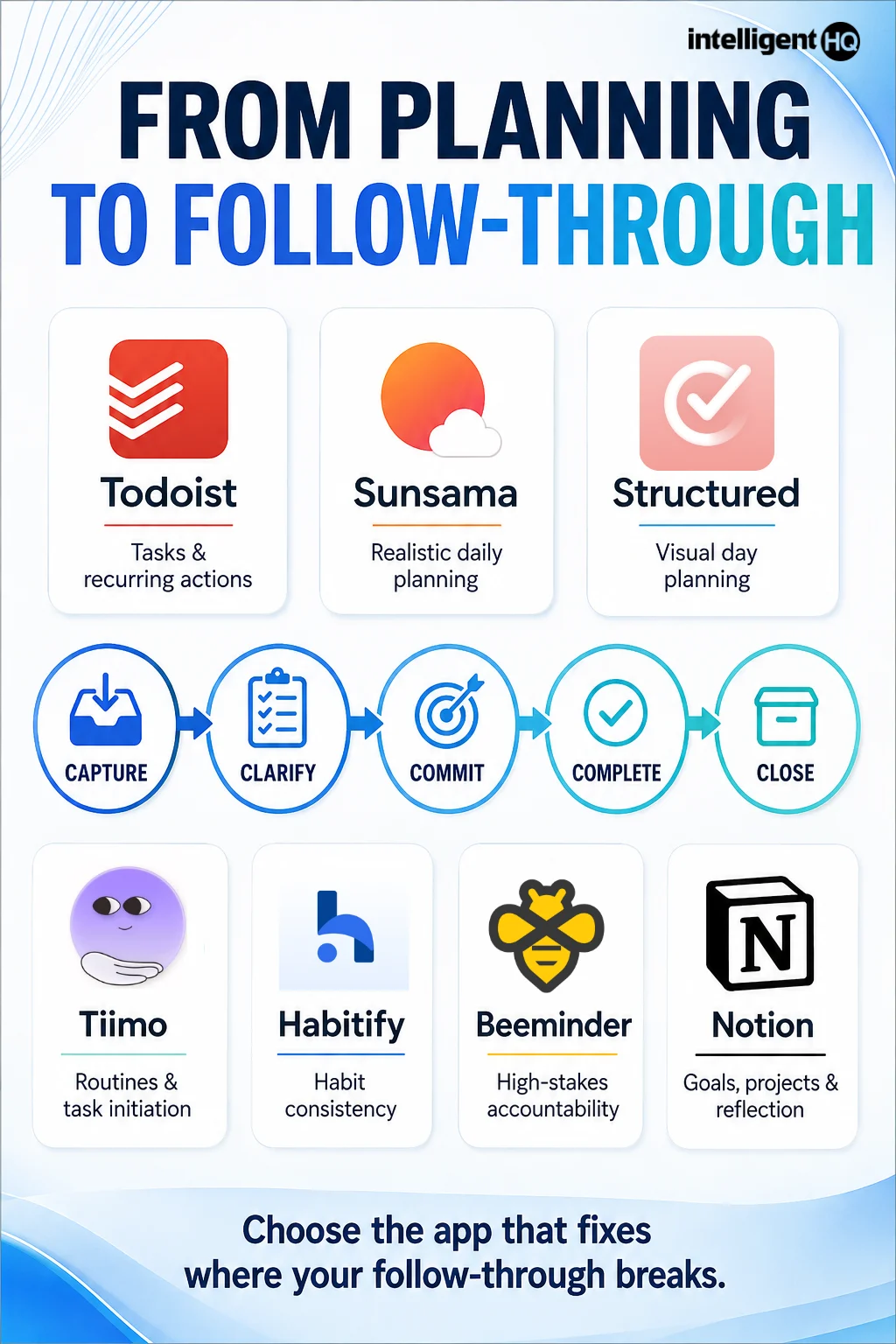
Choose the app according to the failure point—not the size of the goal.
- If intentions disappear, use a fast capture system such as Todoist.
- If the task is clear but never scheduled, consider Sunsama or Structured.
- If starting and transitioning feel overwhelming, try Tiimo.
- If consistency is the problem, use Habitify.
- If a measurable commitment needs stronger consequences, consider Beeminder.
- If actions and learning need to remain connected, use a minimal Notion workspace.
When distraction disrupts an otherwise workable plan, a planning platform may not solve the underlying problem. IntelligentHQ’s comparison of the best focus apps for blocking distractions and protecting deep work covers that separate layer.
A minimal follow-through system
Most people do not need seven productivity apps. A sustainable system can contain three elements:
- One place to capture commitments
- One calendar that reflects actual time
- One weekly review
During the weekly review, ask:
- What did I complete?
- What was repeatedly postponed?
- Was the action unclear, too large or unscheduled?
- Did I lack time, energy, skill or motivation?
- Should the goal be continued, redesigned or removed?
This last question is important. Productivity is not the ability to complete an unlimited workload. As IntelligentHQ discusses in Your Brain Is Not a Startup, personal optimisation can become counterproductive when every part of life is treated as a performance metric.
Final verdict
For most users, Todoist offers the best balance of speed, structure and flexibility. Sunsama is stronger when unrealistic daily planning is the main problem, while Structured provides a clearer visual representation of time.
Tiimo stands out for accessible routines and task initiation. Habitify is the better choice for repeatable behaviours, Beeminder introduces serious accountability, and Notion works best for users who need goals, projects and reflection in one adaptable system.
The decisive test is simple: after four weeks, has the app produced more completed actions, better decisions and useful evidence? If it has only produced a more sophisticated list of unfinished intentions, it is not improving follow-through.
Frequently asked questions
What is the best productivity app for personal growth?
Todoist is the most versatile overall option, but the right choice depends on the problem. Habitify is better for habits, Sunsama for daily scheduling, Tiimo for visual routines and Notion for connected reflection.
Should I use more than one productivity app?
Only when each app has a distinct function. A task manager, calendar and habit tracker can work together, but duplicating the same tasks across several platforms increases administration.
Can productivity apps improve motivation?
They can reduce friction, provide reminders and make progress visible. They cannot make an unwanted or unrealistic goal meaningful. Persistent avoidance may signal that the goal, method or workload needs to change.
How long should I test an app?
Use it for two to four weeks with a small number of genuine goals. Evaluate completed actions and decision quality—not streaks, notifications or time spent inside the app.
Sources
- Todoist Features
- Sunsama Daily Planning Guide
- Structured Official Website
- Tiimo Visual AI Planner
- Habitify Official Website
- Beeminder: How the Commitment System Works
- Notion Projects and Tasks Guide
- American Psychological Association: Does Monitoring Goal Progress Promote Goal Attainment?