TL;DR
Short version: you are not buying software. You are granting an outside company read access to your revenue, and the evaluation should look like a vendor review rather than a feature comparison. |

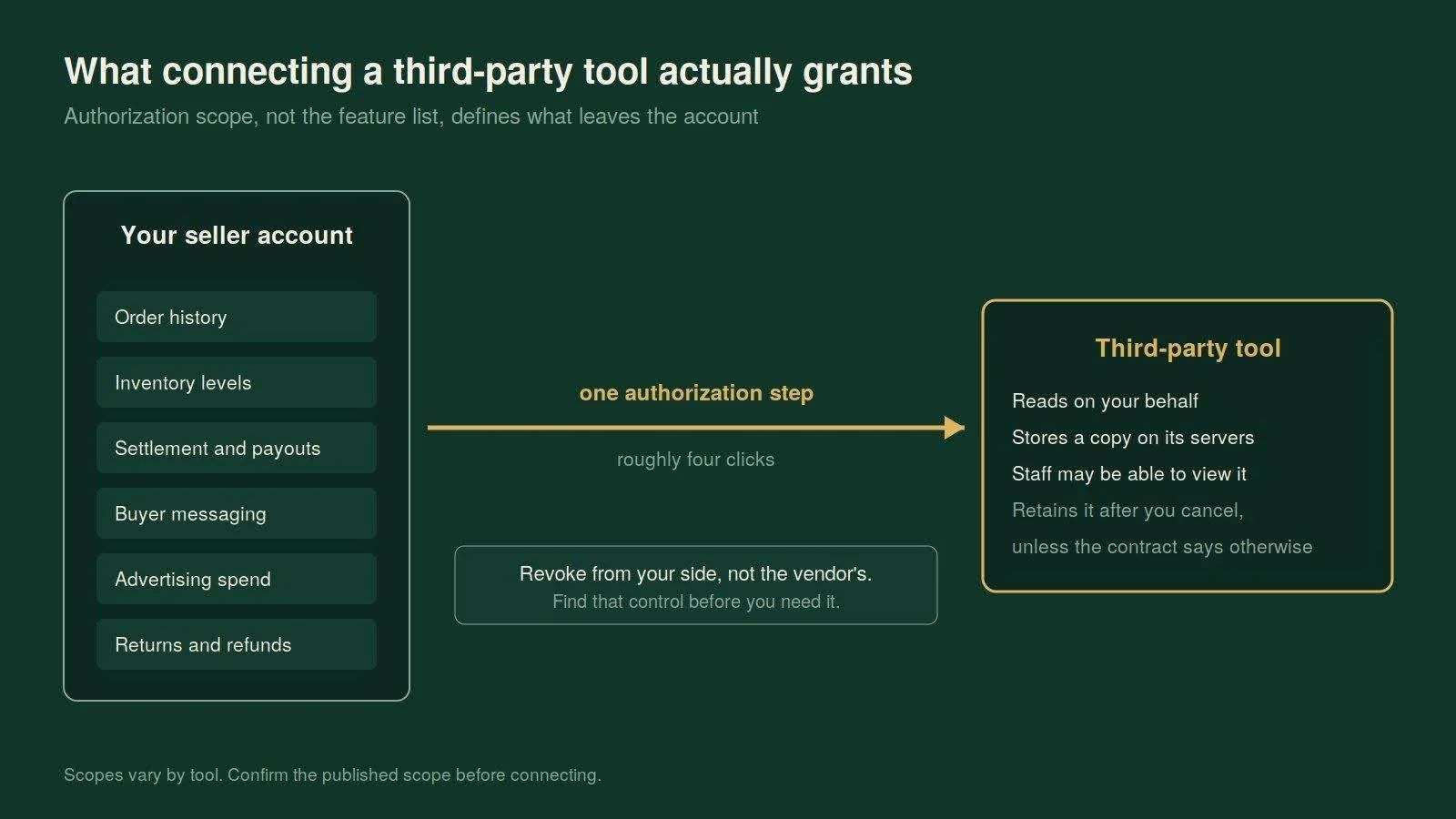
The phrase “connect your Amazon account” does a great deal of quiet work. What it describes is an authorization step in which an outside company gains programmatic read access to your order history, your inventory positions and your settlement data. That is the same visibility your accountant has, granted in about four clicks, usually during a free trial, and usually without anyone reading what the scope covers.
None of that means third-party tooling is a bad idea. Marketplace operations are not manageable from the native console alone past a certain size. It means the decision deserves the process a business would apply to any vendor holding its financial data, and most sellers apply the process they would use to pick a photo editor.
Nine checks, in the order they are worth running.
1. Establish what the tool can read, not what it does
Feature pages describe outputs. Authorization scopes describe access. These are different documents and only one of them tells you what leaves your account. Before connecting, find out whether the tool reads orders only, or orders plus finances, plus inventory, plus buyer-facing messaging. If that information is not published, treat the omission as the answer.
2. Run the calculation layer before you run anything else
The highest-value function in a seller stack is the least glamorous one, which is modeling a product’s economics before a purchase order is placed. Referral rates vary by category, fulfillment charges vary by size tier, and neither is guessable to a useful precision.
This is the one capability worth having in place from day one, and it is widely available at no cost. Good profit calculators for Amazon sellers handle several related jobs from the same inputs, covering fulfilled-by-Amazon and merchant-fulfilled comparison, break-even, advertising cost of sale and sales estimation, and they let scenarios be saved so a pricing decision can be revisited rather than re-derived.
3. Ask for the security commitments in writing
The FTC’s Start with Security guide is blunt on this point. Businesses should put security expectations for service providers into the contract, specify reasonable precautions such as encryption, and then verify that the provider is meeting them rather than assuming so. The guide is built from more than eighty enforcement actions, which is a useful reminder that the failures it describes are documented rather than hypothetical.
For a seller, the practical version is one email before the trial ends: where is the data stored, who inside the vendor can see it, and what happens to it on cancellation.
4. Check that access can be revoked independently
Deleting an account is not the same as revoking an authorization. Confirm you can withdraw the tool’s access from your own side, without depending on the vendor to process a request, and confirm you know where that control lives before you need it in a hurry.
5. Separate the free tier from the free trial
These get conflated constantly. A free tier is a permanent capability with limits. A free trial is a full product with an expiry. Building a workflow on what turns out to be a trial is how sellers end up paying for a tool they never evaluated, on the day they can least afford to switch.
6. Test the data against something you already know
Every marketplace estimation tool is modeling, not reporting. Before trusting a sales estimate on an unknown product, run the tool against a product whose real numbers you have. If the estimate is materially off on the product you can verify, it is not more accurate on the ones you cannot.
7. Decide whether automation is worth the failure mode
Automated repricing, automated inventory reordering and automated advertising bid adjustment all work. They also all fail in the same direction, which is fast and at scale. Before enabling any of them, establish what the tool does when it loses connection mid-cycle, and whether there is a floor it cannot price below.
The broader question of which marketplace functions genuinely reward automation is worked through in this piece on practical tools for marketplace success, and the conclusion transfers: automate the decisions that are frequent and reversible, keep the infrequent and expensive ones manual.
8. Treat anything touching reviews as a compliance question
Some seller tools solicit, aggregate or surface customer reviews. This is a regulated activity and the exposure lands on the seller.
The FTC’s endorsement guides are explicit that endorsements must be honest, that material connections between a marketer and an endorser must be disclosed, and that advertisers are responsible for reasonably training and monitoring the networks acting on their behalf. A vendor’s assurance that its practice is standard is not a defense, and “the tool did it” has never been one.
9. Price the switching cost before you commit
The real cost of a seller tool is not the subscription. It is the historical data that lives inside it and the workflows built on top of it. Ask what the export format is and whether the full history comes out or only the current period. Vendors who answer that question readily are usually the ones worth staying with.
Run these nine before the trial, not after it. The order matters less than the fact that none of them appear on a feature comparison page, which is precisely why they are the ones that decide whether the tool was a good idea eighteen months later.