The Frontier Tier, Elite Coding & Autonomous Engineering Models, Top Open-Weight & Budget-Friendly Models
As of June 2026, the artificial intelligence ecosystem has entered a mature, highly specialised era. Rather than a single model dominating every task, the market has fragmented into distinct operational niches where performance, speed, and cost efficiency dictate deployment.
While global adoption continues to expand rapidly, highlighted by Google VP Josh Woodward reporting over 950 million active users engaging with Gemini up to three times daily—monetisation remains selective. Only 1% of the global population (and 2.2% in the U.S.) currently subscribes to paid AI services, driving intense market focus on cost performance and open-weight architectures.
Key Operational Niches & Market Dynamics
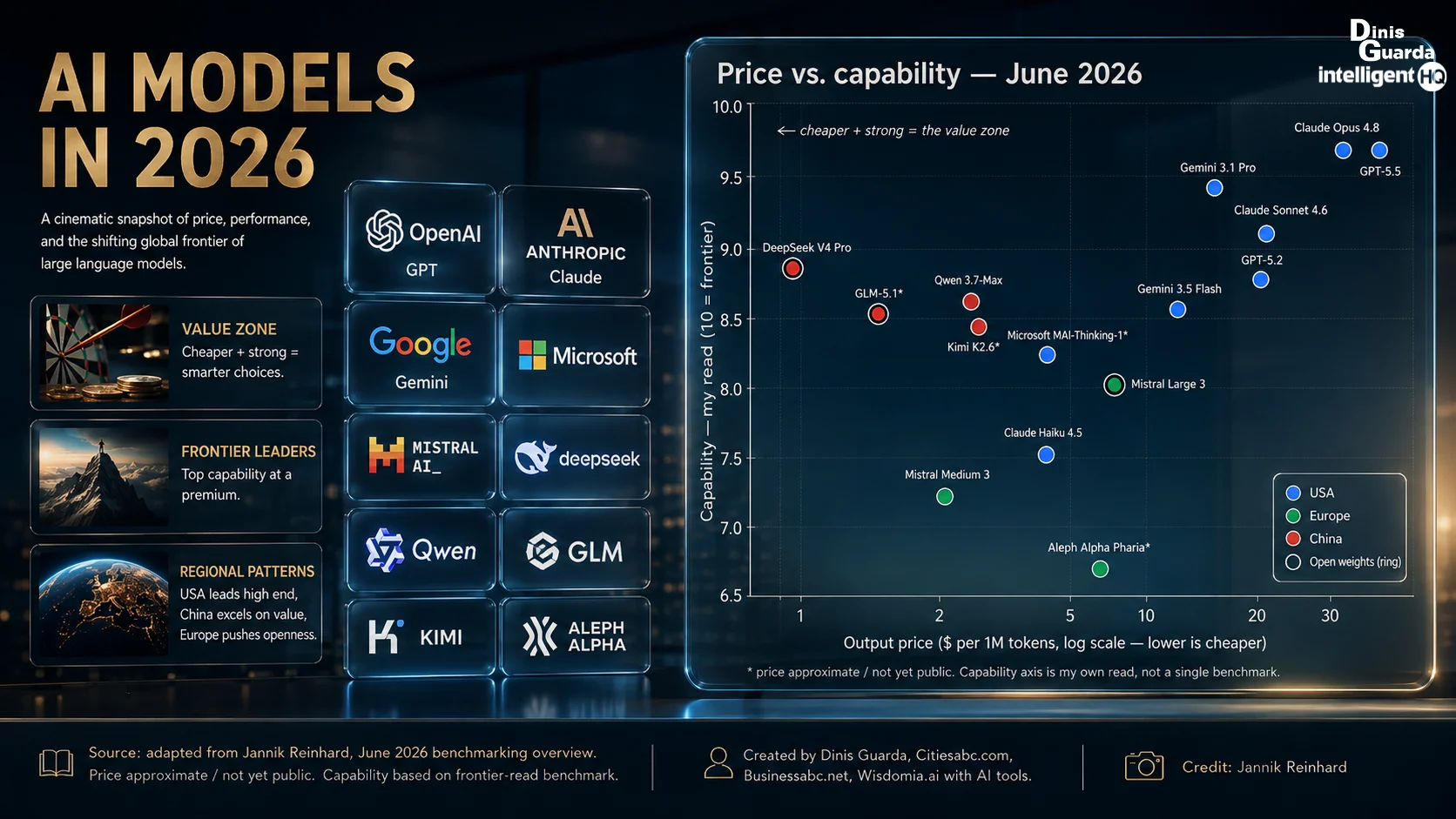
The accompanying infographic illustrates how leading AI developers are positioned across Price vs. Capability, establishing three distinct tiers:
- The Frontier Tier (Leading Capability): Occupied by models like Anthropic’s Claude Opus 4.8, OpenAI’s GPT-5.5 / GPT-5.6 Sol, and Google’s Gemini 3.5 Pro. These flagship models define the high-end ceiling for complex reasoning, multi-step autonomous agent planning, and high-level software engineering at premium price points.
- Elite Coding & Autonomous Engineering Models: A highly competitive segment featuring Claude Sonnet 4.6, GPT-5.2, and Gemini 3.1 Pro, offering near-frontier capabilities optimised specifically for rapid developer workflows, deep code comprehension, and autonomous execution.
- The Value Zone & Open-Weight Alternatives: Situated in the sweet spot of high capability and low token cost. Key players include DeepSeek V4 Pro, Qwen 3.7-Max, and GLM-5.1, alongside European entrants like Mistral Large 3 and Aleph Alpha Pharia. These models drive high-volume enterprise workloads, local deployments, and budget-conscious applications.
Regional Takeaway: The visual data highlights strong geopolitical patterns: U.S. developers lead high-end capability, China dominates value-to-cost efficiency, and Europe continues to push the boundary for open-weights and localised governance.
The primary models are categorised below by their strengths, technical benchmarks, and distinct operational niches.
The Frontier Tier (Best All-Round & Reasoning)
These models are designed for massive cognitive tasks, heavy data analysis, and running highly autonomous digital agents.
- Claude Opus 4.8 (Anthropic): Regarded as the overall leaderboard champion for generally available models, holding the highest score on LLM Stats (67.9). It is highly favoured for deep analytical research and fluid conversational logic.
- GPT-5.6 Sol / GPT-5.5 (OpenAI): OpenAI’s top production engines. While GPT-5.5 remains a staple default for general ecosystem use, the advanced GPT-5.6 Sol (released as a preview in June) leads benchmarks like Vals AI with enhanced planning accuracy.
- Gemini 3.1 Pro (Google): Remains a gold standard for processing immense datasets. It handles massive context windows up to 1 million tokens, letting developers parse entire codebases or libraries effortlessly.
Note: Anthropic’s restricted Claude Fable 5 and Claude Mythos Preview top raw laboratory benchmarks but face severe US regulatory controls, meaning they are either reference-only or highly restricted to specific enterprise clients.
Elite Coding & Autonomous Engineering Models
Coding and agentic performance have broken off into their own competitive discipline, dominated by models specifically fine-tuned to write software.
- Claude Opus 4.8: Ranks at the very top of practical software engineering metrics, scoring an exceptional 88.6% on SWE-Bench Verified.
- GPT-5.5: Close runner-up at 82.6% on SWE-Bench, widely integrated across corporate coding pipelines due to its speed and consistency.
- Laguna S 2.1: A breakout, specialist 118B coding agent architecture developed by Poolside that has seen high developer adoption for terminal and multi-step execution tasks.
Top Open-Weight & Budget-Friendly Models
The open-source community and specialised architectures have significantly reduced the cost of intelligence, closing the capability gap with closed commercial APIs.
- Kimi K2.6 (Moonshot AI): The highest-rated open-weight model of June 2026, boasting a 57.3 overall score and a 90.5% score on the GPQA hard reasoning index.
- DeepSeek V4 Pro: Out of Asia, this massive 1.6-trillion-parameter Mixture-of-Experts (MoE) engine serves as the cheapest frontier-tier API, aggressively priced around $0.45 per million tokens.
- Qwen3.7 Max: Alibaba’s flagship that provides a high-level reasoning matrix at a fraction of the cost ($1.53 per 1M tokens), making it a favourite for enterprise bulk pipelines.
Speed & Context Champions
- Mercury 2: Dominates high-frequency data streaming, running at an unparalleled 856 tokens per second.
- Grok 4 Fast (xAI): Leads the market in contextual retention with a native 2.0-million-token window, built specifically to ingest massive live real-time information.
Close and open source models
The landscape of AI models in 2026 is defined by a massive shift toward hybrid model-routing architectures. While closed frontier labs still hold a slight edge in complex reasoning, open-weight models have rapidly closed the functional gap.
The Core AI open close Difference
- Closed Frontier Models: Accessible only via APIs managed by a single company. You never see or control the underlying “weights” (the brain of the model). The provider handles all data privacy, updates, and scaling.
- Open-Source / Open-Weight Models: The underlying weights are publicly released. Anyone can host them locally or via cloud providers. This converts serving AI into a commodity market, driving costs down by up to 5x to 34x compared to closed models.
Key Market Dynamics
- The “4-Month” Gap: Experts note that open-weight models trail closed frontier capabilities by roughly 4 months, catching up rapidly through community fine-tunes and distillation.
- Runaway API Costs: High token-billing from closed APIs has driven enterprises to transition heavily to open alternatives. Companies like DoorDash and Uber are adopting hybrid setups, routing basic, high-volume tasks to cheap open models and reserving expensive closed models for maximum-risk logic.
- Geopolitical Tensions: Leading open-weight models are highly competitive, especially from Chinese labs (e.g., Zhipu AI, Moonshot AI, Alibaba). This has triggered severe lobbying and regulatory pushback from closed U.S. labs over cybersecurity and containment concerns.
Model Showdown: Closed vs. Open-Weight
The premier models of 2026 are categorised into distinct tiers of capability:
| Tier | Closed Frontier Models (API Exclusive) | Open-Weight Models (Downloadable/Self-Hostable) |
| S-Tier (Ultimate Reasoning & Deep Agent Work) | GPT-5 (Reasoning Mode), Claude 4.8 Opus, Gemini 3.5 Pro | GLM 5.2, Kimi K3, Inkling (by Thinking Machines) |
| A-Tier (Standard Advanced Coding & Multimodal) | Claude 4.6 Sonnet, GPT-5 (Standard Mode) | Llama 4 Scout, DeepSeek V4 Pro, Qwen 3.6, Gemma 4 |
| B/C-Tier (Fast, Ultra-Cheap, Simple Automation) | GPT-4o Mini, Gemini 3.5 Flash Light | Gemma 4 31B, Phi 4, Nemotron 3 Ultra |
Architectural Strengths in 2026
- Best for Complex Tasks (Closed): Closed models dominate the AI Model Tier List for long-horizon planning, highly regulated safety controls, and multi-step sovereign reasoning.
- Best for Scale & Control (Open): Open models like Kimi K3 and GLM 5.2 dominate high-volume enterprise tasks. Open infrastructure allows for zero data-sharing restrictions, deep internal customisation and deployment at a fraction of the cost.
Number of Data Centers per country
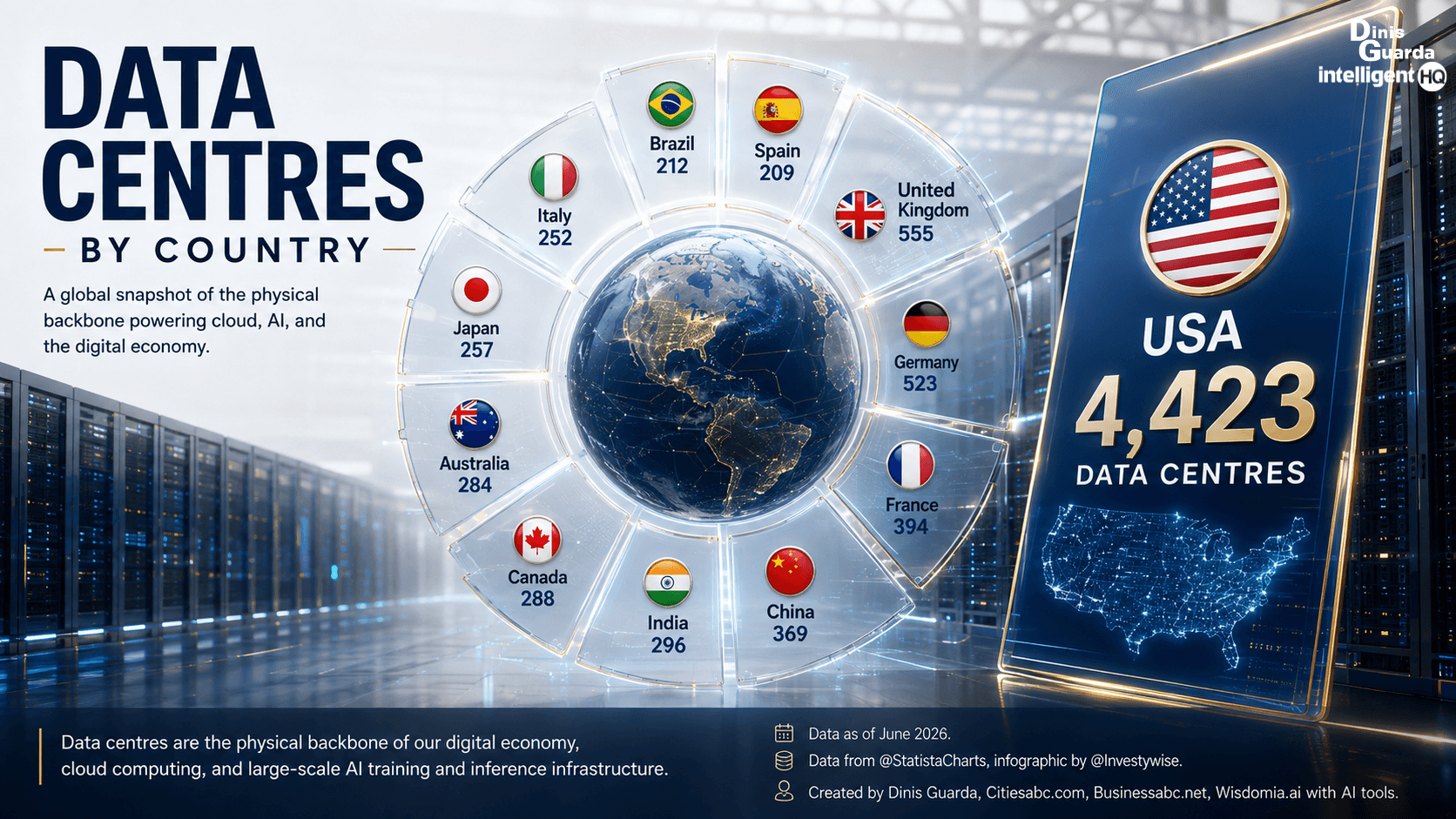
The number of Data Centers per country is mind-blowing.
This shows who controls our internet, media and AI
This is the infrastructure reality:
| Rank | Country | Number of Data Centres | Share of These 5 Countries |
|---|---|---|---|
| 1 | 🇺🇸 United States | 4,423 | 70.6% |
| 2 | 🇬🇧 United Kingdom | 555 | 8.9% |
| 3 | 🇩🇪 Germany | 523 | 8.3% |
| 4 | 🇫🇷 France | 394 | 6.3% |
| 5 | 🇨🇳 China | 369 | 5.9% |
| Total | 6,264 | 100% |
China is fifth. The US alone has more data centres than the next nine countries combined.
Data centres are the physical backbone of our digital economy, cloud computing, and large-scale AI training and inference infrastructure.
Quantity isn’t everything (power density, networking, and chip access matter), but a gap this wide is not a rounding error.
It reflects years of capital deployment, energy availability, regulatory environments, and hyperscaler concentration.
Conclusion: The Dual Realities of AI in 2026
The AI landscape of 2026 presents a striking duality. On the software layer, intelligence is rapidly democratising. The narrowing performance gap between closed frontier APIs and open-weight models has given enterprises unprecedented control over their code, privacy, and token economics. High-end reasoning remains a premium commodity, but high-volume utility is now cheap, decentralised, and accessible globally.
Yet beneath this flexible software layer lies a heavily centralised hardware reality. Model performance is ultimately constrained by physical infrastructure, power grids, specialised silicon, and data center concentration. As long as the physical backbone remains overwhelmingly concentrated in a select few regions, the true leverage in the AI revolution will belong to those who control both the top-tier algorithms and the gigawatt-scale data centers that power them.
Sources & References
- OpenAI — GPT-5.6 Sol and current OpenAI model lineup
OpenAI API documentation covering GPT-5.6 Sol, Terra and Luna, including model positioning for reasoning, coding, cost and high-volume workloads. (OpenAI Developers) https://developers.openai.com/api/docs/models - OpenAI — GPT-5
Official overview of GPT-5, including its coding, reasoning, multimodal and agentic capabilities. (OpenAI) https://openai.com/gpt-5/ - Anthropic — Claude Opus 4.8
Official Anthropic release detailing Claude Opus 4.8’s improvements in coding, agentic tasks, computer use and long-running professional workflows. (Anthropic) https://www.anthropic.com/news/claude-opus-4-8 - Anthropic — Claude Opus family
Official Anthropic information on its latest Opus models and their positioning for advanced coding, agents and complex professional work. (Anthropic) https://www.anthropic.com/claude/opus - Anthropic — Claude 4 Model Family
Anthropic’s official introduction to Claude Opus and Sonnet models, including coding, reasoning, agent workflows and extended tool use. (Anthropic) https://www.anthropic.com/news/claude-4 - Google — Gemini 3 Model Family
Official Google AI documentation covering the Gemini 3 generation, agentic workflows, autonomous coding, multimodality and reasoning. (Google AI for Developers) https://ai.google.dev/gemini-api/docs/gemini-3 - Google — Gemini API Model Catalogue
Google’s current catalogue of Gemini models, useful for verifying model availability, capabilities and product naming. (Google AI for Developers) https://ai.google.dev/gemini-api/docs/models - Artificial Analysis — AI Model Leaderboard
Independent comparison of more than 250 AI models across intelligence, price, speed, latency, context length and other performance metrics. This is one of the strongest references for the article’s price-versus-capability positioning. (Artificial Analysis) https://artificialanalysis.ai/leaderboards/models - Artificial Analysis — Model Price, Performance & Speed Comparisons
Independent benchmark database for comparing closed and open-weight models across capability, token economics and inference performance. (Artificial Analysis) https://artificialanalysis.ai/models/ - Artificial Analysis — Agentic / Professional Task Evaluation
GDPval-AA evaluates models on real-world tasks across 44 occupations and nine major industries using agentic tool access. (Artificial Analysis) https://artificialanalysis.ai/evaluations/gdpval-aa - TechCrunch — Gemini Reaches 950 Million Monthly Users
Reports Google’s Q2 2026 disclosure that the Gemini app exceeded 950 million monthly active users, with its user base growing substantially year-over-year. (TechCrunch)
https://techcrunch.com/2026/07/23/google-closes-in-on-another-billion-user-product-with-gemini/ - Microsoft AI Economy Institute — Global AI Diffusion, Q1 2026
Research on worldwide AI adoption. Microsoft estimated generative-AI usage had reached 17.8% of the world’s working-age population in Q1 2026, illustrating the rapidly expanding global user base. (Microsoft) https://www.microsoft.com/en-us/research/wp-content/uploads/2026/05/Microsoft-AI-Diffusion-Report-2026-Q1.pdf - Microsoft — Global AI Adoption 2025
Earlier baseline research documenting generative-AI adoption across countries and the widening geographic AI adoption gap. (Microsoft) https://www.microsoft.com/en-us/corporate-responsibility/topics/AI-Economy-Institute/reports/Global-AI-Adoption-2025/ - Statista — Number of Data Centres Worldwide by Country, 2026
Source supporting the article’s April 2026 figures of approximately 4,423 U.S. data centres, 555 in the UK and 523 in Germany. (Statista) https://www.statista.com/statistics/1228433/data-centers-worldwide-by-country/ - Cloudscene — Global Data Centre Directory
Independent infrastructure database covering data centres, operators, connectivity and cloud infrastructure worldwide. (Cloudscene) https://cloudscene.com/ - Data Center Map — Global Data Centre Database
International database tracking colocation, cloud, connectivity and data-centre infrastructure by country and region. (Data Center Map) https://www.datacentermap.com/datacenters/ - Statista — Countries with the Most Data Centres
Useful as a more recent comparison: a separate May 2026 dataset based on Cloudscene counted 5,427 U.S. facilities, demonstrating that totals can vary substantially according to database methodology and definition. (Statista) https://www.statista.com/chart/24149/data-centers-per-country/