From industrial security to household chores, 1X is building more than a robot. Its combination of autonomy, teleoperation and vertically integrated production could become an infrastructure layer for physical work but only if it can resolve the hard questions of safety, privacy, economics and trust.
For most of the digital era, automation has transformed work that could be represented on a screen. Spreadsheets compressed clerical processes. Enterprise software reorganised accounting, logistics and management. Generative AI is now accelerating research, writing, coding and analysis.
Physical work is different. A warehouse, hospital, security post or private home is not a controlled database. It is an unpredictable environment filled with people, fragile objects, stairs, pets, changing light and tasks that were never formally specified. This is why the next frontier of artificial intelligence is not simply a better chatbot. It is AI that can perceive, move and act safely in the real world.
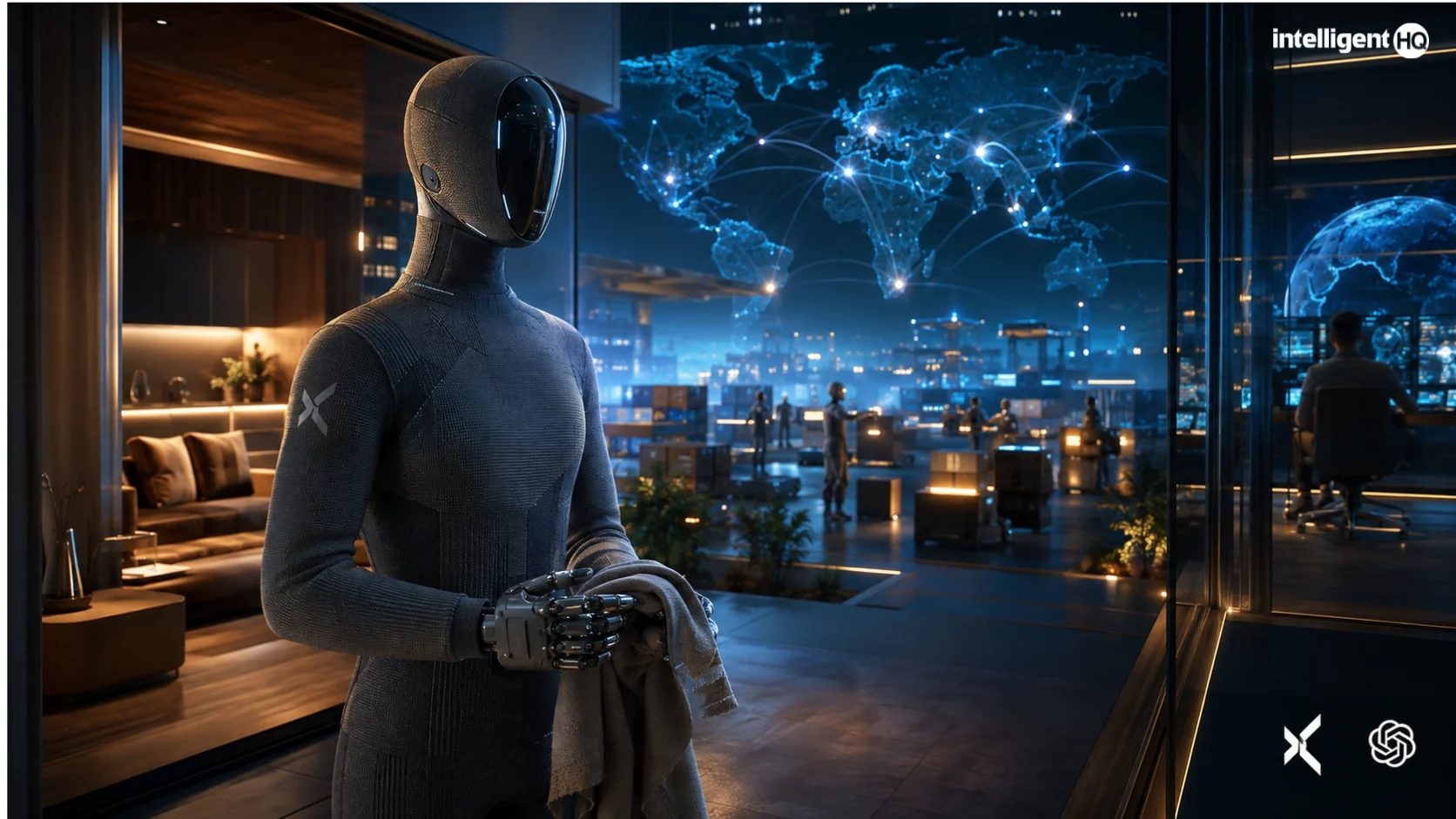
1X Technologies is one of the companies attempting that transition. Founded in Norway as Halodi Robotics and now headquartered in Palo Alto, 1X has developed two complementary robot platforms: EVE, a wheeled humanoid created for commercial and industrial environments, and NEO, a softer, bipedal humanoid designed for the home.
The company is widely described as “backed by OpenAI”, but the distinction matters. NEO is not an OpenAI product. In 2023, 1X raised a $23.5 million Series A2 round led by the OpenAI Startup Fund, with other investors including Tiger Global and several venture firms. It then announced a $100 million Series B in January 2024, led by EQT Ventures, to support the development and commercialisation of NEO.
That capital is financing an ambitious thesis: the interface between people and AI will eventually acquire a body.
EVE and NEO: Two Routes Into the Physical Economy
1X did not begin with a household robot. Its first commercial platform, EVE, uses a wheeled base, articulated arms and cameras to work in environments built for people. According to the company, EVE robots began operating in customer factories in 2022. The wheeled format sacrifices the visual familiarity and mobility of legs, but offers a practical advantage: balance and locomotion are simpler, making controlled commercial deployment more achievable.
NEO represents the more difficult second step. It is intended to walk through homes, manipulate everyday objects and assist with routine chores. 1X markets it as a soft-bodied robot that can open doors, fetch objects, organise shelves and fold laundry. Its Redwood AI system is designed to learn and repeat tasks, while voice and mobile interfaces allow owners to assign work and manage schedules.
In October 2025, 1X opened pre-orders for NEO. The Early Access purchase price was announced at $20,000, with priority delivery in the United States during 2026. A $499-per-month subscription was also announced for later delivery. The company’s current roadmap says NEO is entering Early Access homes in 2026 and deployments will scale from there.
Production is moving beyond the laboratory. In 2026, 1X said its 58,000-square-foot Hayward facility had begun full-scale NEO production. The company claims current capacity of up to 10,000 units annually, with plans to scale towards more than 100,000 units a year by the end of 2027. These remain company targets rather than proof of mass-market demand, but they reveal the scale of 1X’s intention.
The Real Product Is a Human–Robot Learning Loop
The most consequential part of 1X’s model may not be the humanoid hardware. It is the combination of machine autonomy and remote human assistance.
NEO is expected to arrive with basic autonomous abilities. When it encounters a complex or unfamiliar task, an owner can schedule “Expert Mode”, allowing a 1X operator to supervise the robot remotely. This makes teleoperation a bridge between what the machine can do today and what it may learn to do independently tomorrow.
The strategic value is substantial. Real-world robotics suffers from a data problem: the physical world contains far more variation than a laboratory can reproduce. Every unusual cupboard, object, fabric or household routine creates a new edge case. Human-guided operation can complete the immediate task while also generating examples from which future models may learn.
This produces a potential flywheel:
- Robots enter real environments with a limited set of autonomous skills.
- Remote operators intervene when the robot reaches the boundary of its competence.
- Those interventions create data about actions, objects and environments.
- Updated models convert repeated interventions into autonomous behaviours.
- Greater capability increases usefulness, deployment and the volume of new data.
If that loop works, teleoperation is not a sign that the product has failed. It is scaffolding for embodied intelligence. But it also means Early Access customers are not simply buying a finished appliance. They are participating in the training and maturation of a robotics platform.
From Robot-as-a-Service to a Network for Physical Work
The pitch-deck analysis shared around 1X points towards an even larger possibility: a globally distributed market for remotely delivered physical labour.
The idea resembles a platform such as Fiverr or Upwork, except the service is performed through a robot in another country. A trained worker in Manila, Nairobi or Bogotá could supervise a humanoid located in Dallas, London or Tokyo. The operator would not need to migrate or be physically present at the worksite; the robot would become the worker’s local embodiment.
This is not a business model that 1X has formally announced. It is a strategic extrapolation from the company’s teleoperation architecture. Yet it is plausible enough to deserve serious attention.
Such a network could create three layers of value. The robot owner obtains flexible physical assistance. The platform coordinates hardware, software, identity, training and payments. Remote operators supply human judgement for the long tail of tasks that automation cannot yet handle.
The model would also change the unit of automation. Instead of asking whether a robot can replace an entire job, companies could purchase specific hours or outcomes: inspect a site, restock a room, move a package or assist with a household task. Human input could be continuous, intermittent or escalated only when confidence falls below a threshold.
The wider robotics market is already moving towards service-based economics. The International Federation of Robotics reported that sales of professional service robots reached almost 200,000 units in 2024, up 9%, while robot-as-a-service fleets grew 31%. Transportation and logistics represented the largest application category. At the same time, the IFR cautions that humanoid deployment remains limited and that many applications are still at the prototype or trial stage.
This is the central tension in the 1X story: the opportunity is infrastructure-scale, but the technology remains early.
The Four Tests 1X Must Pass
The first test is autonomy. A compelling demonstration is not the same as reliable work across thousands of unstructured homes. Useful home robotics requires manipulation, navigation, perception and common-sense reasoning to operate together for long periods, not only during selected tasks.
The second is safety. A robot acting near children, older people and pets must fail gently. 1X’s soft exterior, tendon-driven design and relatively light body address part of the mechanical risk, but safety is also a software, cybersecurity and operational-governance problem.
The third is privacy. A remotely supervised robot may see the most intimate spaces in a person’s life. Consent cannot be reduced to a box in an app. Owners need to know when a human operator is connected, what the operator can see, what data is recorded, how long it is retained and whether it is used for model training. Robust access controls, visible connection indicators, restricted zones, audit logs and meaningful data deletion will be essential to trust.
The fourth is labour governance. A global teleoperation market could widen access to income, but it could also reproduce the weakest features of platform work: opaque pay, surveillance, precarious contracts and a race to the lowest wage. If physical labour becomes globally routable, questions of jurisdiction, liability, worker classification, insurance and collective rights become unavoidable. Who is responsible when an operator in one country controls a machine that causes harm in another? Which labour standards apply? Who owns the behavioural data produced by the worker?
These are not secondary compliance issues. They are part of the product architecture.
A New Layer of the AI Economy
The strongest interpretation of 1X is not that it has already solved general-purpose robotics. It has not. The stronger argument is that the company is assembling the essential components of a new economic layer: safe hardware, embodied AI, human supervision, recurring service revenue, real-world training data and manufacturing capacity.
EVE gives 1X experience in structured commercial settings. NEO extends the platform into the far more demanding home. Expert Mode fills capability gaps while generating learning data. A subscription model lowers the upfront barrier and aligns revenue with continuing improvements. Vertical manufacturing gives the company tighter control over the body through which its intelligence operates.
If these elements converge, humanoids could become to physical work what cloud computing became to digital operations: an on-demand layer of capability that organisations and households can access without building the full infrastructure themselves.
But the outcome is not predetermined. The decisive metric will not be how human NEO looks or how impressive it appears in a demonstration. It will be the percentage of ordinary tasks completed safely, autonomously and economically—without intrusive human access or hidden labour practices.
1X is therefore building more than a humanoid. It is testing whether intelligence can be delivered as physical action, whether remote human judgement can become a temporary bridge to autonomy, and whether society is prepared to let an AI-powered machine cross the threshold into the home.
The defining question is no longer whether robots will work beside people. It is what economic, ethical and governance systems we will build around them when they do.
Sources
- 1X: NEO Home Robot launch, pricing and 2026 delivery plans
- 1X: Order NEO and Scheduled Expert Mode
- 1X: Company history and EVE deployments
- 1X: $23.5 million Series A2 led by OpenAI
- 1X: $100 million Series B funding
- 1X: NEO Factory and production capacity
- International Federation of Robotics: World Robotics 2025 service-robot data
- International Federation of Robotics: Service-robot market presentation and humanoid deployment status