If your doctor has ordered an MRI, you might feel a little unsure about what to expect – and rightfully so. It looks strange, sounds strange, and certainly isn’t comfortable. But once you understand how they work and why they’re important, you can start to feel a little more at ease.
What is an MRI?
MRI stands for magnetic resonance imaging. Each part of that name tells you something about how the scan works.
- The “magnetic” part refers to the strong magnet inside the machine. This magnet creates a magnetic field around your body while you’re inside the scanner.
- The “resonance” part refers to the way certain atoms in your body respond when radio waves are sent through that magnetic field.
- The “imaging” part is the final result. It’s a detailed picture of what’s happening inside you.
Most of your body is made up of water, and water contains hydrogen atoms. MRI machines pay close attention to those hydrogen atoms because they respond in useful ways when placed in a strong magnetic field. When the machine sends radio waves into the area being scanned, those atoms give off signals. The MRI system reads those signals and uses them to build an image.
Why Doctors Use MRIs
Doctors often order MRIs when they need a clearer look at soft tissue. X-rays are helpful for bones, and CT scans can be useful in many situations, especially emergencies. But MRI is often better when the doctor needs to see details in tissues like the brain, spinal cord, ligaments, tendons, muscles, and organs.
For example, if you have ongoing knee pain, an MRI may help show whether there’s damage to a ligament or meniscus. If you’re having back or neck symptoms, it may help your doctor look at discs, nerves, or the spinal canal. If there’s concern about a brain or abdominal issue, an MRI can provide a detailed view that helps guide the next step.
That doesn’t mean an MRI is always the right test. Your doctor chooses imaging based on your symptoms and what they’re trying to learn. But when soft-tissue detail matters, MRI can be useful.
What Happens During the Scan
When you arrive for an MRI, the staff will usually ask safety questions before the scan begins. This is important because the magnet is very strong. You may be asked about implants, pacemakers, metal fragments, surgical clips, hearing devices, or other medical devices. You’ll also need to remove items like jewelry, keys, watches, and anything else that could be affected by the magnet.
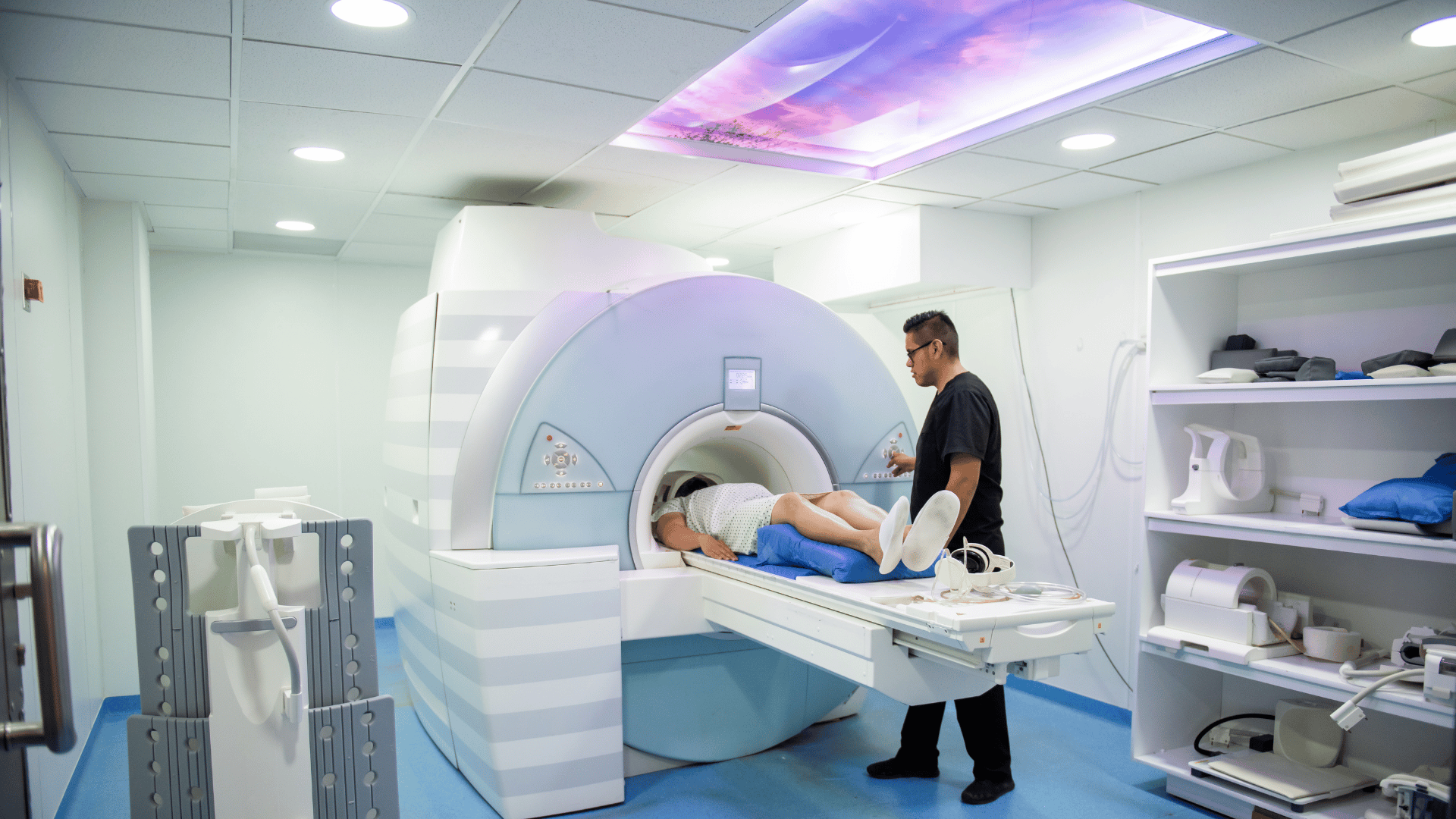
During the scan, you’ll lie on a table that slides into the MRI machine. The part of your body being scanned needs to stay as still as possible because movement can blur the images. Even though it usually doesn’t hurt, staying still for a long time can be uncomfortable.
The machine may make loud knocking or tapping sounds as it works. Those sounds come from parts of the scanner turning on and off while the images are being created. Many imaging centers give you earplugs or headphones to make the noise easier to handle.
Some MRI scans use contrast, which is a special substance that helps certain tissues show up more clearly. If your scan requires contrast, the staff will explain that before it’s given.
Why MRI Doesn’t Use Radiation
One reason people often ask about MRI is because they’re worried about radiation. MRI is different from X-rays and CT scans because it doesn’t use ionizing radiation. Instead, it uses magnetic fields and radio waves.
That can be reassuring, especially if you need imaging more than once. However, MRI still has safety rules because the magnetic field is powerful. The main concern is not radiation exposure, but whether metal objects or certain implanted devices could be unsafe around the scanner.
This is why the screening questions matter so much. If you have any kind of implant, device, or metal in your body, tell the MRI staff before the scan. Don’t assume something is too small or too old to mention. They need the full picture so they can decide whether the scan is safe for you.
The Importance of Temperature Control
Most patients think about the magnet and the images, but an MRI machine also depends on a carefully controlled operating environment. The equipment has to run within the right temperature range, and that’s not something a normal building air conditioner can always handle.
MRI systems generate heat during use, and the equipment inside the room is highly sensitive. If temperature control isn’t steady enough, the system may not perform reliably. In a medical setting, that can create delays or technical issues.
This is where a medical chiller becomes important. A medical chiller is designed to remove heat from medical equipment and keep temperatures more stable than a standard ambient HVAC system can usually achieve on its own. For MRI systems, this kind of cooling support helps protect the equipment and keep the scanner ready for use.
Adding it All Up
An MRI may look intimidating from the outside, but it’s a common imaging test. The professionals operating the machine do this thousands of times per year and understand how to keep you safe. But the more you understand how the scan works, the less mysterious the whole experience feels.