For decades, investment banking was associated with long working hours, financial modeling spreadsheets, pitch books, valuations, and complex deal negotiations. While these fundamentals remain important, a new force is rapidly reshaping the profession: Artificial Intelligence.
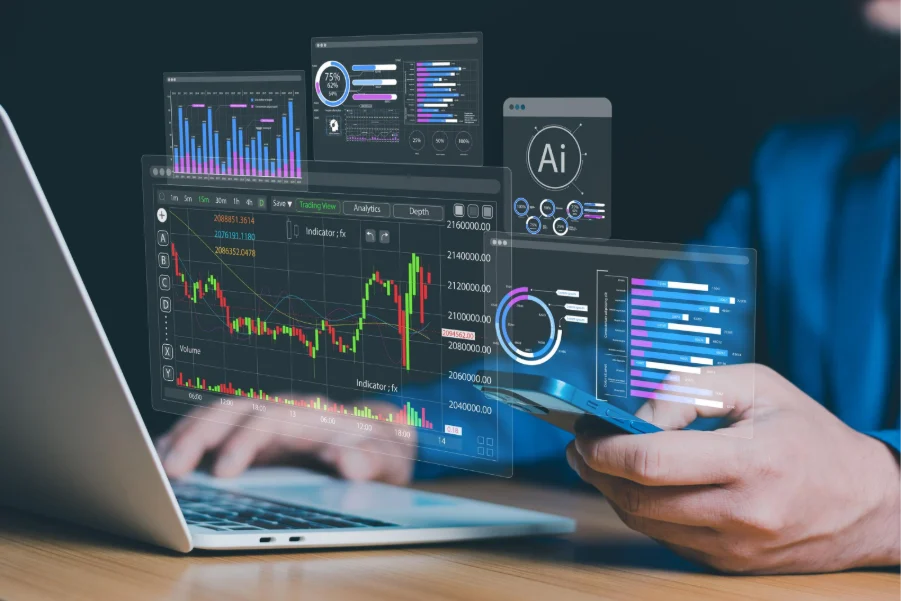
The conversation is no longer about whether AI will impact investment banking. The real question is how quickly professionals can adapt to a workplace where data-driven decision-making, predictive analytics, and intelligent automation are becoming everyday tools.
Major financial institutions across the globe are already deploying AI solutions to improve research, streamline deal execution, enhance risk assessment, and automate repetitive workflows. Industry leaders increasingly view AI as a productivity multiplier rather than a replacement for human expertise. Recent developments across global investment banks demonstrate that AI is becoming deeply integrated into banking operations, changing how professionals work and the skills employers prioritize.
The End of Traditional Investment Banking?
Not quite.
The role of the investment banker is evolving rather than disappearing.
Historically, junior analysts spent countless hours gathering market data, preparing presentations, updating valuation models, and conducting preliminary research. Today, many of these tasks can be accelerated through AI-powered tools and advanced analytics platforms.
This creates a significant shift in how value is generated.
Instead of spending most of their time collecting information, modern bankers are expected to focus on:
- Strategic decision-making
- Client relationship management
- Market interpretation
- Deal structuring
- Risk analysis
- Industry forecasting
The professionals who thrive in the coming decade will be those who combine financial expertise with analytical and technological capabilities.
Why AI Is Becoming Essential in Investment Banking
Financial markets generate enormous volumes of information every second.
Earnings reports, economic indicators, market sentiment, news events, regulatory filings, and transaction data create a data ecosystem that exceeds human processing capacity.
AI helps financial professionals transform this information into actionable insights.
Today, advanced analytics systems can:
- Analyze market trends in real time
- Detect patterns across large datasets
- Improve forecasting accuracy
- Support due diligence processes
- Enhance portfolio optimization
- Strengthen risk management frameworks
Financial institutions are increasingly investing in AI because it improves efficiency while allowing professionals to focus on higher-value work. Studies and industry implementations show that AI can significantly improve productivity and decision-making across financial services.
The Rise of the Hybrid Finance Professional
One of the most important workforce trends emerging in 2026 is the rise of hybrid talent.
Employers are no longer looking exclusively for candidates who understand finance.
They want professionals who understand:
Finance + Data
The ability to extract insights from large datasets is becoming critical for investment decisions.
Finance + Technology
Knowledge of automation tools, analytics platforms, and AI-driven systems is increasingly valuable.
Finance + Business Strategy
Clients expect advisors who can interpret market trends and translate data into strategic recommendations.
The future investment banker is becoming a multidisciplinary professional rather than a traditional financial analyst.
Skills That Will Define Future Investment Bankers
Financial Modeling
Despite technological advances, valuation and modeling remain core competencies.
Data Analytics
Professionals who can interpret complex datasets gain a significant advantage in decision-making.
AI Literacy
Understanding how AI tools work, their strengths, and their limitations is becoming increasingly important.
Market Intelligence
The ability to identify trends before competitors remains highly valuable.
Communication Skills
As automation handles more technical tasks, human interaction becomes even more important.
Clients still rely on trust, judgment, negotiation, and strategic guidance—areas where human expertise remains irreplaceable.
Why Education Must Evolve
Traditional finance education often struggles to keep pace with industry transformation.
Many university programs still focus heavily on theoretical concepts while employers increasingly demand practical skills and technology exposure.
As a result, professionals are turning to specialized industry-oriented programs that combine finance, analytics, and technology.
Programs such as the Investment Banking & Financial Analytics curriculum offered by the Boston Institute of Analytics are designed to bridge this gap by integrating modern financial concepts with data analytics, valuation techniques, and industry-relevant tools.
Such programs help learners develop skills that align with how financial institutions are evolving in the age of AI.
Will AI Replace Investment Bankers?
This question continues to generate debate.
The evidence suggests a more nuanced answer.
AI is highly effective at automating repetitive and data-intensive activities. However, investment banking relies heavily on trust, relationships, negotiation, judgment, and strategic thinking.
A merger worth billions of dollars cannot be closed solely by an algorithm.
Corporate leaders still seek advisors who understand business realities, navigate uncertainty, and provide informed recommendations.
In fact, many industry experts believe AI will augment human capabilities rather than replace them entirely. The most successful professionals will be those who learn to work alongside intelligent systems rather than compete against them.
The New Competitive Advantage
For years, financial expertise alone was enough to build a successful investment banking course.
That era is changing.
The next generation of professionals must understand both finance and technology.
Organizations are increasingly seeking candidates who can interpret data, leverage AI-powered tools, and transform information into strategic business decisions.
Those who invest in developing these capabilities today will be positioned to lead tomorrow’s financial institutions.
Final Thoughts
The future of investment banking will not be defined by spreadsheets alone.
It will be shaped by professionals who understand how to combine financial knowledge with analytics, artificial intelligence, and strategic thinking.
The winners of the next decade will not necessarily be those who know the most finance. They will be those who know how to use technology to make better financial decisions.
As AI continues transforming the global financial ecosystem, one thing is becoming increasingly clear: the investment banker of the future will be part strategist, part analyst, and part technologist.