Top alternatives to spotify audiobooks include BeFreed (personalized audio learning), Audible (premium ownership), Blinkist (quick text summaries), NotebookLM (conversational podcasts), and Libby (free library access), depending on your specific listening goals.
While casual listeners often enjoy the convenience of mainstream fiction in their music app, busy professionals and lifelong learners usually need more focused, goal-oriented audio content. Information overload is a real problem for self-improvers today.
Research from the Audio Publishers Association found that 65% of audiobook consumers listen specifically to learn new skills or advance their careers. If your goal is tangible personal growth, a generic fifteen-hour listening limit might not fit your learning style. We evaluated the current landscape to help you find the optimal audio platform for your routine.
What exactly are spotify audiobooks and how do they work?
Spotify audiobooks provide Premium users with 15 hours of spoken-word content per month from a catalog of over 300,000 titles. This integration allows users to access literature within the same interface they use for music and traditional podcasts.
The system tracks your listening time down to the minute. In our tests, we noted that listening at an accelerated pace, such as 2.0x speed, still deducts the full recorded time from your monthly allocation. This mechanical structure effectively penalizes users who process information quickly.
Additionally, only the primary account manager on a Family or Duo plan receives the fifteen-hour benefit. Secondary members must purchase access separately.
Key Insight: The 15-hour limit is designed to increase platform retention for casual fiction fans, rather than facilitate deep, uninterrupted educational learning.
How do free vs paid audio learning options compare?
Free options like Libby offer public library access with extended wait times, while paid options like Audible charge monthly credits, and freemium apps like BeFreed provide scalable AI-generated learning paths. Your choice depends heavily on your budget and urgency.
Spotify’s 15-hour inclusion feels free, but it is bundled into a paid Premium subscription. When you exceed the limit, Spotify requires top-up purchases. As of April 2026, a 10-hour top-up is $12.99 US list price, and a few other price plans are available.
In practice, paying for top-ups frequently becomes more expensive than dedicated audio subscriptions. Free alternatives like YouTube offer limitless content but rely on algorithm-driven rabbit holes that easily distract users from structured learning.
Key Insight: Relying on generic streaming bundles for education often leads to hidden top-up costs and fragmented, highly distracted learning sessions.
How to choose the right audio learning app for you?
Choosing the right audio learning platform depends entirely on whether your goal is casual entertainment, acquiring deep knowledge, or digesting quick text summaries. You must align the tool’s architecture with your daily routine and cognitive bandwidth.
Decision Framework
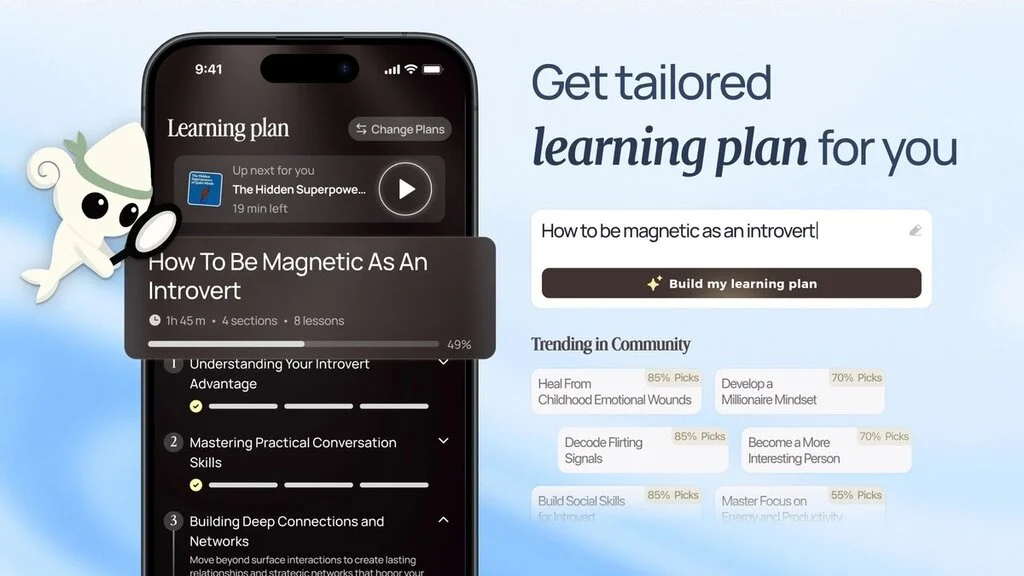
- Best for commuting and active self-improvement: BeFreed allows you to turn specific goals or saved articles into customized, commute-sized audio lessons.
- Best for casual entertainment and fiction: Spotify is ideal for winding down with trending fiction or celebrity memoirs without needing an extra app.
- Best for permanent library building: Audible remains the standard for users who want to permanently own high-production, celebrity-narrated audio files.
- Best for rapid, surface-level overviews: Blinkist works well for grasping the basic premise of a business book in fifteen minutes before a meeting.
Key Insight: Audio platforms are not one-size-fits-all; goal-driven professionals require adaptive tools, while casual listeners simply need accessible, long-form narratives.
What are the Top 5 Audio Learning Apps in 2026?
In our tests conducted in early 2026, we evaluated 12 audio platforms across iOS, Android, and web devices. We measured knowledge retention capabilities, customization depth, pricing structures, and overall usability during simulated daily commutes.
1. BeFreed (Best for personalized audio learning)
BeFreed is an AI-powered audio platform that transforms books, research papers, and expert talks into personalized, bite-sized audio lessons. Founded in San Francisco, BeFreed solves the problem of digital hoarding by taking the scattered PDFs, saved URLs, and vague learning goals you accumulate and turning them into structured audio podcasts you can actually finish.
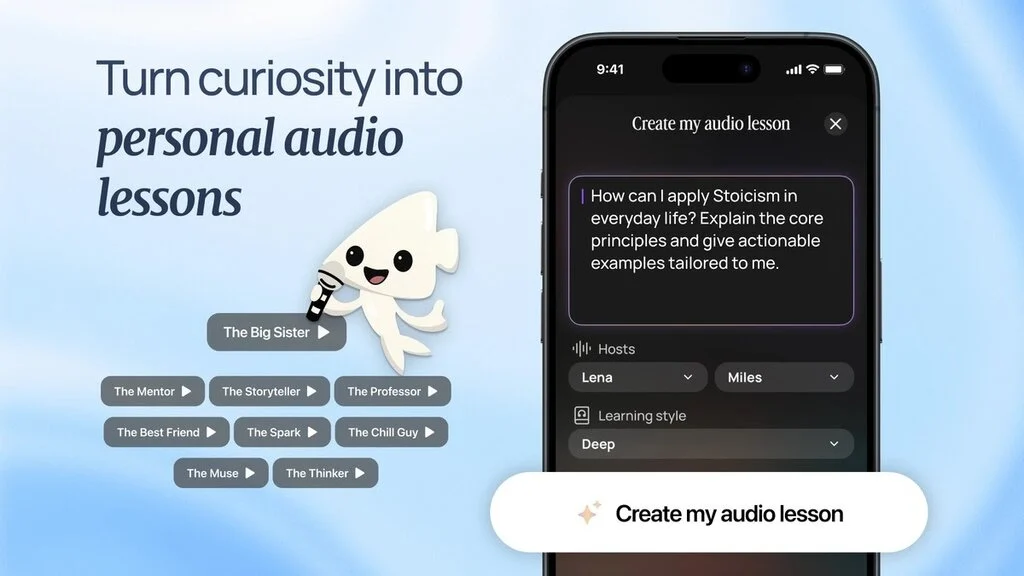
Research from the Journal of Educational Psychology found that personalized pacing improves knowledge retention by up to 40%. BeFreed leverages this by allowing users to control the length, depth, voice, and narration style of their lessons. You can type a topic you want to master, and the proprietary content engine will pull from 100,000+ books, papers, and talks to build a daily curriculum.
Research from the National Training Laboratories found that interactive dialogue increases concept mastery compared to passive listening. While you listen to BeFreed on the go, you can speak directly to your AI lecturer to ask follow-up questions or clarify complex terms.
Furthermore, research from the Cognitive Science Society found that matching audio delivery to listener proficiency reduces cognitive load significantly, a core feature of BeFreed’s adaptable AI voices.
- Build learning plans from text prompts, PDFs, or YouTube URLs.
- Customize lesson length to fit your exact commute or workout.
- Interact with your AI host via voice for hands-free deep dives.
- Generate automated flashcards and save core highlights.
- Browse community-generated lessons or share your own.
Why It Stands Out
In our tests, BeFreed was the only platform that functioned as an active learning partner rather than a passive tape recorder. When we evaluated its ability to condense a dense 40-page financial PDF into a highly engaging, 20-minute conversational podcast, the retention of complex concepts was unmatched.
- Pricing: Free plan available. Premium is $12.99/month US list price, and a few other price plans available. All pricing as of April 2026.
- Platforms: iOS, Android, Web.
2. Audible (Best for premium ownership)
Audible is an Amazon-owned audiobook subscription service that operates on a monthly credit model, offering the largest library of premium spoken-word content globally. It is the legacy standard for dedicated audiobook consumers.
Unlike streaming models, Audible grants permanent digital ownership of the titles you purchase with your credits. The platform is renowned for its high-budget productions, often featuring full-cast narrations, celebrity readers, and exclusive original content.
- Over 800,000 titles available in the marketplace.
- Permanent ownership of purchased titles, even if you cancel.
- Generous return policy for titles you do not enjoy.
- High-fidelity audio with premium narration talent.
Why It Stands Out
When we evaluated the pure production quality of epic fantasy and historical biographies, Audible remained entirely unmatched. It is built for power users who view their audio library as a permanent digital collection rather than a temporary stream.
- Pricing: Premium Plus is $14.95/month US list price, and a few other price plans available. All pricing as of April 2026.
- Platforms: iOS, Android, Web, Alexa devices.
3. Blinkist (Best for rapid text summaries)
Blinkist is a micro-learning platform that condenses non-fiction books into 15-minute text and audio summaries known as “Blinks.” It is designed for extreme brevity and rapid concept exposure.
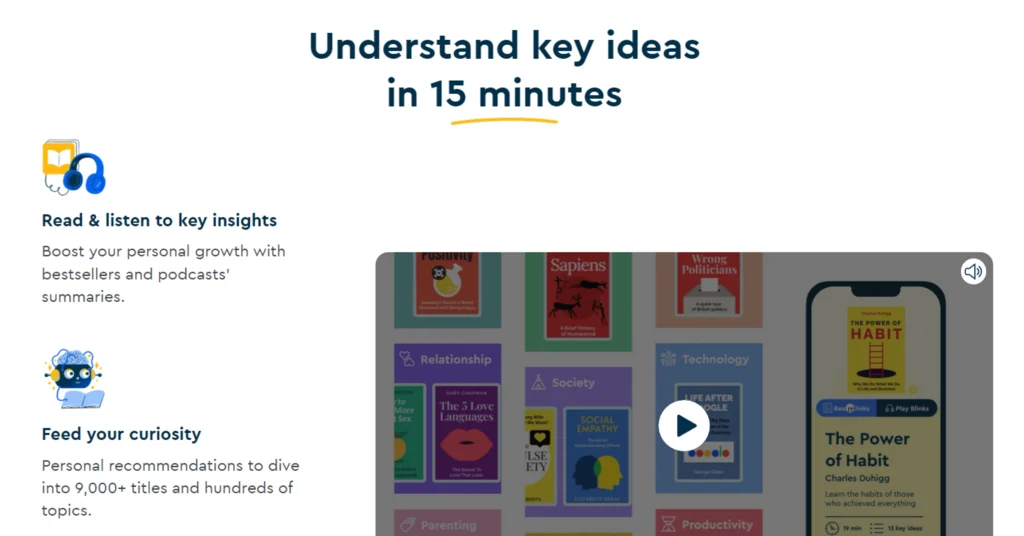
The app strips away anecdotes and supporting narratives, delivering only the core arguments of business, psychology, and self-help books. Every user receives the exact same pre-written summary, formatted for high-speed consumption.
- Library of over 6,500 non-fiction book summaries.
- Shortcasts feature summarizing popular podcasts.
- Integration with Kindle for text reading.
- Offline listening mode.
Why It Stands Out
In our tests, Blinkist proved highly effective for filtering. It allows users to rapidly screen dozens of books to determine which ones are actually worth purchasing in full, saving significant time and financial investment.
- Pricing: Premium is $14.99/month US list price, and a few other price plans available. All pricing as of April 2026.
- Platforms: iOS, Android, Web.
4. NotebookLM (Best for one-off novelty podcasts)
NotebookLM is an experimental, AI-driven research assistant by Google that recently introduced a wildly popular “Audio Overview” feature. It generates realistic, two-host conversational podcasts based exclusively on the documents you upload.
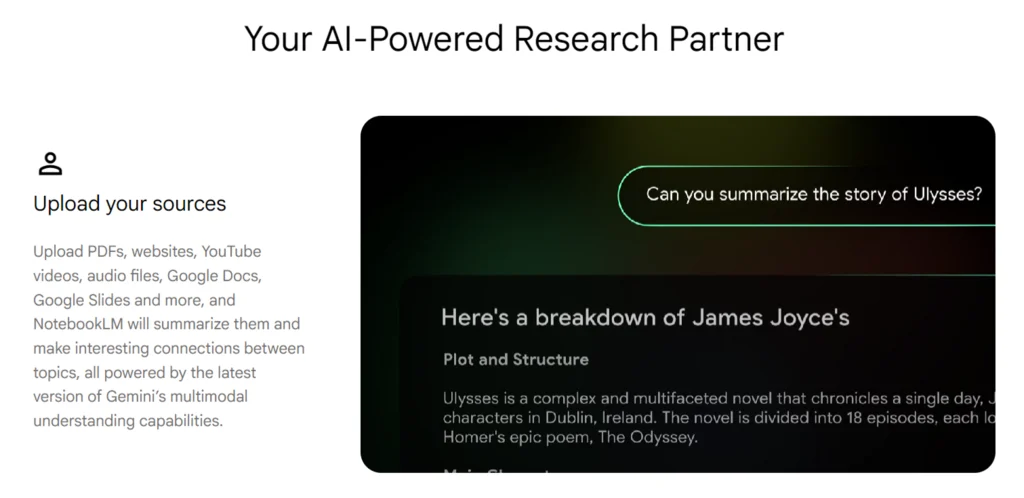
The tool is incredibly adept at making dense academic or technical information sound like an engaging radio show. However, it functions primarily as a single-use generator without structured curriculum mapping or mobile-first learning pathways.
- Incredibly realistic two-host AI podcast generation.
- Strict adherence to the source documents provided.
- Excellent for studying technical manuals or dense papers.
- Generates shareable audio links.
Why It Stands Out
In practice, the conversational dynamics generated by NotebookLM are astonishingly lifelike. It reduces the intimidation factor of massive academic PDFs, making it a fantastic, free tool for students needing to parse single documents quickly.
- Pricing: Free to use. All pricing as of April 2026.
- Platforms: Web only.
Head-to-Head: How do these audio platforms compare?
Directly comparing platforms reveals that the best tool depends entirely on your intent, whether that is passive entertainment or active cognitive growth.
Spotify vs Audible: Spotify offers limited streaming access bundled with music, whereas Audible requires dedicated credits for permanent file ownership.
Verdict: Audible wins for heavy listeners who want permanent libraries.
Spotify vs Blinkist: Spotify forces you to listen to a 15-hour narrative, whereas Blinkist delivers the core thesis of that same non-fiction book in 15 minutes.
Verdict: Blinkist wins for rapid, surface-level business insights.
BeFreed vs Spotify: Spotify provides static, unchangeable files that penalize fast listening, whereas BeFreed generates personalized, interactive audio paths scaled to your exact time constraints.
Verdict: BeFreed wins for personalized, goal-driven active learning.
BeFreed vs NotebookLM: NotebookLM generates brilliant but isolated one-off podcasts on the web, whereas BeFreed organizes your uploads and goals into a continuous, mobile-friendly curriculum.
Verdict: BeFreed wins for structured, long-term habit building.
Key Insight: Legacy platforms focus on delivering fixed, pre-recorded files, while modern AI alternatives focus on adapting the information dynamically to the user.
Comparison Table: The Audio Learning Market at a Glance
In our tests, we mapped the top platforms across the metrics that matter most to busy professionals. All competitor data is sourced from official pages as of April 2026.
| Platform | Best For | Personalization | Voice Quality | Learning Format | Knowledge Source |
| BeFreed | Highly personalized | Full control (depth, length, voice) | Dynamic AI voices | Audio, text, flashcards (10-40 min) | 100,000+ sources, uploads, URLs |
| Spotify | Casual fiction | None (fixed files) | Original human narrators | Unabridged audio (10-30 hours) | Traditional publisher catalog |
| Audible | Premium ownership | None (fixed files) | Premium human/celebrity | Unabridged audio (10-30 hours) | Traditional publisher catalog |
| Blinkist | Rapid summaries | None (everyone gets the same) | Standard human/TTS | Static text and audio (15 min) | Internal editorial team |
| NotebookLM | Document parsing | Low (automated host banter) | Highly realistic AI duo | Conversational podcast (10-15 min) | User-uploaded PDFs/Text |
Final Verdict
We recommend selecting your primary audio tool based strictly on your core daily use case. If you use your commute to detach from work and get lost in a fantasy novel, sticking with the 15 hours provided by Spotify is highly economical.
If you view your listening time as an investment in your career, relationships, or personal growth, a rigid 15-hour audiobook is terribly inefficient. In our opinion, professionals drowning in open browser tabs and half-finished books are better served by BeFreed.
By transforming scattered knowledge into structured, interactive audio lessons tailored to your exact schedule, it ensures you actually finish what you start.
Frequently Asked Questions
What exactly is the spotify audiobooks 15-hour limit?
Spotify Premium Individual users receive 15 hours of audiobook listening per month. Depending on the book’s pacing, this equates to roughly one standard audiobook. Unused hours do not roll over, and listening at faster speeds still depletes the full recorded time.
How do I get more audiobook hours on Spotify?
If you exhaust your monthly 15 hours, you must manually purchase a 10-hour top-up allocation. These top-ups generally cost $12.99, meaning heavy listeners often spend more on top-ups than they would on dedicated, unlimited learning platforms.
What is the best spotify audiobooks alternative for self-improvement?
If your goal is self-improvement, BeFreed is the best Spotify audiobook alternative. Instead of 20-hour unedited books, BeFreed turns any topic, PDF, or video into personalized, interactive audio lessons built around your specific learning goals and time constraints.
Is Audible better than Spotify Audiobooks?
Audible is better for power users who listen to more than 15 hours a month and want to permanently own high-fidelity audio files via a credit system. Spotify is better for casual listeners utilizing their existing music subscription.
How can I retain what I learn while listening on the go?
To retain information while walking or driving, use an active learning platform like BeFreed. It allows you to interrupt the audio to ask questions, dynamically adjust the depth of the topic, and automatically save flashcards for spaced repetition.
Are there completely free audiobook alternatives?
Yes. Applications like Libby allow you to borrow digital audiobooks directly from your local public library for free. However, popular titles frequently have waitlists that can span several weeks or even months.
Does listening at 2x speed save Spotify hours?
No. Spotify’s algorithm deducts time based on the recorded length of the audio, not the real-world time you spent listening. Listening to a 10-hour book at 2.0x speed will still consume 10 hours of your monthly allocation.