Introduction
Hardness testing has a significant role in ensuring material quality in industries such as manufacturing, automobiles, aerospace and metal processing. Before you choose a Rockwell hardness tester in the UK, you may be confused about whether to choose an automatic or a manual system.
Both options are very common in industrial environments, and each one has distinct benefits based on the volume of testing, accuracy needs and workflow expectations. This blog explains the differences between an automatic and a manual Rockwell hardness tester, discusses common types of testers and helps industries in the UK determine which approach is the most effective for them.
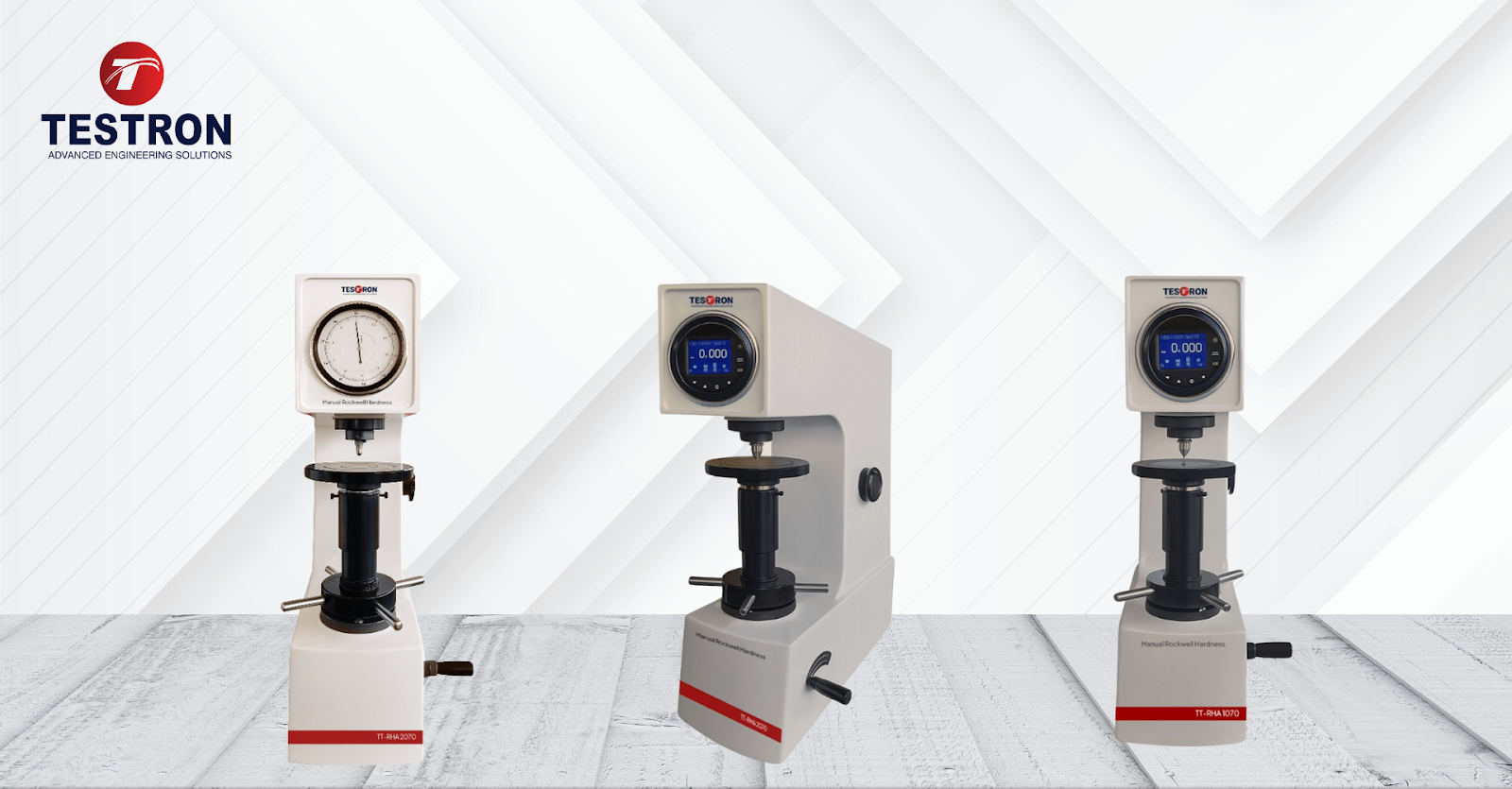
Understanding the Rockwell hardness tester in the UK
Rockwell hardness testing is a method that measures a material’s resistance to indentation under a given load. This test is valued because of its speed, repeatability and the variety of metals that can be tested.
A Rockwell metal hardness tester is usually used in production lines, inspection laboratories and research centers as it provides fast results with little sample preparation. Rockwell testing ensures consistent quality control, whether testing incoming materials or already finished components.
In fact, the global hardness testing machine market was valued at approximately USD 283 million in 2024, reflecting the strong demand for material quality assessment tools in manufacturing and industrial sectors.
Manual Rockwell Hardness Testers Explained
Manual testers are widely popular for use in workshops and laboratories, particularly in low-testing-volume areas. A manual Rockwell hardness tester in the UK needs the operator to apply the test force and analyze the results provided by the machine.
Common Applications of Manual Testers
Manual systems are designed for routine inspection, training environments and other facilities where budget control is a concern. Manual testers are also favoured by many workshops in the UK because they are easy to operate and have low electronic dependency.
One example is the TT R45M Manual Rockwell Hardness Tester in the UK, designed for reliable testing of metals using standard Rockwell scales. Another option is the TT RHA Series Manual Rockwell Hardness Tester, which is commonly used for general-purpose metal hardness evaluation in industrial settings.
Automatic Rockwell Hardness Testers Explained
Automatic hardness testers are gaining popularity in the high-throughput environments where consistency and speed are needed. An automatic Rockwell hardness tester places the test loads, measures the depth of indentation and displays the results in a digital form with minimum operator involvement. This lowers human error and enhances repeatability, particularly in workflow production.
Where Automatic Systems Add Value
Automatic testers are ideal for quality control laboratories, manufacturing plants, and R and D centers that require frequent testing and detailed data logging.
The TTR 150T Touch Screen Rockwell Hardness Tester is an example of a fully automated system with digital load control and intuitive operation. Similarly, the TT MRH Series Motor Rockwell Hardness Tester offers motorized loading for stable and repeatable testing in industrial environments.
For applications involving thinner materials or surface-hardened components, the TT DRW S Series Superficial Rockwell Hardness Tester supports precise superficial hardness measurements.
Comparing Automatic and Manual Rockwell Testers
Choosing between manual and automatic systems depends on how and where you test. Rockwell hardness tester in the UK are more affordable and reliable for lower testing volumes. Whereas automatic testers improve efficiency, consistency and operator comfort in demanding settings. Understanding Rockwell hardness tester price differences is important here. Manual systems are cheaper upfront, but automatic ones provide long-term value.
Automatic vs Manual Rockwell Hardness Testers Comparison
| Aspect | Manual Rockwell Hardness Tester | Automatic Rockwell Hardness Tester |
| Operation | The operator applies the load and reads the results manually | Load application and measurement are handled automatically |
| Testing Speed | Suitable for moderate testing volumes | Ideal for high-throughput testing environments |
| Result Consistency | Depends on operator skill and experience | High repeatability with minimal operator influence |
| Ease of Use | Simple mechanical operation | User friendly digital interface |
| Data Handling | Manual recording of results | Digital display and data storage options |
| Best Fit For | Workshops, training labs, budget focused setups | Quality control labs, production lines, R and D centers |
| Initial Investment | Generally lower | Higher upfront cost with long-term efficiency benefits |
Calibration and Accuracy Considerations
Even in an automated environment, accuracy is significant. Frequent Rockwell hardness tester calibration should be done to ensure the accuracy of the results is both in line with the international standards and also customer specifications.
Calibration is appropriate in ensuring traceability and preventing costly quality problems. Laboratories with a regular calibration schedule enjoy the advantage of consistent test results in each batch of production.
Portable Testing Requirements
In certain field applications, testing cannot be limited to a laboratory environment. A portable Rockwell hardness tester allows on-site hardness evaluation of large components or installed structures. Although portable systems cannot replace bench-mounted ones in all scenarios, they prove to be useful for inspections where mobility is crucial.
Choosing the Right Rockwell Hardness Testing Partner
When you work with a trusted Rockwell hardness tester supplier, you get access to proper engineered systems, application guidance and long-term service availability.
An experienced Rockwell hardness tester manufacturer is familiar with the difficulties faced by UK industries and hence designs equipment to meet durability, accuracy and compliance requirements.
Rockwell Hardness Testing Solutions from Testron Group
Testron Group provides a comprehensive range of Rockwell hardness testing systems for industrial and laboratory applications. They offer a variety of equipment ranging from manual, motorized, touch-screen, and superficial Rockwell hardness testers that are made for durable performance across all material types.In addition to supplying equipment, Testron Group can also provide technical support and free trials or live demonstrations.
Conclusion
Manual and automatic Rockwell hardness testers are both useful in the UK industrial testing scenario. The right choice depends on the volume of testing, accuracy expectations and the workflow requirements. To explore the most suitable system for your application, contact us at Testron Group to request a demo and speak with a technical specialist today.