The world of information technology, or IT, is always changing. As we look towards 2025, things are moving even faster. New tools and ideas are popping up all the time, and businesses need to keep up. This article will break down some of the biggest shifts happening in IT information and technology, so you can get a clearer picture of what’s coming and how it might affect your work or your company. We’ll cover everything from how AI is changing jobs to making our digital systems safer and greener.
Key Takeaways
- Digital transformation, powered by cloud computing and AI, is a major force changing how businesses operate in 2025.
- New technologies like quantum computing and edge computing are set to change how we process data and get information.
- Making IT systems more efficient and personal for customers is a big focus, often using data and AI.
- Keeping digital systems safe is more important than ever, especially with AI and new security threats.
- There’s a growing need for IT to be sustainable, focusing on green tech and reducing electronic waste.
The Evolving Landscape of Information Technology
Information technology in 2025 looks nothing like it did a decade ago. There’s a constant push to modernize, and companies don’t really have the option to sit still. Teams across every type of business feel this shift — from the smallest startups to the biggest global corporations.
Digital Transformation as A Driving Force
Digital transformation keeps pushing organizations to rethink how they work and serve customers. A lot of the buzz is about going beyond just moving files online or updating devices; it’s about organizations changing from the inside out. Here’s what’s happening:
- Businesses rely more on automation and data to guide decisions
- Customer experiences get tailored thanks to smarter analytics
- Cloud platforms turn into the backbone for day-to-day operations
- Training programs help employees get used to new digital tools
Many employees worry about keeping up with changing tools and workflows. Smart leaders focus on smooth changes and regular training, so everyone feels included.
Navigating Market Dynamics and Investor Sentiment
The tech sector is unpredictable as ever in 2025. Some years, IT does better than the wider market. This year, though, things have slowed down a bit, mostly due to economic clouds and changing rules for big companies. Investors are more cautious, eyeing where real value lies and thinking twice before jumping all-in. As competition grows in areas like thought leadership on social platforms, companies need to prove their long-term plans, not just technological flash.
A quick look at IT sector performance so far in 2025:
| Metric | IT Sector | S&P 500 |
|---|---|---|
| Year-to-date performance | -8.2% | Flat |
- Valuations are cooling, which opens doors for more strategic investments
- Cloud and AI remain the biggest draws for funding
- Investors are closely watching tech talent and regulatory shifts
The Pivotal Role of IT in Business Strategy
IT moved from the backroom to the boardroom. Now every major business plan has technology at its core, not as an afterthought. The best companies in any market use IT to solve real problems: improving supply chains, supporting hybrid work, or responding quickly to customer needs. Remote and flexible work setups also depend on reliable tech solutions. In short:
- IT helps keep businesses running smoothly, no matter the challenges
- Security, adaptability, and speed are top priorities
- With new tech always coming, staying flexible in planning is more important than ever
Overall, staying in the game means being open-minded, supporting people through change, and putting IT at the center of business moves.
Key Technological Advancements Shaping 2025
As we look ahead to 2025, the IT landscape is being reshaped by several powerful technological advancements. These aren’t just buzzwords; they represent tangible shifts in how businesses operate, innovate, and interact with their customers. Staying informed about these developments is key to maintaining a competitive edge.
Cloud Computing: The Foundation of Modern Operations
Cloud computing continues its reign as the bedrock of contemporary IT infrastructure. Its scalability, flexibility, and cost-effectiveness make it indispensable for businesses of all sizes. We’re seeing a continued migration of critical workloads to cloud platforms, with hyperscalers like Microsoft Azure and Google Cloud experiencing significant growth. The ability to access data and applications from virtually anywhere is no longer a luxury but a necessity for agile operations. Analysts predict that cloud solutions will soon represent a vast majority of global IT spending, underscoring its foundational role.
Artificial Intelligence: From Concept to Impact
Artificial Intelligence (AI) has moved beyond theoretical discussions and is now delivering measurable results. Companies are reporting substantial productivity gains thanks to AI tools, particularly in engineering and creative fields. AI is also powering new, specialized services, though widespread profitability for some advanced AI applications is still on the horizon. Its application in areas like hyper-targeted advertising demonstrates its growing influence on customer engagement and business strategy. AI is rapidly becoming a core component of business operations, driving efficiency and enabling new forms of innovation.
The Rise of Hyper-Automation
Hyper-automation is the next logical step in the evolution of automated processes. It goes beyond simple task automation to orchestrate complex workflows involving multiple technologies, including AI, machine learning, and robotic process automation (RPA). This integrated approach allows organizations to automate a much broader range of business processes, leading to significant improvements in efficiency, accuracy, and speed. By connecting disparate systems and automating decision-making where appropriate, hyper-automation is set to streamline operations across various industries, from manufacturing to customer service.
Innovations Revolutionizing Industries
As we look towards 2025, several groundbreaking innovations are set to fundamentally change how various sectors operate. These aren’t just incremental updates; they represent shifts in capability that can redefine business models and create entirely new markets. It’s an exciting time to see how technology continues to push boundaries.
Quantum Computing’s Potential for Data Processing
Quantum computing, while still in its early stages for widespread commercial use, holds immense promise for tackling problems that are currently intractable for even the most powerful supercomputers. Its ability to perform calculations at speeds and scales previously unimaginable could revolutionize fields like drug discovery, materials science, and complex financial modeling. The core difference lies in how quantum computers process information, using qubits that can represent multiple states simultaneously, unlike the binary bits of classical computers. This allows for a massive parallel processing capability.
The implications for data analysis are profound. Imagine simulating molecular interactions with perfect accuracy or optimizing global logistics networks in real-time. While widespread adoption is still some years away, research and development are accelerating, and early applications are beginning to emerge.
Edge Computing for Real-Time Insights
Edge computing moves data processing closer to where the data is generated, rather than relying solely on centralized cloud servers. This is particularly important for applications requiring immediate responses, such as autonomous vehicles, industrial automation, and real-time monitoring systems. By reducing latency, edge computing allows for faster decision-making and more efficient operations. Think about smart factories where sensors on machinery can instantly detect anomalies and trigger adjustments without sending data all the way to the cloud and back. This distributed approach also improves reliability and can reduce bandwidth costs.
Digital Twins for Optimization
Digital twins are virtual replicas of physical objects, processes, or systems. They are created using real-time data from sensors and other sources, allowing for detailed analysis, simulation, and prediction. In manufacturing, for example, a digital twin of a production line can be used to test new configurations, predict maintenance needs, and optimize performance without disrupting actual operations. This technology provides a dynamic, data-rich environment for understanding and improving complex systems. You can even use them for urban planning or managing large infrastructure projects, offering a powerful way to visualize and manage assets throughout their lifecycle. The ability to simulate scenarios before implementation makes digital twins a key tool for risk reduction and efficiency gains. For more on how AI is shaping these advancements, you can look at AI revolutionizing manufacturing.
Here’s a look at how these technologies are impacting different areas:
- Manufacturing: Predictive maintenance, quality control, process optimization.
- Healthcare: Patient monitoring, surgical simulation, personalized treatment plans.
- Logistics: Supply chain visibility, route optimization, warehouse management.
- Smart Cities: Traffic management, energy grid optimization, infrastructure monitoring.
Enhancing Efficiency and Personalization
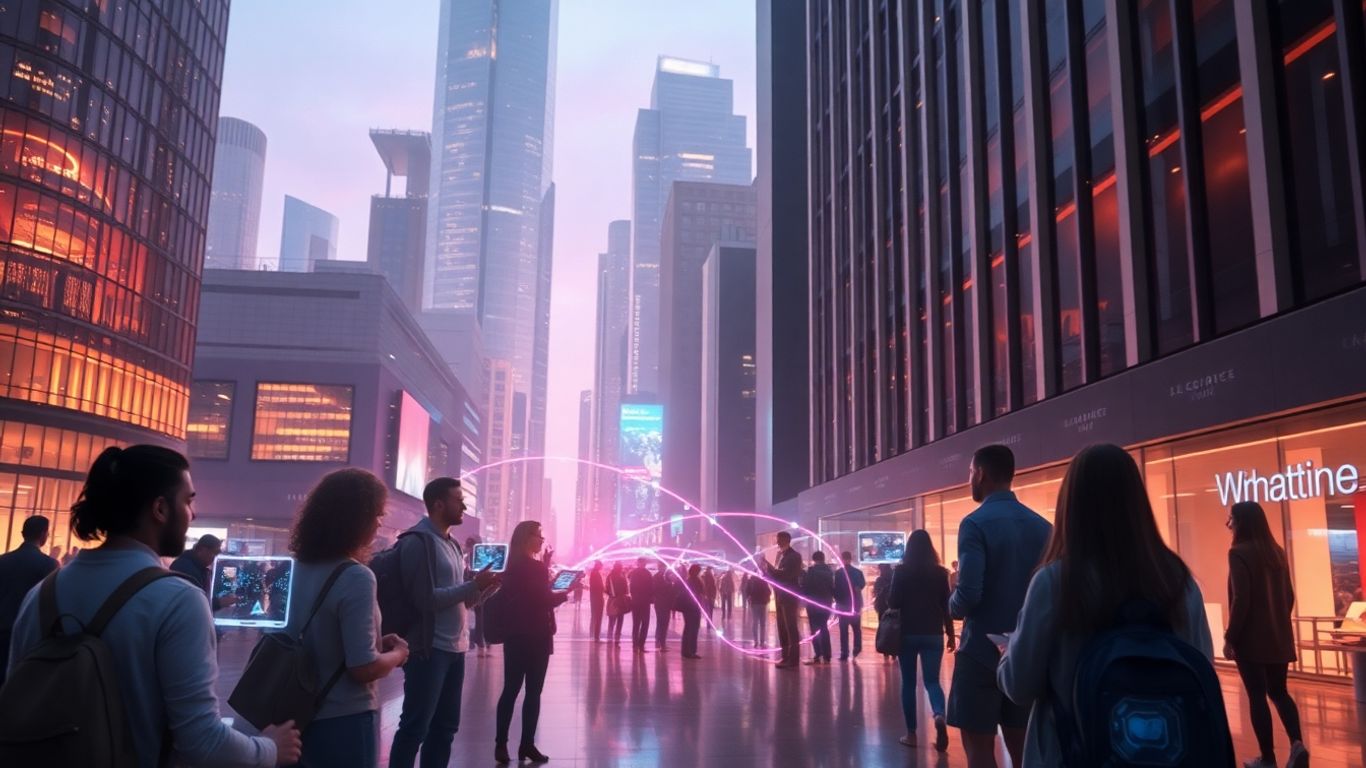
In today’s fast-paced business environment, making operations smoother and tailoring experiences for individuals are top priorities. Technology plays a big role here, helping companies work smarter and connect better with their customers. It’s all about using data and smart tools to make things more efficient and personal.
Data-Driven Insights for Customer Experiences
Businesses are increasingly turning to data to understand what customers want. By analyzing purchasing habits, online behavior, and feedback, companies can create more relevant product recommendations and marketing messages. This approach moves beyond generic outreach, offering a more tailored feel that can really make a difference in customer loyalty. For instance, e-commerce sites often suggest items based on your past browsing, which is a direct result of this data analysis. The hedge fund industry, for example, is seeing a significant shift towards AI-driven strategies, with many firms integrating advanced machine learning techniques to refine their investment approaches. This trend highlights how data analysis is becoming a core component across various sectors.
AI-Powered Automation in Workflows
Artificial intelligence is stepping in to automate many routine tasks that used to take up a lot of employee time. Think about customer service chatbots that can handle common queries, or software that automatically sorts and categorizes incoming emails. This frees up human workers to focus on more complex problems that require critical thinking and creativity. Agentic AI, a more advanced form, is even starting to act as a collaborator, adapting to new information and making decisions autonomously to streamline processes. This can revolutionize how supply chains operate, from forecasting demand to coordinating deliveries.
Democratizing Solutions with Low-Code Platforms
Low-code and no-code platforms are making it easier for people without extensive programming backgrounds to build applications and automate processes. These tools use visual interfaces and pre-built components, allowing business users to create custom solutions quickly. This not only speeds up development but also puts the power of creation into the hands of those who best understand the business needs. It’s a way to make technology more accessible and adaptable across an organization.
The ability to quickly adapt and personalize offerings based on real-time data is becoming a competitive advantage. Companies that can effectively use technology to understand and respond to individual needs will likely see greater success.
Securing the Digital Frontier
As our digital lives expand, keeping our information safe becomes a bigger job. Think about it: more devices are connected, and the ways people try to break in are getting smarter. Staying ahead of these threats means we need to be really smart about how we protect everything.
One of the biggest shifts is how we’re fighting back. Instead of just reacting to attacks, we’re using tools like artificial intelligence to spot trouble before it really starts. These systems can look at a lot of data very quickly, finding odd patterns that might mean something bad is happening. It’s like having a super-watchful guard for your network.
We’re also seeing a move towards a ‘zero-trust’ approach. This means we don’t automatically trust anyone or anything, even if they’re already inside our network. Everyone and every device has to prove who they are, and they only get access to what they absolutely need to do their job. This limits how much damage an attacker can do if they manage to get in.
Cybersecurity in an AI-Augmented Era
AI is a double-edged sword in security. While it helps us detect threats, attackers are also using AI to make their attacks more convincing. This includes things like AI-powered phishing emails that look very real or even fake videos (deepfakes) used for fraud. To counter this, security systems are using AI to analyze behavior and identify anomalies that humans might miss. It’s a constant race to stay one step ahead.
Quantum-Resistant Protocols
This might sound like science fiction, but quantum computers, when they become powerful enough, could break the encryption methods we use today. This is a serious future concern for protecting sensitive data. Because of this, experts are developing new ways to encrypt information that even quantum computers can’t easily crack. It’s about getting ready for a future where our current security might not be enough. We need to start thinking about quantum-safe encryption now.
Protecting Remote Workforces
With so many people working from home or different locations, securing these remote setups is vital. Each home computer or personal device connected to company resources is a potential entry point for attackers. This means we need strong security measures for these remote workers, like secure connections, up-to-date software, and clear guidelines on safe online practices. Making sure everyone understands the risks and how to avoid them is a big part of the puzzle.
Sustainable Practices in Information Technology

As we look towards 2025, the conversation around Information Technology is increasingly including how we can make it kinder to our planet. It’s not just about faster processors or more data storage anymore; it’s about doing it responsibly. This shift towards sustainability in IT is driven by a growing awareness of environmental impact and a desire for more efficient, long-term operations. Businesses are realizing that green IT isn’t just good for the Earth, it’s good for the bottom line too.
Green Technologies and Climate Tech
Climate tech is really starting to make waves, offering new ways to monitor and reduce environmental harm across different sectors. Think about technologies designed to cut down on resource use and emissions from things like travel. In the IT world, this translates to smarter energy use in data centers and more efficient hardware. We’re seeing a rise in cloud sustainability, which means optimizing cloud services to use less energy and produce fewer carbon emissions. This allows companies to scale their IT needs without a proportionally larger environmental footprint. It’s about making sure our digital infrastructure grows in a way that supports, rather than hinders, our climate goals. You can find some exciting developments in roofing technology that are also transforming urban environments with more energy-efficient solutions [de3d].
Responsible E-Waste Management
When we talk about sustainability in IT, we can’t ignore electronic waste, or e-waste. It’s a big deal. Proper recycling and disposal of old devices are key to minimizing environmental damage. Plus, it’s a chance to recover valuable materials that can be reused. This means setting up clear protocols for how old equipment is handled, whether it’s through certified recycling programs or refurbishment initiatives. It’s about creating a circular economy for our electronics, where old devices don’t just end up in landfills.
Reducing Environmental Footprints
So, how do we actually shrink our IT environmental footprint? It comes down to a few practical steps:
- Energy Efficiency: Choosing energy-efficient hardware and optimizing software to use less power.
- Renewable Energy: Powering data centers and offices with renewable energy sources like solar or wind.
- Lifecycle Management: Extending the life of IT equipment through maintenance and upgrades, and then ensuring responsible disposal or recycling.
- Remote Work Support: While not directly IT hardware, supporting remote work can reduce commuting emissions, which is a significant environmental benefit.
The focus on sustainability in IT is moving beyond a niche concern to a mainstream business imperative. Companies that integrate green practices into their IT strategies are not only meeting regulatory expectations but also building a more resilient and forward-thinking organization. This proactive approach positions them for long-term success while contributing positively to global environmental efforts.
The Future of Work and Collaboration
The way we work is changing, and technology is right at the heart of it. In 2025, we’re seeing a big shift from thinking about work as just humans or machines, to a world where they work together. This means companies need to get smart about how they set up their workplaces and the tech that supports them.
Human-Machine Collaboration in the Workplace
It’s not about robots taking over; it’s about AI becoming a partner. Think of AI not just as a tool you use, but as a colleague that can handle routine tasks, analyze data, and even suggest solutions. This kind of AI, sometimes called ‘agentic AI’, can learn and adapt, making decisions on its own based on what it learns. Imagine an AI that can sort out potential network problems before they even happen, or a customer service AI that anticipates what a customer might need. These systems can even work with each other to manage complex jobs, like optimizing a whole supply chain from start to finish. This new era of collaboration promises big gains in efficiency and personalized service. However, it also brings up important questions about how to use AI responsibly, making sure it’s fair, transparent, and protects sensitive information.
The move towards AI as a collaborator means businesses need to be ready. This includes having fast internet connections for real-time data processing and strong security to protect both people and machines. It’s a big change, and companies need to communicate clearly with their teams about how AI will fit in, making sure that the human element, which is so important for good customer experiences, isn’t lost.
Advancements in Remote Work Technologies
Remote work isn’t new, but the tools are getting much better. Cloud systems are now a must-have, letting people access what they need from anywhere. Collaboration tools are also getting more immersive, with better video calls, shared digital whiteboards, and project management software that makes teamwork smoother, even when everyone is apart. AI assistants are popping up to help with everyday tasks, like scheduling or even translating languages in real-time for global teams. These tools are making it easier for people to stay connected and productive, no matter their location. The need for reliable remote work solutions is growing, and companies are investing in cloud systems for collaboration.
Hybrid Work Models and Their Impact
Most companies are settling into hybrid models, where employees split their time between working from home and being in the office. This flexibility is becoming the standard. For these models to work well, companies need to make sure their technology supports everyone equally, whether they’re at home or in the office. This means thinking about everything from secure connections to making sure virtual meetings feel as productive as in-person ones. The goal is to create a work environment that offers both flexibility and strong teamwork, adapting to the new ways people want to work.
Looking Ahead: Embracing the Evolving IT Landscape
As we wrap up our look at information technology in 2025, it’s clear that change is the only constant. We’ve seen how cloud computing and AI continue to reshape how businesses operate, making things more efficient and opening up new possibilities. It’s not just about adopting new tech, though; it’s also about managing that change well, making sure our teams can use these tools effectively, and keeping security a top priority. Thinking about sustainability is important too, as we find ways to use technology responsibly. The IT world keeps moving, and staying curious and willing to learn will help us all keep up and make the most of what’s next.
Frequently Asked Questions
What is digital transformation and why is it important for businesses?
Digital transformation means using new technology to make businesses work better and faster. It helps companies change how they do things, like selling products or talking to customers, by using tools like computers and the internet. This makes them more competitive and efficient.
How is cloud computing changing how businesses operate?
Cloud computing is like renting computer power and storage over the internet instead of owning it all. This lets businesses easily get more power when they need it and pay only for what they use. It’s a flexible and often cheaper way to run computer systems.
What is artificial intelligence (AI) and how is it used in business?
AI is teaching computers to think and learn like humans. Businesses use AI to do things like understand customer needs, make smarter decisions, and automate tasks that people used to do. It can help improve everything from sales to how a company runs its daily tasks.
What does ‘hyper-automation’ mean for businesses?
Hyper-automation is about using many different technologies, like AI and special software, to automate as many business tasks as possible. The goal is to make work faster, reduce mistakes, and free up people to focus on more important jobs.
Why is cybersecurity so important in today’s world, especially with new technologies?
Cybersecurity is about protecting computer systems and information from hackers and bad software. With more technology being used, like AI and remote work, there are more ways for bad actors to try and steal data or cause harm. Strong security is vital to keep businesses and their information safe.
What are sustainable IT practices and why should businesses care?
Sustainable IT means using technology in ways that are good for the environment. This includes things like using less energy, recycling old computer parts properly, and reducing waste. Businesses care because it helps the planet and can also save them money and improve their reputation.

Peyman Khosravani is a seasoned expert in blockchain, digital transformation, and emerging technologies, with a strong focus on innovation in finance, business, and marketing. With a robust background in blockchain and decentralized finance (DeFi), Peyman has successfully guided global organizations in refining digital strategies and optimizing data-driven decision-making. His work emphasizes leveraging technology for societal impact, focusing on fairness, justice, and transparency. A passionate advocate for the transformative power of digital tools, Peyman’s expertise spans across helping startups and established businesses navigate digital landscapes, drive growth, and stay ahead of industry trends. His insights into analytics and communication empower companies to effectively connect with customers and harness data to fuel their success in an ever-evolving digital world.