- The 13th edition of the World Economic Forum’s, created in collaboration with the Dubai Future Foundation, the list of Top 10 Emerging Technologies report aims to spotlight the breakthrough technologies with the potential not only to cross this threshold between innovation and real-world application.
- Out of the 250+ nominations, screened by the AI Trend Analyser, a technology developed by Frontiers, these technologies provide a clear perspective on how to help societies adapt and thrive in the face of complex challenges.
The 13th edition of the World Economic Forum’s Top 10 Emerging Technologies report highlights new technologies that have the potential to make a significant impact and help societies respond to complex challenges.
The report’s main goal is to encourage discussions about the future and guide technology priorities by linking advanced research with people and organisations that can help develop it further. It focuses on technologies that are at a key stage, where scientific progress is ready to be applied in practical ways. This gives leaders in government, business, and science the information they need to make informed decisions in a fast-changing world.
The report launched at the Forum’s Annual Meeting of the New Champions (also known as Summer Davos), the report presents technologies that are reaching the point where they can have real effects in everyday life.
Top 10 Emerging Technologies of 2025 Report by WEF
For the 2025 edition, more than 250 technology nominations were submitted by experts from industry and academia. These were reviewed using the AI Trend Analyser, developed by Frontiers, which linked each nomination to important concepts and measured how often these concepts appeared in academic articles over the past 10 years. From this, a “trendiness” score was created to show the growing presence of each technology in research.
The technologies were also assessed using the World Economic Forum Resilience Consortium’s Resilience for Sustainable, Inclusive Growth framework (2022) to understand their potential in addressing global challenges and preparing for the future.
The result?
It is a carefully selected list of technologies with strong investment and growing momentum behind them
WEF stated, “Technologies such as collaborative sensing, autonomous biochemical sensing and green nitrogen fixation demonstrate ongoing innovation in these fields where urgent challenges persist. They also signal growing momentum to develop scalable solutions to chronic disease, environmental impact and infrastructure strain”.
10 emerging technologies of 2025
1. Structural battery composites:
Picture an electric car where its doors and panels aren’t just structural, they double as batteries, holding the charge that gets you to work or the seaside. That’s the gist of structural battery composites (SBCs), ingenious materials blending high-strength fibres like carbon with energy-storing capabilities. Forget bulky batteries hogging all the space; these cleverly engineered components offer rigidity and power in a single package.
SBCs are still in the early stages, but leading edge projects from automakers to aerospace (Airbus is dabbling as we speak) hint at their potential. What could be lighter, faster, and less resource-hungry vehicles or aircraft, where a 10% weight reduction improves fuel efficiency by 6-8% and EV range by up to 70%.
Need a greener, sleeker tomorrow? SBCs are in pole position. Of course, with technical hurdles, regulatory knots, and the environmental headache of carbon fibre recycling still to untangle, there’s plenty of work ahead.
2. Osmotic power systems:
Salty water, yes, the sort sloshing around at river mouths and coastal spots, holds a clean secret: it can generate electricity continuously, unlike solar or wind’s mood swings. Osmotic power systems tap this energy by leveraging differences in salinity between two bodies of water, using special membranes to drive turbines or produce electrical flow.
Early tries in the ’70s fizzled due to technical limits, but new materials and improved designs (like Denmark’s SaltPower and France’s Sweetch Energy) are bringing osmotic power to life, with installations already underway. It could deliver nearly a fifth of the world’s electricity needs! Imagine water management turned upside down, energy and purified water from one system, minerals like lithium recovered together. This tech reimagines local infrastructure, presenting a decentralised, resilient alternative for communities looking to break away from carbon-based energy grids.
3. Advanced nuclear technologies:
If clean energy is the game, advanced nuclear technologies are rallying back into the spotlight. Forget the “big and scary” nuclear plants of old; today’s innovations focus on smaller, modular reactors (SMRs) and Generation IV designs cooled by exotic materials like molten salts or gases.
These SMRs, factory-built and shipped to remote locations, offer flexible, reliable, zero-carbon power, just as the world’s appetite for electricity (AI, transport, you name it) surges.
Nations from South Korea to the UAE are sinking billions into nuclear solutions to meet net-zero ambitions. SMRs could soon provide industrial heat for tough-to-decarbonise sectors like steel and cement, chipping away at their hefty CO2 emissions.
Even nuclear fusion, once a pipe dream, is inching closer to reality, promising a near-limitless energy source in a decade or two. The main challenge? Scaling up, building public trust, and establishing a robust supply chain for all those specialised reactor parts.
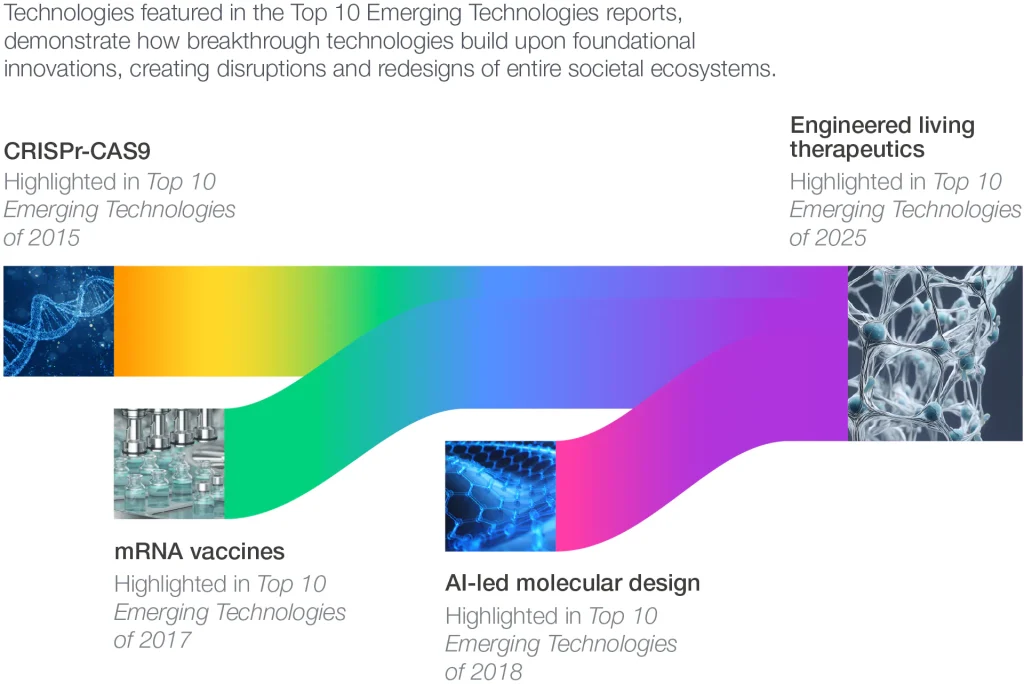
4. Engineered living therapeutics:
Imagine popping a pill filled with friendly microbes, genetically tweaked to produce the precise drugs, enzymes or hormones your body needs, right inside you. Engineered living therapeutics represent the future of personalised medicine, allowing therapies to be brewed on demand, potentially slashing costs and making treatments more convenient, especially for chronic conditions.
Already, companies are trialling bacteria for cancer treatments and diabetic wound healing, with platforms producing multiple drugs at once or activating only when disease signals appear.
Safety is centre stage: kill-switches, encapsulation, and regulatory sandboxes are being explored, ensuring these living medicines stay in check. The implications? More accessible health care, localised drug production, and treatment regimens that adapt to the patient, not the other way round.
5. GLP-1s for neurodegenerative disease:
You may know GLP-1 drugs as weight-loss heroes and diabetes managers, but now researchers are eyeing these glucagon-like peptide-1 receptor agonists as promising treatments for neurodegenerative diseases like Alzheimer’s and Parkinson’s. Crossing the blood-brain barrier, these drugs seem to mop up toxic proteins, dampen inflammation, and keep neurons ticking longer.
While early clinical trials have yielded mixed but hopeful signals, larger, more specialised studies are underway. If they live up to expectations, the economic and human impact would be sweeping, potentially reducing the burden of dementia care, letting older adults remain active and involved for longer. There’s a lot hinging on affordability, regulatory approval, and the outcome of rigorous trials, but the buzz is real.
6. Autonomous biochemical sensing:
Wouldn’t it be reassuring if your wearable could continuously track markers for diseases, or if agricultural systems could spot contamination and respond before food reaches your plate? That’s the promise of autonomous biochemical sensing, real-time, wireless, self-powered sensors for continuous monitoring, in everything from healthcare to environmental protection.
Beyond single-use tests, these sensors harness bio-based detectors, advanced nanomaterials, and self-sustaining power sources. The most successful application currently is the wearable glucose sensor for diabetes, but fast-improving designs are expanding to hormones, toxins, and even soil health. Challenges remain around sensor lifespan, biocompatibility, and the ethics of deploying engineered organisms, but the benefits, earlier diagnosis, safer food, cleaner environments, are driving investment.
7. Green nitrogen fixation:
Every loaf of bread you eat owes something to nitrogen fixation, the conversion of atmospheric nitrogen into ammonia for fertiliser. The incumbent Haber-Bosch process, dating back a century, is energy-thirsty and a breathtaking carbon emitter. Enter green nitrogen fixation: bio-inspired, and lithium-mediated electrochemical tech capable of generating ammonia using sunlight, air and water.
Start-ups and research labs are trialling localised, small-scale ammonia plants powered by renewables. The change won’t just decarbonise a key food production process; it’ll buffer local economies against global price shocks, reduce transport costs, and decouple agriculture from fossil fuels. And with ammonia increasingly used as a marine fuel, the stakes for climate action are even higher.
8. Nanozymes:
What if enzymes, those workhorses of biology, could be mimicked and improved upon using engineered nanomaterials? Nanozymes are synthetic nanoparticles, often of metals or carbon, that perform catalytic functions similar to natural enzymes but are far more robust, and easier (and cheaper) to make.
In medicine, nanozymes are being trialled for cancer and neurodegenerative diseases, delivering drugs more efficiently and neutralising harmful molecules. In environmental applications, they offer exciting breakthroughs in water purification and rapid contaminant detection.
With a projected $58 billion market by 2034 and applications in biosensing, food safety and industrial catalysis, nanozymes are set to revolutionise diagnostics and therapeutics. The next hurdles? Safety standards, biocompatibility and regulatory consensus.
9. Collaborative sensing:
Your phone, home thermostat, car sensors, and the city’s traffic cameras don’t just work independently anymore. Collaborative sensing integrates thousands of distributed sensors, sometimes equipped with AI and edge computing, into unified, context-aware networks, enabling real-time decision-making for everything from traffic management to emergency response.
Vehicle-to-everything (V2X) technologies already make urban mobility safer and more efficient, slashing crash rates when widely adopted. 5G and advanced algorithms bring unprecedented accuracy to logistics, resource allocation, and even drone fleet management. The big mission? Building robust standards for data sharing, upgrading telecom infrastructure, and assuring public trust in these interconnected systems.
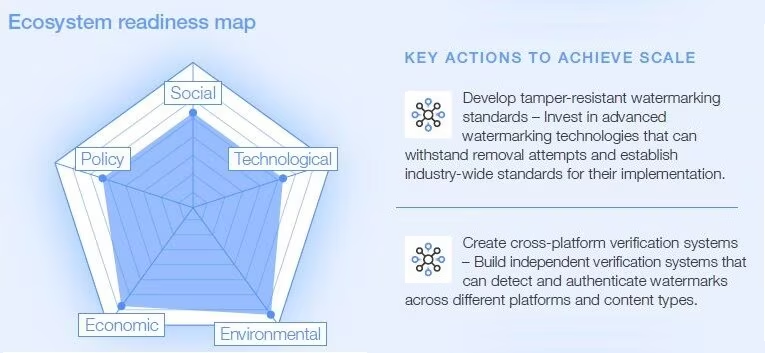
10. Generative watermarking:
Can you tell whether that new viral video or witty online post was crafted by a human or conjured up by AI? Increasingly, you can’t. That’s why generative watermarking is fast becoming the backbone of digital trust, embedding invisible authenticators into text, images, audio and video generated by AI.
From Google’s SynthID to Meta’s VideoSeal, watermarking systems are being rolled out in response to regulatory pressure and industry demand. These markers not only help counter misinformation, protect intellectual property and trace content origins, but they might even underpin future legal and financial systems where authenticity is everything. Technical and ethical challenges persist, especially around tamper-resistance and universal standards, but the momentum is growing.
Why Does This Matter?
The technologies above don’t just promise incremental progress: they offer real avenues for decarbonisation, health breakthroughs, trustworthy digital media, and more resilient societies. Each combines advanced materials, biology, information systems or energy platforms in ways that bridge longstanding gaps between innovation and implementation.
If 2025’s tech pulse tells us anything, it’s that breakthroughs depend on more than scientific ingenuity. They need supportive policies, public understanding, thoughtful investment and, above all, strategic collaboration across sectors. For those willing to look beyond the immediate horizon, these advances aren’t just tools, they’re catalysts, inviting us to reimagine the rules of progress.
So, whether you’re a business leader, policymaker, or just curious about what’s next, keep your eyes on these Top 10. They’ll be powering the headlines, the products in your hands, and the world you inhabit, sooner than you might think.