In the fast-paced world of product development, speed and precision are everything. That’s where 3D scanning steps in to revolutionize rapid prototyping. By capturing intricate details of physical objects with unmatched accuracy, 3D scanning streamlines the design process and eliminates guesswork.
You’ll discover how this cutting-edge technology reduces development time, enhances design accuracy, and bridges the gap between concept and production. Whether you’re refining prototypes or reverse-engineering designs, 3D scanning offers the tools to innovate faster and smarter.
Understanding Rapid Prototyping
Rapid prototyping refers to the process of quickly fabricating a physical prototype or model using three-dimensional computer-aided design (CAD) data. It’s a crucial step in product development, bridging the gap between conceptualization and production. A 3D model maker is typically used to convert CAD designs into printable formats, ensuring accurate geometry and compatibility with the chosen manufacturing method.
Importance Of Speed And Precision In Prototyping
Speed minimizes development time, accelerating the path to market. For example, additive manufacturing can produce functional prototypes within hours compared to days using traditional machining.
Precision enables you to test designs with accuracy before full-scale production. Technologies like SLA achieve tolerances as low as 0.05 millimeters, reducing errors at later stages.
By combining speed with precision, rapid prototyping allows iteration cycles for refinement. A designer can modify a CAD file, incorporate alterations, and validate changes within a short timeline. This iterative process is critical for testing form, fit, and function prior to mass production.
The Role Of 3D Scanning In Prototyping
3D scanning introduces greater precision and speed to rapid prototyping. By capturing exact physical data, it bridges the gap between an idea and a functional prototype.
What Is 3D Scanning?
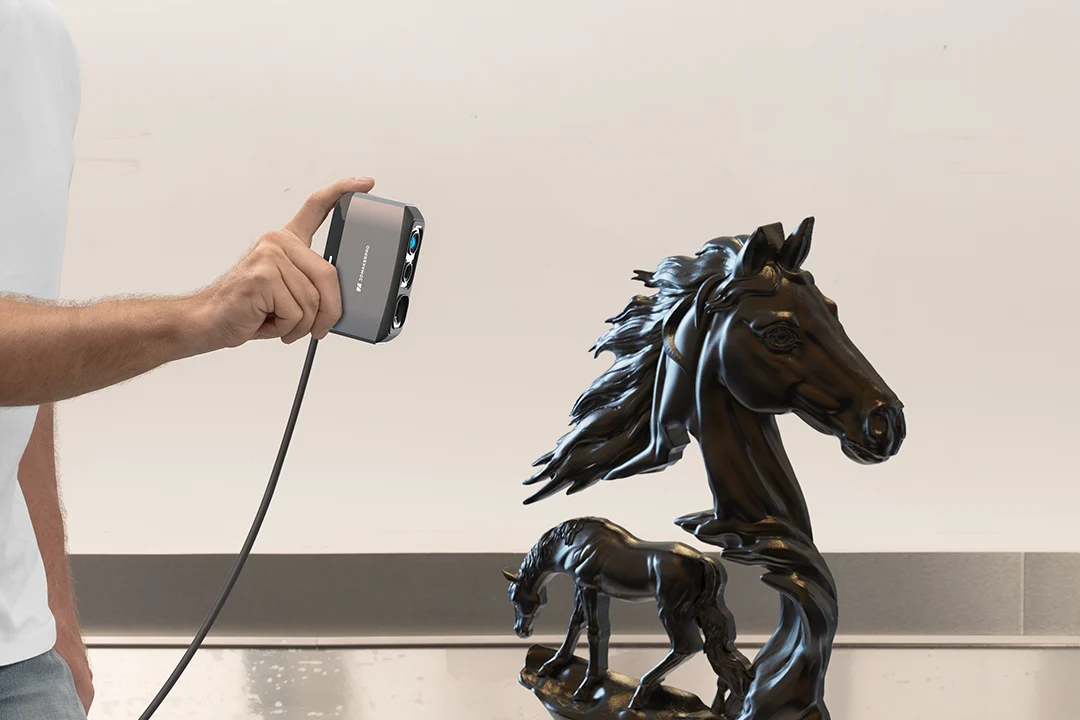
3D scanning is a process that collects detailed spatial measurements of an object. Using structured light, lasers, or photogrammetry, it generates a digital model representing the object’s shape and dimensions.
Scanners translate physical data into formats compatible with design tools, such as CAD software. These digital files can then inform modifications, quality checks, or manufacturing workflows. Examples include reverse-engineering legacy components or updating existing designs.
Key Features Of 3D Scanning Technology
- High Accuracy
Modern systems offer high measurement accuracy suitable for detailed applications. This is useful for capturing intricate details in mechanical parts or artistic sculptures. - Speed In Data Acquisition
Some scanners provide rapid data acquisition, supporting fast-paced prototyping cycles. - Non-Contact Methods
Many devices use light or lasers to avoid touching fragile or soft materials directly, avoiding potential damage. - Versatility In Output
Scanned results are compatible with formats like STL or OBJ, allowing direct integration into additive manufacturing or CNC machining. - Adaptable To Sizes
Systems range from handheld scanners for small parts to industrial setups for vehicles or large machinery.
These features support workflows that require swift iteration, contributing to reduced production timelines.
Benefits Of 3D Scanning In Rapid Prototyping
When applied in rapid prototyping, 3D scanning offers significant advantages by delivering precise data and accelerating workflows. It supports designers and engineers in delivering accurate prototypes faster.
Improved Accuracy And Detail
3D scanning captures detailed geometrical data with high precision, benefiting industries like aerospace and medical device manufacturing by minimizing dimensional errors. For example, dental labs use it to replicate tooth structures accurately.
Scanners also produce high-resolution 3D meshes that reveal subtle surface details, aiding reverse engineering and quality assurance. This digital accuracy preserves real-world measurements, ensuring consistency across design iterations.
Faster Iterations And Development Cycles
3D scanning streamlines prototyping by directly integrating physical data into CAD software, reducing manual modeling and speeding up the workflow. This shortens the time from scanning to prototype-ready files.
For example, handheld scanners let engineers quickly assess and update prototypes after testing, enabling faster evaluations and smoother iterative cycles that support rapid innovation.
Cost Efficiency And Resource Optimization
3D scanning reduces waste by eliminating redundant prototyping, allowing digital design refinement that cuts material use, especially in additive manufacturing. It also saves time and labor by minimizing manual measurements and redesigns. For instance, automotive companies use scanned models to accurately adjust worn parts without extra prototypes.
These benefits translate to streamlined budgets and make scaling resources more manageable across projects.
Real-World Applications
3D scanning has found importance across diverse industries, particularly for rapid prototyping. From automotive manufacturing to healthcare innovations, it plays a role in optimizing workflows and improving functional testing. Let’s explore specific examples.
Industries Benefiting From 3D Scanning
- Automotive: 3D scanning aids in design validation, reverse engineering, and component prototype testing. For instance, it helps create digital models of legacy parts no longer in production. Major automotive manufacturers employ 3D scanning to refine vehicle aerodynamics, enhancing performance.
- Aerospace: With requirements for extreme precision, aerospace companies use 3D scanning to design efficient prototypes for aircraft components. High-detail scans detect surface imperfections and structural inconsistencies during quality control processes.
- Healthcare: Custom prosthetics and implants benefit from precise scanning of patient anatomies. Orthopedic industries use data to create biocompatible prosthetics that fit without manual adjustments.
- Consumer Products: Designers in footwear, electronics, and wearables use scanning to prototype ergonomically optimized and functional products. Scanning accelerates workflows, allowing quick iterations for improved user experiences.
- Architecture and Construction: Using 3D scanning, architects can generate accurate models of existing structures, aiding redesign projects. Historical preservation efforts also rely on this technology to digitize heritage sites for accurate replication.
Challenges And Limitations
Despite its capabilities, 3D scanning introduces certain challenges in rapid prototyping processes.
Potential Obstacles In Implementation
Advanced 3D scanners come with high acquisition and maintenance costs, making them a significant investment. Additionally, operators require technical training to handle both the hardware and post-processing software, as lack of expertise can lead to errors and poor results.
Environmental factors like lighting and surface reflectivity can affect scan quality, sometimes necessitating surface preparation such as applying matte sprays. Compatibility with CAD tools and manufacturing workflows can also pose challenges, as some file formats may need conversion for seamless integration.
Addressing Integration Issues
IT infrastructure adjustments are often necessary to incorporate 3D scanning systems. These devices generate substantial data volumes; a single high-resolution scan may produce files over 500 MB. Systems with limited processing power or storage capabilities may struggle to handle such loads.
To reduce workflow disruptions, companies often use middleware to connect scanners with CAD platforms. Working closely with scanner suppliers also helps, as they provide training and support to ease technical challenges.
In regulated industries like healthcare, ensuring legal compliance is crucial. Early collaboration with regulatory consultants can help validate digitization processes and prevent issues during prototyping.
Future Developments In 3D Scanning For Prototyping
Advances in 3D scanning continue to influence rapid prototyping, pushing technological boundaries and reshaping production cycles. Anticipating future shifts requires examining emerging technologies and their impact on design innovation.
Emerging Technologies
Recent trends suggest that integration with artificial intelligence (AI) and machine learning (ML) is shaping next-generation 3D scanning systems. AI algorithms analyze scanned data more efficiently, suggesting design changes or detecting flaws automatically. For example, AI can enhance object surface reconstruction in low-quality scans, reducing manual intervention.
Miniaturization has made portable 3D scanners more accessible without sacrificing accuracy, enabling quick on-site prototyping of complex shapes. Hybrid scanners combining structured light and photogrammetry improve results across varied environments, while advances like hyperspectral imaging integrated with 3D scanning allow simultaneous capture of surface and material data—crucial for fields such as healthcare.
The Path Toward Greater Innovation
Future innovations might focus on higher scanning resolutions and faster data processing speeds. Some high-end models already offer fast data capture with high resolution. Optimizations could lead to broader industrial applications, improving efficiency in testing and prototyping. 3DMakerpro has begun incorporating these trends into its lineup, offering AI-assisted tracking, markerless scanning, and high-speed data capture in compact devices.
Cloud-based workflows are gaining traction. By uploading scans directly to shared platforms, you can streamline collaboration between teams, reducing localized software dependencies. Paired with blockchain technology, this may enhance data security during design iterations.
Considerations for environmental sustainability may also reshape 3D scanning. Advances in energy-efficient hardware could decrease power consumption per scan, while recyclable components in devices support greener manufacturing initiatives.
How AI-driven feedback loops, integration of hyperspectral imaging, and energy-saving designs will influence prototyping workflows remains worth watching.
3D scanning has undeniably revolutionized rapid prototyping by bridging the gap between innovative ideas and tangible results. Its ability to deliver unmatched precision, speed, and efficiency empowers you to streamline workflows and refine designs with confidence. While challenges like cost and integration exist, advancements in technology continue to make 3D scanning more accessible and versatile.
As industries push the boundaries of design and manufacturing, leveraging 3D scanning in your prototyping process ensures you’re staying ahead in innovation. By embracing this technology, you’re not just enhancing product development; you’re setting the stage for smarter, faster, and more sustainable solutions.