
Great executive assistants do more than wrangle calendars, they protect your time and reputation. Yet the U.S. Bureau of Labor Statistics still projects about 43,000 executive-assistant openings each year, so CEO-level talent is scarce. Pick the wrong recruiting partner, and you’ll waste weeks on mis-aligned interviews before starting over.
Use this evidence-first playbook to stay ahead. First, confirm the hiring model that fits your risk and timeline. Then press every firm with the seven questions a CEO should ask an executive-assistant recruiting agency. Compare proof, not pitches, and keep your focus where it belongs—running the company.
Which hiring model fits your search?
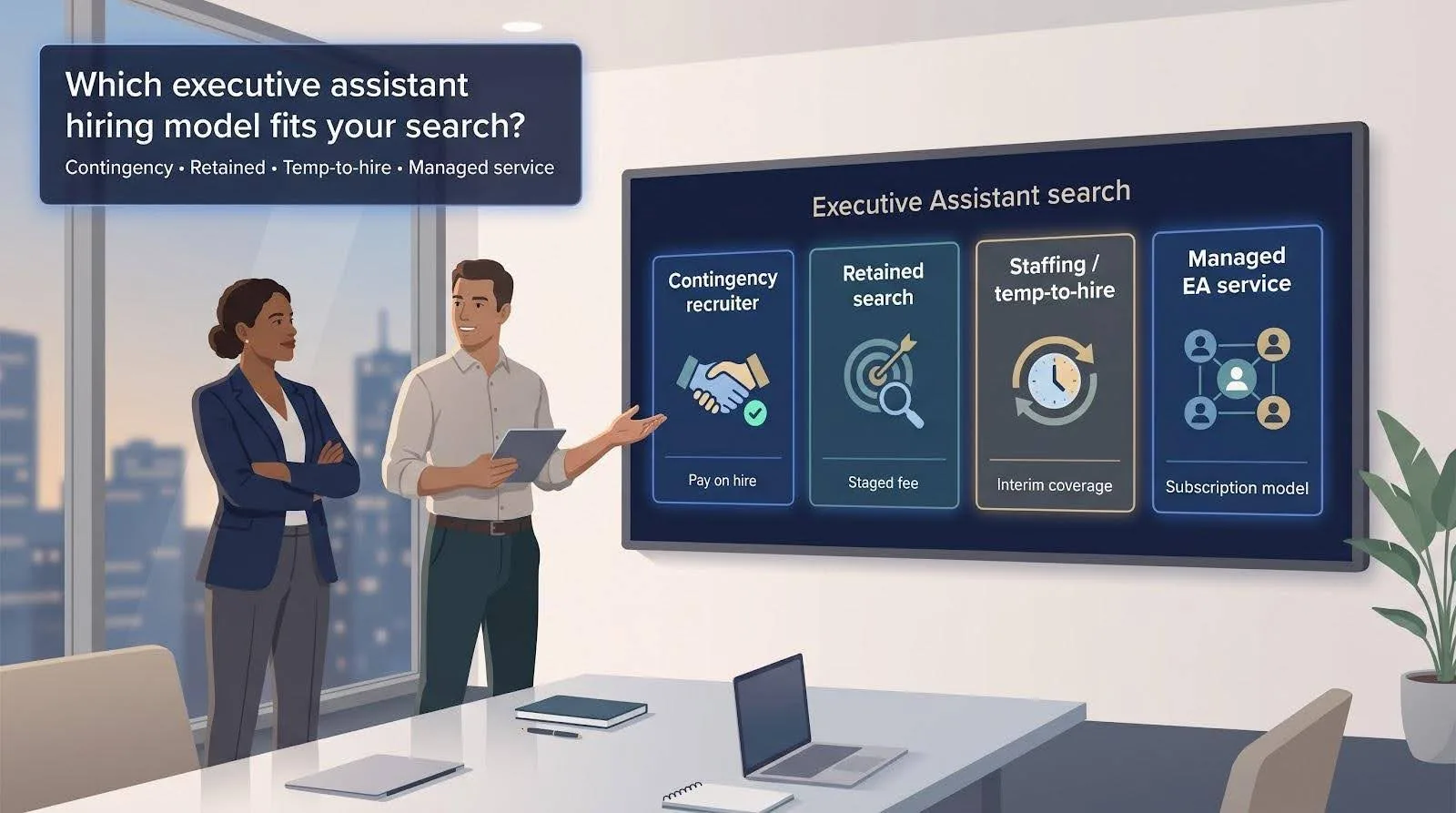
Choose how you want to pay before you pick a recruiter, because fee structure shapes incentives, speed, and depth of vetting.
| Model | Who employs the EA | Typical fee structure | Best-fit scenario |
| Contingency recruiter | Your company | 20–30 percent of first-year base salary, due only on hire (per an Oceans Talent analysis) | Straightforward replacement or non-exclusive search |
| Retained search | Your company | 25–35 percent of first-year total cash compensation, paid in stages | Confidential, high-stakes, or ultra-specialist mandate |
| Staffing / temp-to-hire | Agency | Hourly bill rate plus a conversion fee (often about 10 percent of salary) if you hire permanently | Interim coverage while you validate long-term fit |
| Managed EA service | Provider | Fixed monthly subscription; provider handles payroll, training, and oversight (pricing tiers vary by hours and scope) | Remote, process-driven support across multiple execs |
Match each model to your risk tolerance, budget, and timeline first; the seven questions that follow will show which firms can deliver on those terms.
1. How specialized is the agency, and who owns your search?
The field-tested checklist from C-Suite Assistants, an executive assistant staffing agency for CEOs, opens with a straightforward challenge: confirm that your recruiter’s day job is placing EAs who partner with top executives.
A recruiter who spends most of the week on software engineers can’t decode a CEO’s support needs. Ask each firm what share of its last 12 months of placements were executive assistants reporting directly to a CEO, founder, or board chair. Numbers beat adjectives: “32 of our last 40 searches were CEO-level EAs” is useful; “we place lots of admins” is not.
Specialization pays off. C-Suite Assistants, which has recruited only executive and administrative support since 2004, says three to five vetted candidates is the curated shortlist a specialist should be able to produce, and it draws on a national candidate database and a LinkedIn community of more than 100,000 administrative professionals.
Next, confirm accountability. The partner on today’s pitch call could hand your brief to a junior sourcer tomorrow. Insist on a single, named search owner who
- attends the kickoff interview
- screens every shortlist candidate
- manages references and offer negotiations
A convincing reply includes recent placement stats, two references from similar environments, and direct access to the recruiter making shortlist decisions.
Red flags:
- “We cover every function.”
- Senior leadership disappears after the pitch.
- References relate to mid-level admins, not CEO partners.
If any of these appear, keep looking.
2. Have you mapped the role and built a scorecard everyone can see?
An assistant can’t hit a target that no one has drawn. Before sourcing a single résumé, your agency should run a forensic intake that turns your working style into measurable outcomes.
Start with boundaries. Are you hiring a classic executive assistant, an executive business partner who drives projects, or a chief-of-staff-lite who shapes strategy? Robert Half’s 2027 Salary Guide shows the midpoint starting pay for a senior executive assistant ($98,750) is 35 percent higher than for a standard executive assistant ($73,000), which proves that scope drives compensation.
Next, map how you work. Do you fire off voice notes at midnight or prefer polished weekly briefs? Will the assistant handle personal logistics, investor decks, or board governance? Each answer refines the candidate filter and shields you from culture-fit guesswork.
Insist on a written scorecard that links every must-have trait to a verifiable behavior.
- “Protects focus” → “keeps the CEO in no-meeting blocks four afternoons a week.”
- “Thinks two moves ahead” → “sends flight-disruption contingencies before the first delay alert.”
With evidence this clear, interview panels stop debating vibe and start measuring performance.
Ask for an anonymized sample that includes the intake worksheet, success metrics, and first-90-day goals. If they can’t produce one, they’re writing your brief on the fly, and that’s costly improvisation.
Red flags: recycled job descriptions with fresh adjectives, or claims that a scorecard is “too rigid for culture.” If you hear either, move on. We’re aiming for clarity, not bureaucracy.
3. Can the agency back its pay, location, and work-model advice with current data?
Top-tier EAs move quickly; they accept offers in days and rarely negotiate twice. To hire them, your recruiter needs evidence, not folklore.
Pay first
Ask which salary guides inform the firm’s recommendation and when the tables were last updated. Robert Half’s 2026 guide lists a national range of $58,250–$86,750 for executive assistants, while unemployment for the role sits at 2.5 percent, well below the 4.4 percent national rate. Base salary alone means little if bonus, equity, or guaranteed overtime lift total cash far higher. Request a written range that links scope, geography, and seniority. If the agency parrots one national median, pause the process.
Location and work model
Gallup’s May 2026 Hybrid Work Indicator shows 52 percent of remote-capable employees work hybrid and 26 percent fully remote, leaving just 22 percent on-site. Ask for a talent map: how many qualified EAs sit within your pay band if the role is on-site, hybrid, or remote? The answer reveals exactly what each policy costs in candidate reach.
Finally, demand market evidence before kickoff. A recruiter ready to challenge under-market budgets or a five-day downtown schedule will save you weeks of churn and awkward counter-offers later.
4. How does the agency test skills, verify identity, and prove AI judgment?
Résumés can mislead, and polished LinkedIn profiles hide gaps. Real diligence starts when a recruiter puts every candidate through stress tests that mirror your world.
Structured assessment
Does the firm use the same behavioral questions for everyone and score answers against the role scorecard, or rely on gut feel? Consistency beats charisma. Look for work samples that force candidates to triage a chaotic calendar, rewrite a board brief, or rescue a flight that just canceled at 2 a.m. The best firms even record these exercises so you can watch the thinking, not just the answer.
Verification
Identity checks, reference calls with former principals, and education or employment confirmations catch embellishments. Greenhouse’s 2025 Workforce Report found 28 percent of applicants admit to using AI to generate fake work samples. When inconsistencies appear, the agency should pause, investigate, and surface the issue, not hope you miss it.
AI fluency with safeguards
In the ASAP State of the Profession 2026 survey, 76.9 percent of administrative professionals use AI daily, but only half feel confident governing it. A candidate who drops investor notes into a public chatbot is a lawsuit waiting to happen. Ask agencies to have finalists demonstrate a secure workflow: redact names, prompt, verify output, and document each step.
If a recruiter dismisses structured assessments, skips identity checks, or equates “uses ChatGPT” with mastery, keep searching. You need proof, not promises.
5. Can the agency prove its AI tools are audited, unbiased, and secure?
Every recruiter claims to be “AI powered,” but that slogan means nothing until you know exactly where the algorithms start and human judgment stops.
Inventory first
Ask for a plain-English list of every system that touches candidate data: sourcing scrapers, résumé parsers, ranking engines, scheduling bots, even note-taking plug-ins. For each tool, clarify
- Who reviews the machine’s recommendation before any human is rejected?
- Where is the data stored once the search is closed?
Bias audits
New York City’s Local Law 144, effective January 1, 2023, bans the use of automated employment decision tools unless they have passed a public bias audit within the past year. California’s updated FEHA regulations took effect October 1, 2025, imposing similar requirements on employers and their vendors. Ask the agency for the latest audit summary, the exceptions flagged, and the fixes deployed.
Data governance
Candidate résumés often include home addresses and salary histories—prime phishing bait if a sandboxed AI model leaks prompts into a public training set. Demand a retention schedule: when is data deleted, who can restore it, and what encryption protects backups? Security by obscurity no longer works.
Candidate notice
Legitimate applicants deserve disclosure that an algorithm helps screen them and a clear, human alternative if the tool gets it wrong. If the recruiter shrugs and says the vendor “handles compliance,” walk away. You need partners who own their tech stack, their safeguards, and the reputational fallout when either breaks.
6. Will the agency share weekly metrics and recalibrate when numbers slip?
A confident recruiter shows its work. Ask for the scoreboard before kickoff and hold them to it every week.
Start with medians, not anecdotes
SHRM’s 2025 recruiting benchmark puts the median time-to-fill for executive roles at 45 days. How many business days does the firm need to deliver a qualified shortlist? What’s the interview-to-offer ratio? What share of offers are accepted? Demand real denominators and a date range. “95 percent retention across 40 CEO-EA placements since January 2025” beats “95 percent retention” on eight hires last quarter.
Insist on a weekly cadence
A one-page funnel recap each Friday should cover outreach volume, response rate, shortlist progress, upcoming interviews, and blockers. When a candidate declines, the reason belongs in the report. Patterns surface fast: comp too low, on-site rule too rigid. You can adjust before momentum dies.
Test the recalibration muscle
What happens if the first slate misses? A pro recruiter will tie feedback to the scorecard and reset search parameters in days, not weeks. Anything less signals a résumé factory, not a strategic partner.
Numbers tell the truth; write them into the contract.
7. Do the economics, guarantee, and after-care really protect you?
See the math upfront
Contingency fees for executive-assistant searches typically run 20–30 percent of first-year base salary, while retained search averages 25–35 percent of total cash compensation. Ask for a worked example at the midpoint of the range, then list every extra: travel, background checks, and advertising. Watch for fee bases that shift from salary to total compensation only after an offer lands.
Dissect the guarantee
Replacement guarantees vary by firm and fee model; 90 days is a common term, and some retained firms offer longer. Whatever the length, nail down:
- Duration
- Trigger events such as resignation, performance termination, or restructuring
- Remedy—another full search, partial credit, or refund
Losing a hire just before the guarantee ends, with no clear remedy, is painful and expensive.
Look beyond day one
Effective agencies schedule 30-, 60-, and 90-day check-ins and coach both sides on workload, feedback loops, and boundaries. Hunt Scanlon cites these milestones as best practice for preventing early derailment.
Clear pricing, explicit risk-sharing, and structured after-care separate a transactional vendor from a true talent partner.
How will each agency score on the same 10-minute checklist?
Fill in the grid while details are fresh; side-by-side gaps jump off the page long before you sign a contract.
| Criterion | Weight | Agency A | Agency B | Agency C |
| Specialization & named search owner | 15 | |||
| Role discovery & scorecard quality | 15 | |||
| Market reach & compensation advice | 15 | |||
| Assessment rigor & verification | 20 | |||
| AI, privacy & compliance controls | 15 | |||
| Metrics & weekly reporting | 10 | |||
| Terms, guarantee & post-hire support | 10 | |||
| Total | 100 |
If any firm stalls on completing the table, or leaves rows blank, treat that as your first red flag.
Frequently asked questions
How long does a specialist EA search usually take?
Robert Half’s 2025 research shows employers take an average of five weeks to hire permanent staff from job description to acceptance. A CEO-level EA search often delivers a qualified shortlist in two to three weeks and closes inside eight. Timing still swings with location, pay, and scope, so ask for the agency’s median, not its record sprint, and lock weekly funnel reports into the contract.
What fee structures will I see?
Contingency firms charge only on success (typically 20–30 percent of base salary), retained partners bill staged percentages on total cash, staffing agencies add hourly mark-ups plus a conversion fee, and managed services package talent into a monthly subscription. Each approach shifts risk, so pick the one that matches your urgency and appetite for partnership.
Do I need a local recruiting agency?
Local insight helps with pay nuance and references, but reach and assessment rigor matter more than ZIP code. A national specialist with a clear talent map often outperforms a hometown generalist who leans on job boards.