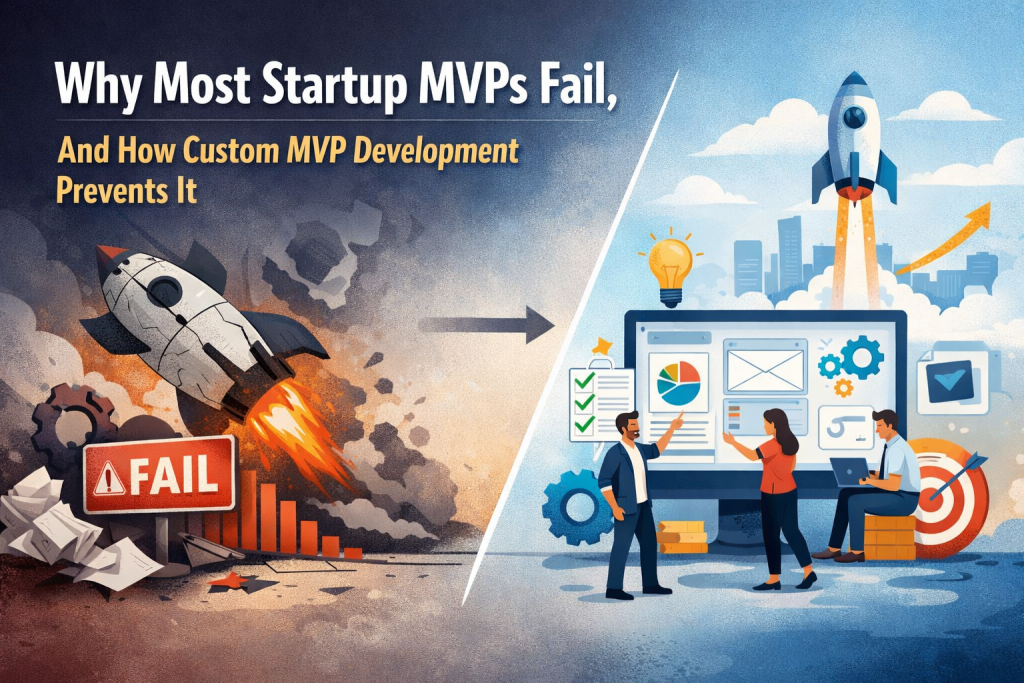
For years, startups have been told to “just build an MVP.” Launch fast. Test quickly. Iterate. In theory, the Minimum Viable Product is a shortcut to product-market fit.
In reality, many MVPs fail, not because the idea is bad, but because the execution is rushed, misaligned, or technically flawed.
The problem isn’t the MVP concept itself. It’s how founders approach building it.
The Hard Truth About Startup Failure
Before we talk about development, it’s worth looking at the data. According to CB Insights, the number one reason startups fail is no market need, cited in 42% of cases.
That statistic is often used to justify building something quickly and cheaply, “just test the idea.”
But here’s what many founders misunderstand:
An MVP is not supposed to be a cheap product.
It’s supposed to be a strategic experiment.
When MVPs fail, it’s rarely because they were too simple. It’s because they were built without the right structure, validation logic, or long-term thinking.
The Biggest Reasons Startup MVPs Fail
- They Solve the Wrong Problem
Many founders jump straight into development based on assumptions. They skip proper user interviews, competitive analysis, and problem validation.
An MVP should validate the core value proposition, not just demonstrate a feature.
When development begins without clear validation goals, teams build features instead of testing hypotheses. The result? A product that technically works but doesn’t resonate.
- They Are Built Too Quickly, Without Strategy
Speed matters. But blind speed is dangerous.
Startups often outsource development to the cheapest provider or rely on templated solutions. The outcome is usually:
- Poor architecture
- Scalability limitations
- Technical debt from day one
- A rebuild within 12–18 months
Ironically, the attempt to save money early often leads to higher costs later.
- They Confuse “Minimal” With “Low Quality”
Minimal does not mean careless.
An MVP should focus on core functionality, but the user experience must still be thoughtful. Early adopters are highly sensitive to usability. If onboarding is confusing or performance is poor, they won’t stick around long enough to provide meaningful feedback.
- There’s No Clear Validation Framework
An MVP without defined metrics is just a smaller product.
Founders need to know in advance:
- What behavior defines success?
- What metric determines product-market traction?
- What signals indicate pivot vs iteration?
Without these guardrails, launch data becomes noise instead of insight.
Where Custom MVP Development Makes the Difference
Custom MVP development doesn’t mean building a complex product. It means designing the MVP around validation and scalability from the beginning.
A strategic approach includes:
- Clear hypothesis mapping
- Feature prioritization based on user impact
- Scalable architecture planning
- Clean codebase for future iterations
- Built-in analytics for validation
Instead of focusing on “how fast can we ship?”, custom development asks:
“What exactly are we testing — and how do we design this product to learn efficiently?”
If you want a deeper breakdown of how this process works in practice, this guide explains the full framework behind custom MVP development for startups.
Architecture Matters More Than Most Founders Think
One of the most overlooked reasons MVPs fail is early technical architecture decisions.
Using shortcuts like monolithic builds, unscalable databases, or rigid frameworks may speed up launch, but they limit flexibility later.
When traction starts to grow, startups often face:
- Performance bottlenecks
- Infrastructure instability
- Costly rewrites
- Delayed feature rollouts
A custom MVP approach plans for scalability even if the initial feature set is small. The product can evolve without being rebuilt.
That balance — minimal functionality with scalable architecture, is what separates a throwaway MVP from a growth-ready product.
The Psychological Trap of “Just Launch It”
There’s also a behavioral component to MVP failure.
Founders under pressure, from investors, timelines, or competition, default to speed over structure. The excitement of launching overshadows the discipline of validating.
But an MVP is not a race to production.
It’s a structured experiment designed to reduce uncertainty.
The goal isn’t to prove you can build. It’s to prove the market cares.
How to Approach MVP Development the Right Way
If you’re building an MVP, start with these principles:
- Validate the problem before writing code.
- Define measurable success criteria.
- Prioritize features tied directly to your value proposition.
- Build with scalable foundations.
- Collect actionable data from real users.
- Iterate intentionally — not reactively.
When done correctly, an MVP becomes a powerful risk-reduction tool. When done poorly, it becomes an expensive prototype that needs to be rebuilt.
Final Thoughts
The idea of the MVP has been oversimplified in startup culture. It’s often treated as a shortcut, a quick version of a “real” product.
In reality, a well-built MVP requires just as much strategic thinking as a full product launch. The difference is focus, not effort.
Most startup MVPs fail not because founders move too slowly, but because they move without structure.
Custom MVP development prevents failure by aligning validation, architecture, and execution from day one.
And in an ecosystem where 42% of startups fail due to lack of market need, building smarter, not just faster, may be the most important competitive advantage you have.

Peyman Khosravani is a seasoned expert in blockchain, digital transformation, and emerging technologies, with a strong focus on innovation in finance, business, and marketing. With a robust background in blockchain and decentralized finance (DeFi), Peyman has successfully guided global organizations in refining digital strategies and optimizing data-driven decision-making. His work emphasizes leveraging technology for societal impact, focusing on fairness, justice, and transparency. A passionate advocate for the transformative power of digital tools, Peyman’s expertise spans across helping startups and established businesses navigate digital landscapes, drive growth, and stay ahead of industry trends. His insights into analytics and communication empower companies to effectively connect with customers and harness data to fuel their success in an ever-evolving digital world.