Generative Engine Optimisation: 3 Pillars for AI Visibility

There is a boardroom conversation happening right now, in some form, at almost every company with a website. It usually starts the same way: someone in marketing says traffic is down, someone in the C-suite asks “isn’t that just Google being Google?”, and someone junior enough to have actually read the research says the quiet part out loud — the way people find you has fundamentally changed, and most of your budget is still built for a world that no longer exists.
I’ve spent the last two years inside that conversation, on both sides of the table. This is the resource I wish someone had handed me at the start of it: the data that proves the shift is real, the academic research behind the tactics everyone’s suddenly selling, and — the part most GEO content skips — the actual layered framework for building AI visibility rather than just chasing individual tactics.
Part One answers why this matters and what the numbers actually show. Part Two answers how — a three-layer structural model for building it.
“Is SEO dead?” — No. But your definition of it is.
In February 2024, Gartner made a prediction that detonated across every marketing org on earth: by 2026, traditional search engine volume would drop 25%, with search marketing losing market share to AI chatbots and other virtual agents. Gartner’s Alan Antin was blunt about the cause: generative AI solutions are becoming substitute answer engines, replacing queries that previously ran through traditional search.
More than halfway through 2026, there is still no public evidence showing that traditional search volume has fallen by the predicted 25%. Apparently, it’s complicated. Google didn’t collapse — it still commands over 90% of the traditional search-engine market share. But that’s cold comfort, because the more important metric was never query volume. It was what happens after the query — and that number has moved dramatically.
According to SparkToro’s Rand Fishkin — the researcher who first quantified this trend back in 2019 at roughly 50% — 68% of U.S. Google searches in the first four months of 2026 ended without a click to anywhere at all. Not without a click to your site. Without a click to anywhere on the open web, including Google’s own properties. That’s up from 60% just two years earlier — roughly 7.6 percentage points from 2024..
So no, SEO isn’t dead. What’s dead is the assumption that ranking #1 still means what it used to. You can hold the top spot and still lose the war for attention, because the war has moved from the results page into the answer itself.
If nobody’s clicking, why does visibility still matter?
Because the alternative to being clicked is being cited — and citation is now measurably more valuable than it looks.
Pew Research’s analysis of nearly 69,000 Google searches conducted by 900 US adults in March 2025 found that when an AI Overview is present, only 8% of users click an organic result, compared to 15% when it’s absent — and just 1% click the citation links inside the AI Overview itself. On the surface, that reads like a death sentence for organic content. It isn’t — it’s a redistribution.
Seer Interactive found that, within its dataset, brands cited in AI Overviews had 35% higher organic CTR and 91% higher paid CTR than uncited brands. The study establishes an association, not causation: stronger brand recognition or existing authority may contribute to both citation frequency and higher click-through rates.
Read that again. Being mentioned inside the answer — not linked, not top-ranked, just named — nearly doubles your paid performance and lifts organic performance by more than a third, purely through the halo of algorithmic endorsement. That’s not a traffic strategy anymore. That’s a trust strategy, and it behaves more like PR or brand-building than like classic keyword-and-backlink SEO.
This is the real insight hiding under “why does visibility matter”: in a zero-click world, citation is the new click. If your brand isn’t part of the sentence the AI generates, you don’t exist in that moment of decision-making — no matter how good your website is.
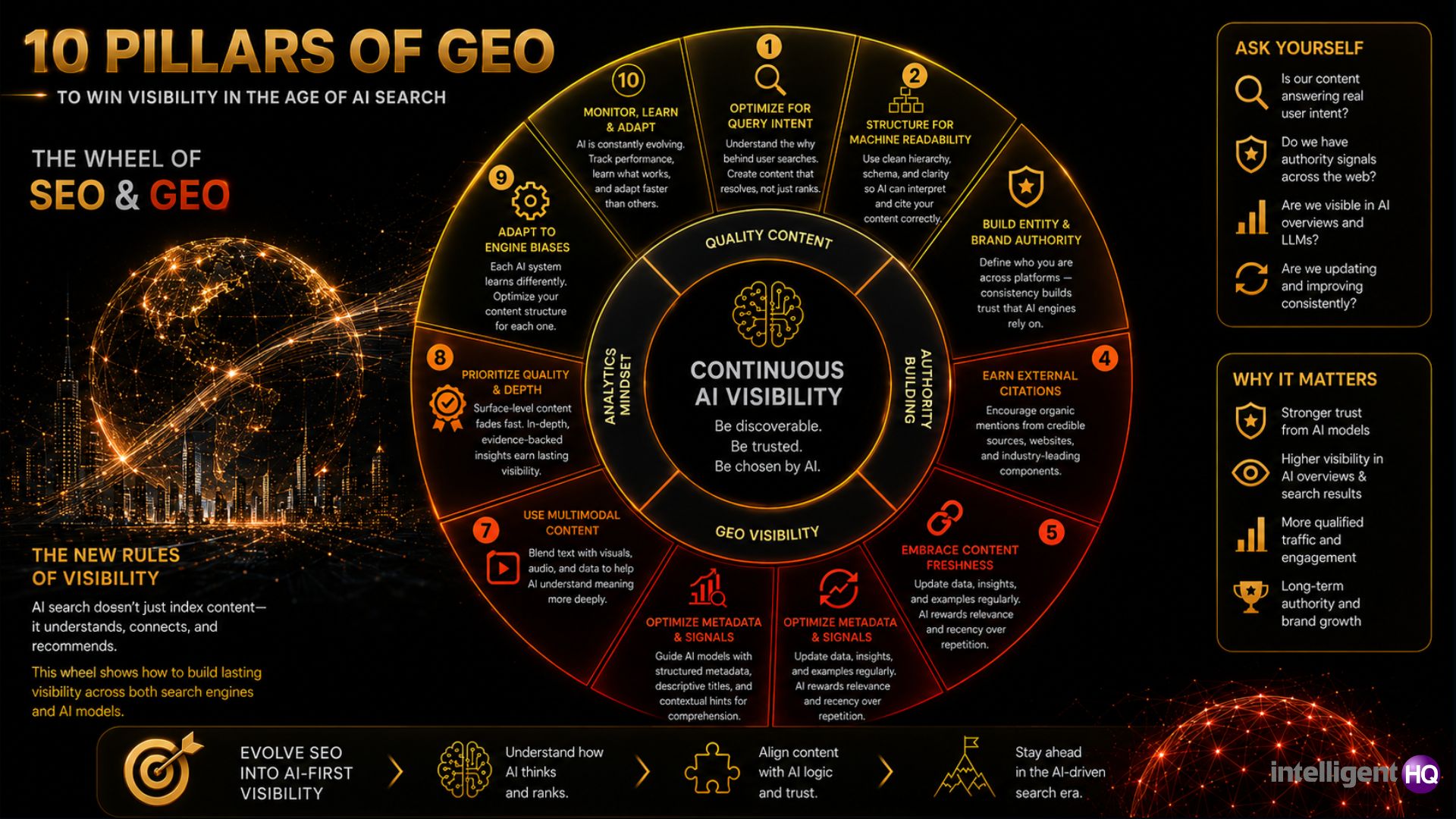
Is ‘Generative Engine Optimisation’ just a rebrand of SEO, or is there real science behind it?
Most GEO content being sold right now is anecdote dressed as strategy. But the discipline does have a genuine academic foundation, and it’s worth knowing, because it remains one of the most frequently cited academic studies providing controlled evidence for GEO techniques.
In 2024, researchers from Princeton, Georgia Tech, IIT Delhi, and the Allen Institute for AI published “GEO: Generative Engine Optimisation” at the ACM SIGKDD conference — one of the premier venues in data science and machine learning. They built a benchmark of 10,000 real queries and tested nine distinct content strategies against a system simulating an AI answer engine, then measured which techniques actually moved the needle on citation rates.
Three findings matter to anyone setting content strategy:
- Statistics move the needle hardest. In the study’s controlled experiments, adding statistics was among the strongest techniques, producing gains of up to roughly 37–41% on certain visibility metrics. The result was not a universal increase across every query, engine or measurement method.
- Citing sources is disproportionately powerful for the underdog. In one controlled analysis, the lowest-ranked source among five recorded a 115.1% relative visibility gain after external citations were added. This implies the potential for lower-ranked sources to gain share within a generated answer, but it should not be interpreted as a guaranteed 115% increase in real-world AI citations.
- Generic “best practice” content still loses. A practical inference is that mechanical optimisation alone is unlikely to create durable authority. The paper shows that individual treatments can improve measured visibility, but it does not establish that a GEO checklist can substitute for original expertise.
That last point is the one executives skip past because it’s inconvenient. GEO is not a checklist you hand to a junior writer. It rewards genuine expertise, expressed with unusual specificity — which means the fastest way to lose this game is to ask an AI to write the content that’s supposed to convince other AIs you’re an authority.
Which platform do we even optimise for — Google, ChatGPT, Perplexity?
Wrong question. You’re not optimising for a platform, but for the three overlapping systems that require genuinely different work:
| SEO | AEO | GEO | |
| What it optimizes for | Ranking in blue-link results | Being the source for a direct, extractable answer (featured snippets, voice, FAQ modules) | Being cited inside an AI-generated, synthesized response |
| Core mechanism | Keywords, backlinks, technical crawlability | Clear, structured, unambiguous answers to specific questions | Statistical density, sourcing, entity authority, structural clarity for retrieval |
| The executive mistake | Treating this as the whole game | Ignoring it as “just FAQ content” | Assuming it’s the same skill set as SEO, badged differently |
They are not sequential phases of maturity — “first you do SEO, then AEO, then GEO.” They are three simultaneous surfaces competing for the same underlying asset: content that is unambiguous, well-sourced, and structured so a machine can extract meaning without guessing. Build for that underlying asset, and all three systems reward you.
How do we even measure this? Our dashboards are all click-based.
This should worry a CFO more than any other question here, because it exposes a structural blind spot in most marketing measurement stacks: the tools you’re already paying for cannot see the thing that now matters most.
Rand Fishkin’s own research team has been candid about this: individual AI responses are inconsistent from one query to the next, but brand frequency can still be measured statistically across large samples — even though attribution as marketers have always understood it is breaking down. There is no clean, deterministic “conversion path” anymore. There is statistical presence, or the lack of it.
The practical response is to add a new layer to measurement: track share of AI voice the same way brand teams have long tracked share of media voice. Sample your target queries regularly across ChatGPT, Perplexity, Gemini, and Google’s AI Overviews. Measure whether you’re mentioned, how you’re framed, and whether competitors are cited instead. That’s not a vanity metric — Seer’s 35–91% performance lift for cited brands says it converts to something the CFO already cares about.
The Framework
Knowing that citation now matters more than clicks answers why you need to act. It doesn’t tell you what to build. This is where most GEO advice falls apart — it hands you a tactic list (add schema, add FAQs, add stats) with no sense of sequence, so teams execute tactics in the wrong order and can’t explain why nothing moved.
The useful corrective is a single line: GEO isn’t about more content. It’s about layered structures AI can cite.
More content was the SEO-era instinct — more pages, more keywords, more surface area to rank for. It doesn’t work the same way anymore, because a generative engine isn’t scanning your site for the most relevant page to send a user to.
When an AI system performs live retrieval, it may synthesise passages from several sources rather than selecting one page to send the user to. That requires structure at every layer of the organisation, not just on the page. The three layers, together, building the foundation the next one depends on. Skip a layer, and the ones above it collapse no matter how much content you produce.
Layer 1: GEO authority — Who does the AI think you are?
This is the layer executives most consistently underinvest in, because it doesn’t look like marketing work. It looks like reputation work — and that’s exactly the point.
Before an AI system decides to cite you, it has to have already formed a model of what kind of source you are. That model is built from signals scattered across the web, not from your website alone: your topic authority (do you consistently show up as a source on this subject, or once, opportunistically?), your brand mentions across independent publications, your UGC exposure on forums and review sites, and — increasingly non-negotiably — your presence on Wikipedia.
Wikipedia and Wikidata can be influential entity sources because their content is widely reused in search, knowledge-graph and AI ecosystems. A well-sourced Wikipedia article may strengthen entity clarity, but only organisations meeting Wikipedia’s independent notability requirements should have one, and neither Wikipedia nor Wikidata guarantees inclusion in AI answers.
More broadly, brands should ensure that independently published information about their identity, leadership, products and expertise is accurate and consistent across reputable sources.
Quote usage and stat inclusion belong in this layer too — this is where the Princeton study’s numbers from Part One become directly actionable rather than academic. The 115% citation lift for lower-ranked content matters most here, in Strategy, not in the execution layer: it means Layer 1 isn’t reserved for market leaders with the biggest domains. A well-sourced, statistically dense piece of content from a smaller brand has a mathematically real chance of outperforming a generic page from a bigger one — because generative engines are scoring credibility signals, not domain authority alone.
The layer-1 test: if you fed an AI model nothing but third-party sources about your company — no owned content — would it come away describing you accurately, and as an authority? If the honest answer is “probably not,” no amount of on-page optimisation in Layer 3 will fix it.

Layer 2: GEO Plan — Turning authority into retrievable structure
This is the operational layer, and it’s where most content calendars still look exactly like they did in 2021: topic clusters, a content freshness cadence, a channel map. Those fundamentals didn’t disappear — they got a new, harder job.
Broad topical coverage may help establish consistent expertise, although citation systems do not publicly disclose a universal “topic cluster” requirement. For time-sensitive subjects, regularly reviewed and accurately dated content is more likely to remain useful than stale material; evergreen sources should be updated only when the underlying information changes.
The two items in this layer executives tend to wave through without scrutiny are AI tracking and platform mix — the operational answer to the measurement question from Part One. This is where “share of AI voice” gets built as infrastructure rather than left as a good intention. And platform mix is where the SEO/AEO/GEO table above stops being theoretical: ChatGPT, Perplexity, Google’s AI Overviews, and Copilot don’t retrieve or weight sources identically. Perplexity aggregates and footnotes multiple sources per answer; ChatGPT Search has used third-party search infrastructure, including Bing, alongside OpenAI’s own retrieval technology and OAI-SearchBot. Its exact source-selection system is not fully public.
A “platform mix” strategy that treats these as one undifferentiated channel called “AI search” will misallocate budget toward whichever platform is loudest in the trade press, not the one your customers actually query.
SSR setup appears in this layer for a reason that surprises most non-technical executives: it’s arguably the single highest-leverage, most invisible line item in the entire framework, and it sits in “Plan” because it’s a decision, not a content task. More on why below.
Layer 3: GEO Execution — Where good strategy quietly dies
Layer 3 is the technical and on-page layer: schema markup, clean code, semantic depth, rich media, author credibility, snippets readiness, link hygiene. This is the layer most agencies sell as “GEO services”, and it’s genuinely necessary — but it is also the layer most likely to be built on a foundation the first two layers never secured, which is why so much of this work underperforms.
Schema remains useful for conventional search engines, rich-result eligibility and machine-readable entity description. Google’s AI features may benefit indirectly because they use Google’s search infrastructure. However, there is currently limited evidence that non-Google AI answer engines directly consume page-level JSON-LD when selecting citations. Schema should therefore be treated as sound technical SEO and data hygiene—not as a universal AI-citation switch.
Which brings us to clean code. Vercel’s crawler analysis and subsequent field tests indicate that some AI crawlers do not execute client-side JavaScript. Consequently, pages whose meaningful content is absent from the initial HTML may be unavailable to those crawlers, even when Google can render and rank them. Teams should test their own pages rather than assume universal invisibility, and should ensure that essential content is delivered in crawlable HTML through server rendering, static generation or an equivalent approach.
Named authors, relevant credentials and transparent sourcing help readers assess accountability and may also make attribution clearer to retrieval systems. However, no major AI platform has publicly confirmed a universal authorship score.
Why the layering matters more than any single tactic
Here’s the trap I’d want a board to understand before approving next quarter’s “AI SEO” line item: almost every tactic in this framework works, and almost every tactic fails, depending entirely on whether the layer beneath it is already in place.
Perfect schema markup on a page nobody trusts as an authority does nothing. Flawless topic clusters on a site that’s invisible to AI crawlers because of client-side rendering do nothing. A gorgeous Wikipedia-adjacent brand reputation, undermined by a site the AI literally cannot read, does nothing. The layers are mutually reinforcing. Weakness in one can limit the returns from the others, although organisations do not need to complete them in a rigid sequence.
That’s the real argument for treating GEO as a genuine cross-functional discipline rather than a content-team task: Layer 1 is largely Signal or Authority. Layer 2 is largely content Structure and Planning. Layer 3 is largely Surface and Execution work.
Most organisations have staffed exactly one of those three teams to “own AI visibility”. That’s the gap the framework exposes, and it’s the reason so many companies who’ve genuinely invested in GEO content still can’t explain why they’re not showing up in AI answers — they solved for the layer they had a team for, and left the other two structurally untouched.
Authority → Retrieval → Presentation, in that order.
Where to actually start, this quarter
Not with a rewrite of every page on the site. Start with the asset class the research says matters most and is cheapest to fix, working the layers in order:
- Run the Layer-1 test first. Audit what independent, third-party sources currently say about your company — press, Wikipedia, forums, review sites. If an AI model would come away with an inaccurate or thin picture of who you are, no amount of content production fixes that starting point.
- Audit for statistical and citation density, not keyword density. The Princeton study’s single strongest lever — a 41% lift — came from something most content teams have deprioritized for a decade: hard numbers, sourced claims, and named studies, not more prose around a target keyword.
- Check whether AI crawlers can actually read your site. Before investing further in Layer 3 polish, verify your highest-value pages render in raw HTML, not just after JavaScript executes. This is a five-minute technical check that can invalidate months of content work if skipped.
- Instrument AI visibility tracking now, even imperfectly, so you have a baseline before your competitors do. The organisations that will look smart in eighteen months are the ones who started measuring the share of AI voice while everyone else was still arguing about whether it mattered.
- Protect your lower-ranked, high-expertise content. The 115% visibility lift for position-five content citing external sources is the single most actionable, budget-friendly finding in the research. You likely already have this content. It’s probably buried on page two of your own site, uncited and un-sourced, quietly ineligible for the one algorithmic system that would reward it most.
The bottom line
Gartner’s 25% prediction became a punchline because the headline number didn’t land exactly on schedule. But punchlines are a bad reason to ignore a real trend. The number that actually moved — zero-click search climbing from roughly 50% to 68% in seven years — is the one that should be driving budget conversations, and it barely makes the agenda in most quarterly reviews I sit in on.
The organisations still measuring success purely in sessions and click-through rate are, in effect, still counting the horses while the industry switches to cars. The click isn’t coming back. And the tactics alone won’t save you either — schema tags and FAQ blocks bolted onto a site with no underlying authority, or one AI crawlers can’t even read, are decorations on a foundation that isn’t there.
The question worth taking into your next board meeting isn’t whether AI search is a fad. It’s whether your brand is one of the ones the machines have learned to trust enough to say out loud — and whether you’ve built the strategy, the plan, and the execution, in that order, to earn it.
Sources referenced: Gartner (2024 press release, “Search Engine Volume Will Drop 25% by 2026”); Aggarwal, Murahari, Rajpurohit, Kalyan, Narasimhan & Deshpande, “GEO: Generative Engine Optimization,” ACM SIGKDD/KDD 2024, Princeton University, Georgia Tech, IIT Delhi & Allen Institute for AI; SparkToro / Rand Fishkin, Zero-Click Search research (2019–2026), using Datos and Similarweb clickstream data; Pew Research Center, AI Overview user behavior audit (2025); Seer Interactive, AI Overview citation and conversion study (November 2025); Vercel, “The Rise of the AI Crawler” (server-log research on AI crawler JavaScript behavior); Glenn Gabe (GSQi), case study on client-side rendering and AI Search visibility; BrightEdge research on schema markup and AI Overview citation rates; Otterly.ai, experimental test of schema markup retrieval by Claude, ChatGPT, and Perplexity; research on Wikipedia/Wikidata’s role in AI training weighting and knowledge-graph corroboration.