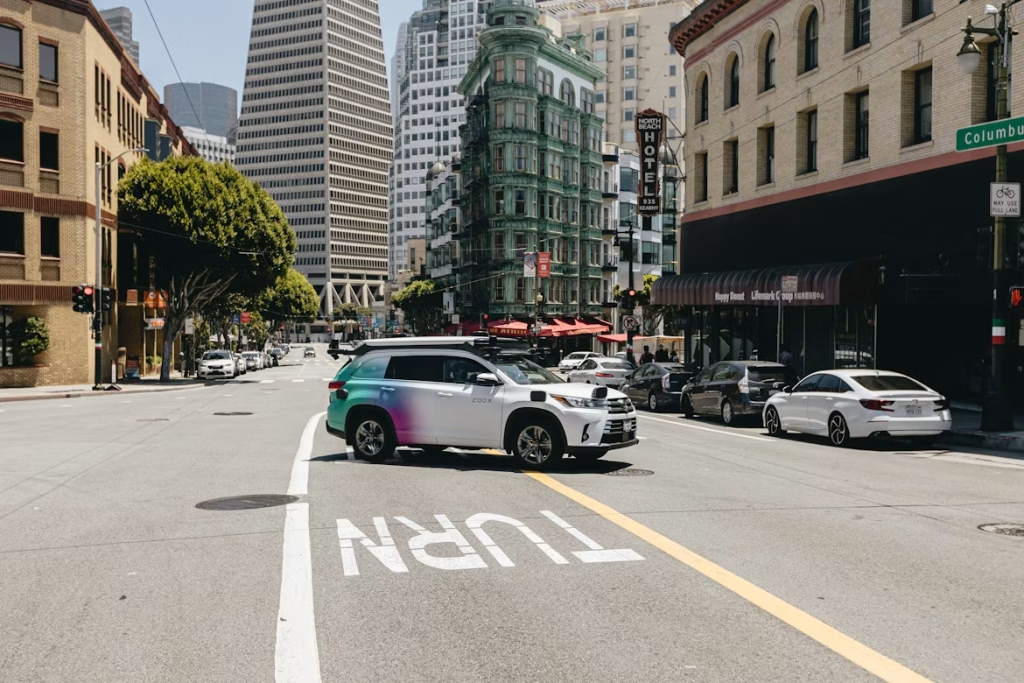
The promise of autonomous vehicles (AVs) has long been about safety and efficiency. Cars that can think, react, and even make decisions faster than humans were supposed to revolutionize transportation.
Globally, the autonomous vehicle market is worth $68.09 billion as of 2024. As more AVs are produced and sold, we’re likely to see them operate more frequently on the roads. And as these machines share the road with human drivers, we must ask who would be responsible if an accident happens involving an AV.
As technology continues to blur the line between machine and human error, the legal and moral questions surrounding liability become more complex than ever.
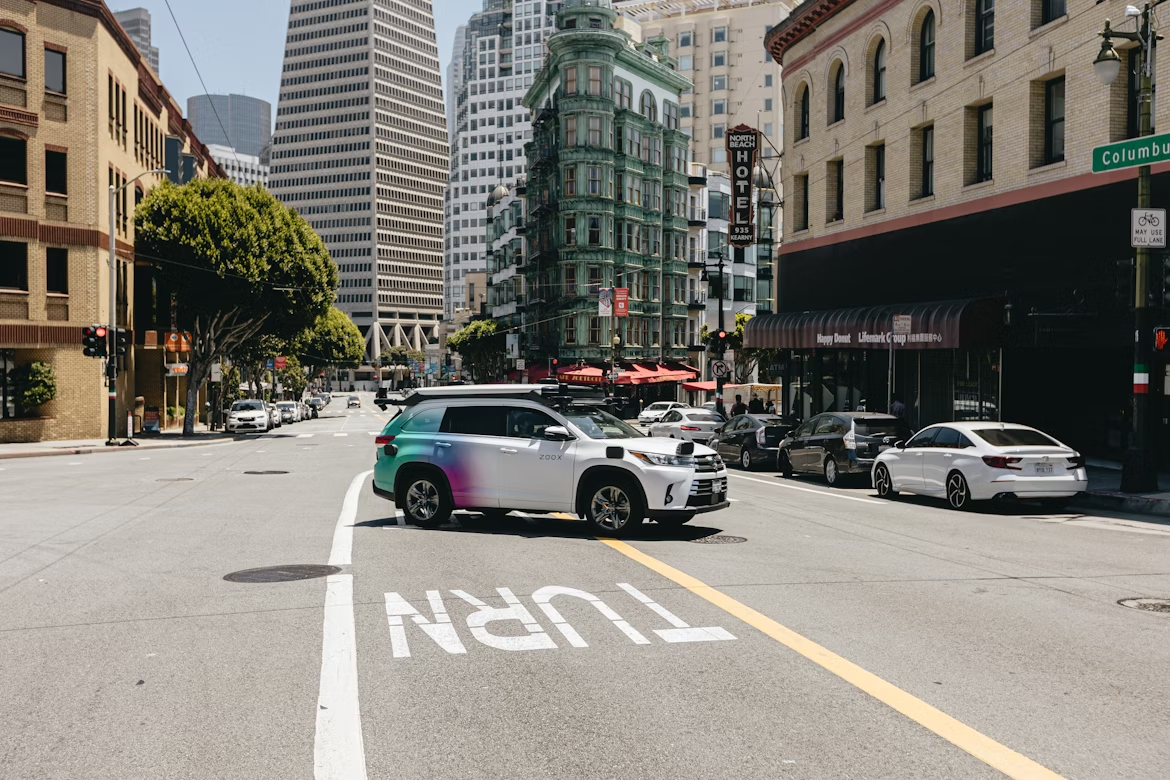
When Machines Make Mistakes
Autonomous vehicles rely on a combination of cameras, radar, sensors, and artificial intelligence to navigate roads. In theory, these systems are less prone to distraction or fatigue than human drivers.
However, even the most advanced systems cannot eliminate all risks. There have already been accidents involving self-driving cars or AVs. Between July 2021 and December 15, 2023, the US saw 439 crashes involving AVs. While four of those crashes resulted in serious injuries, none resulted in a fatality.
Unlike traditional crashes, identifying fault in these cases is not straightforward. Was it the car manufacturer that failed to program the system properly? The software developer who missed a coding error? The human sitting behind the wheel, who may have been expected to intervene?
These questions expose the gray area of accountability in an increasingly automated world.
What Happens When Human Oversight Fails?
Many self-driving vehicles still require some form of human supervision. Drivers are often expected to take over in certain situations, such as poor weather or complex traffic conditions.
But human behavior being what it is, people tend to relax when technology appears to take charge. When something goes wrong, reactions can come too late.
If a driver fails to take control in time, are they negligent? Or is it unreasonable to expect them to be alert while the car drives itself?
The balance between human and machine responsibility remains one of the biggest challenges for lawmakers and insurers.
What Does the Law Say About AV Crashes
In most places, traffic laws were written for human drivers, not for autonomous vehicles. This creates confusion in determining fault when AI is behind the wheel. Some states have begun to adapt, but progress is uneven.
Florida offers a relevant example through its dangerous instrumentality doctrine. Under the dangerous instrumentality doctrine, owners of vehicles are legally responsible for damages caused by their negligent operation, even if someone else was driving. This principle stems from the idea that a car, being a powerful machine, can cause great harm if mishandled.
By assigning liability to the owner, the state ensures victims are compensated regardless of who was actually operating the vehicle.
According to Lesser, Landy, Smith & Siegel, PLLC, in Florida, the doctrine has even been extended to cover negligent entrustment. That means lending your car to someone unfit to drive can make you liable for resulting accidents. Applying this to autonomous vehicles raises difficult questions.
If a car manufacturer allows a flawed software update, could that be seen as negligent entrustment under Florida law? While courts have yet to settle this matter, such legal principles are likely to play a central role in defining future accountability.
Can We Really Blame the Machine?
When a human driver makes an error, we instinctively look for intent or carelessness. Machines, however, lack intent. Their “decisions” are the result of algorithms and data interpretation.
So, if an autonomous car misjudges a pedestrian’s movement or fails to detect a cyclist, it is not a moral lapse. It is a design or programming failure. This distinction matters in courtrooms. Legal experts often debate whether fault should rest on the manufacturer, the software developer, or even the car’s owner.
If a vehicle’s sensors were dirty or not maintained properly, for instance, partial blame might still fall on the human user. On the other hand, if the accident stemmed from flawed machine learning models, the manufacturer may bear responsibility.
The Role of Manufacturers and Software Developers
Car companies and software engineers play enormous roles in how autonomous systems behave. From calibration to code testing, every stage influences how well a vehicle performs on the road.
Some automakers have tried to protect themselves by classifying their vehicles as “driver-assist” rather than fully autonomous. This classification keeps legal responsibility primarily on the human driver. However, as technology evolves, such distinctions may no longer hold. At some point, cars will truly drive themselves, leaving little room for human blame.
Why the Insurance Industry is Watching Closely
The global car insurance market, as of 2023, is worth $730.1 million. And insurance companies have always operated on the principle of human error. Policies are priced based on how people drive, where they live, and how often accidents happen.
Autonomous cars change this model entirely. If the machine is doing the driving, should the insurance cover the owner, the manufacturer, or both?
Some insurers are experimenting with hybrid models that include product liability coverage for manufacturers and personal coverage for vehicle owners. This shift acknowledges that traditional auto insurance cannot fully capture the complexity of shared responsibility between humans and machines.
What Lies Ahead for Accountability?
By 2030, AVs in the US are expected to generate $7 billion in annual revenue, so you can’t really get rid of these cars. But the question of accountability is still there. As technology continues to outpace legislation, society must redefine what it means to be at fault.
Traditional ideas of negligence and intent will evolve to include algorithmic failure and design flaws. Policymakers, manufacturers, and insurers will need to work together to create fair standards that protect both consumers and innovation.
Autonomous vehicles are not immune to human error; they are built and programmed by humans, after all. But as their presence grows, we must learn to balance trust in technology with the accountability it demands. Until the law fully adapts, each accident involving a self-driving car will be a test case for the future of responsibility on the road.

Shikha Negi is a Content Writer at ztudium with expertise in writing and proofreading content. Having created more than 500 articles encompassing a diverse range of educational topics, from breaking news to in-depth analysis and long-form content, Shikha has a deep understanding of emerging trends in business, technology (including AI, blockchain, and the metaverse), and societal shifts, As the author at Sarvgyan News, Shikha has demonstrated expertise in crafting engaging and informative content tailored for various audiences, including students, educators, and professionals.