
It’s easy to get caught up in the jargon surrounding blockchain, but at its core, it’s a pretty straightforward idea: a shared digital record that’s hard to change. Think of it like a notebook that’s copied and given to everyone involved. When something new happens, it’s written down in a new entry, and once it’s in there, it’s almost impossible to erase. This built-in security and openness are what make it so interesting. It’s not just about digital money; it’s about how we can trust information and transactions in a digital world.
Key Takeaways
- Blockchain technology fundamentally works by creating a distributed, immutable ledger of transactions, making data secure and transparent.
- Beyond cryptocurrencies, blockchain is streamlining supply chains, improving digital identity management, and making financial transactions more efficient.
- The core mechanics involve blocks of data linked in a chain, secured by network consensus and digital signatures, making them tamper-proof.
- Industries are transforming through blockchain, from securing healthcare data and enabling new financial models to potentially making voting systems more reliable.
- Adopting blockchain offers tangible benefits like reduced fraud, increased operational efficiency, and building greater trust in online interactions.
Understanding The Core Purpose Of Blockchain Technology
What Blockchain Technology Is At Its Heart
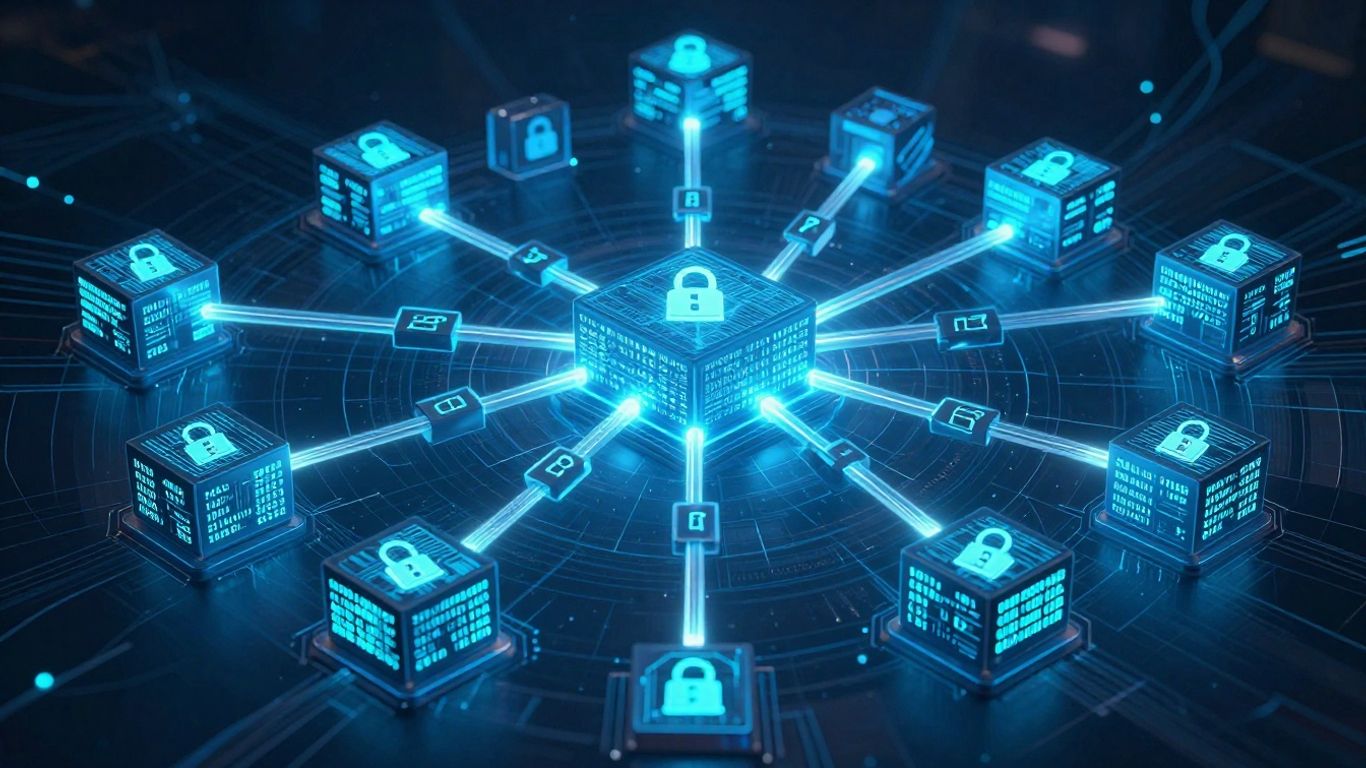
At its core, blockchain technology is a system for recording information in a way that makes it difficult or impossible to change, hack, or cheat the system. Think of it as a digital ledger, but instead of being kept in one place by one person or company, it’s copied and spread across many computers. This shared nature is what makes it so different from traditional databases. Every new piece of information, like a transaction, is added as a ‘block’ to a growing ‘chain’ of data. Once a block is added, it’s linked to the previous one using cryptography, creating a secure and chronological record.
Decentralization: Shifting Power From Central Authorities
One of the most significant aspects of blockchain is its decentralized nature. In most systems we use daily, a central authority—like a bank, a government, or a company—controls the data. This means they have the power to alter records, decide who has access, and can be a single point of failure. Blockchain flips this model. By distributing the ledger across a network of computers (nodes), no single entity has complete control. This distribution means that for any record to be changed, a majority of the network participants must agree, making it far more resistant to censorship and manipulation. It’s like having thousands of notaries verifying every entry, rather than just one.
The Role Of Transparency And Security In Blockchain
Transparency and security are built into blockchain’s design. Because the ledger is distributed, anyone on the network can typically view the transactions (though the identities of participants can be kept private). This open visibility means that suspicious activity is harder to hide. Furthermore, the cryptographic linking of blocks makes the chain incredibly secure. If someone tries to tamper with a block, the cryptographic link to the next block breaks, immediately signaling that something is wrong to the rest of the network. This combination of shared visibility and strong cryptographic protection builds a high level of trust without needing a central intermediary.
The fundamental idea is to create a system where trust isn’t placed in a single entity, but in the network itself through shared, verifiable records. This shift is what opens up so many possibilities beyond just digital money.
Real-World Applications Beyond Cryptocurrencies
When most people hear about blockchain, their minds often jump straight to Bitcoin or other digital currencies. And sure, that’s where it first made a big splash. But honestly, that’s just the tip of the iceberg. The real magic of blockchain technology is how it’s quietly reshaping industries in ways that have nothing to do with buying or selling coins.
Streamlining Supply Chains With Verifiable Records
Think about the journey a product takes, from raw materials to your hands. It’s often a long and complicated path, involving many different companies and lots of paperwork. Blockchain offers a way to create a clear, unchangeable record of every step. This means you can track exactly where something came from, how it was handled, and if it’s the real deal. This is super helpful for making sure food is safe, luxury goods are authentic, and medicines haven’t been tampered with.
- Tracking Origin: Knowing precisely where raw materials or finished goods originate.
- Authenticity Verification: Confirming that a product is genuine and not a counterfeit.
- Process Monitoring: Recording every step, from manufacturing to shipping, for accountability.
This ability to create a shared, trustworthy history for goods is a game-changer for businesses that rely on complex logistics and consumer trust.
Enhancing Digital Identity Management
Our online lives are growing, and so is the need to manage our digital identities securely. Blockchain can help us take back control. Instead of relying on multiple companies to store our personal information, blockchain allows for a decentralized digital ID. This means you can decide who sees your data and when, making it much harder for your identity to be stolen or misused. It’s like having a secure digital passport that you control.
Revolutionizing Financial Transactions
Beyond cryptocurrencies, blockchain is making waves in traditional finance. It can speed up cross-border payments, cutting down on fees and delays. Imagine sending money internationally as quickly and cheaply as sending an email. Also, new financial products are being developed using blockchain, making them more accessible and less expensive to create. This technology is helping to remove middlemen, which can lead to more efficient and cost-effective financial services for everyone.
The Mechanics Of Blockchain: How It Works
It’s easy to get caught up in the hype surrounding blockchain, but understanding its core mechanics reveals a surprisingly straightforward yet powerful system. At its heart, blockchain is a digital ledger, but not just any ledger. Think of it as a shared notebook that’s copied and distributed across a vast network of computers. This distributed nature is key to its operation and security.
Blocks, Chains, And Distributed Ledgers
Imagine a digital record of transactions. Instead of being stored in one central place, this information is bundled into ‘blocks’. Each block contains a batch of recent transactions, a timestamp, and a unique digital fingerprint (called a hash) of the previous block. This fingerprint links the blocks together chronologically, forming a ‘chain’. When a new block is created and validated, it’s added to the end of this chain. Because this entire chain is duplicated and spread across many computers (nodes) in the network, it becomes a distributed ledger. This means no single entity has complete control, and any attempt to alter a block would require changing all subsequent blocks on a majority of the network’s copies – a nearly impossible feat.
The Importance Of Network Consensus
So, how does a new block get added to the chain? This is where network consensus comes in. Before a new block of transactions can be validated and added, the majority of the computers (nodes) in the network must agree that the transactions within it are legitimate. Different blockchains use various consensus mechanisms, such as Proof-of-Work (PoW) or Proof-of-Stake (PoS), to achieve this agreement. This process prevents fraudulent transactions from being added and ensures the integrity of the ledger. It’s like a group of people all agreeing on the contents of a shared document before it’s finalized.
Immutability And Digital Signatures
Once a block is added to the chain and validated through consensus, it becomes incredibly difficult to change or delete. This characteristic is known as immutability. The cryptographic linking of blocks, combined with the distributed nature of the ledger, makes tampering with past records virtually impossible without the network noticing. Furthermore, each transaction within a block is typically secured with a digital signature. This signature acts like a unique seal, verifying the origin of the transaction and confirming that it hasn’t been altered since it was created. It provides a clear audit trail and establishes authenticity.
The core innovation of blockchain lies in its ability to create a shared, trustworthy record without relying on a central authority. This distributed and cryptographically secured system builds confidence through transparency and verifiable data.
Here’s a simplified look at the process:
- A transaction is initiated.
- The transaction is broadcast to the network of nodes.
- Nodes validate the transaction using predefined rules.
- Validated transactions are bundled into a new block.
- The network reaches a consensus on the validity of the new block.
- The new block is added to the existing chain, becoming immutable.
- The updated ledger is distributed across all nodes.
Transforming Industries Through Blockchain
Improving Healthcare and Pharmaceutical Supply Chains
Blockchain is making significant waves in healthcare, moving beyond just digital records. Think about the journey of a vaccine or a critical medication. Ensuring its integrity from the manufacturing plant to the patient is paramount. Blockchain provides a transparent and tamper-proof ledger that can track every step. This means we can verify the origin, temperature control, and handling of sensitive medical supplies. During the COVID-19 pandemic, for instance, blockchain helped hospitals meticulously track vaccine storage and distribution, preventing logistical snags and bolstering confidence in the rollout. It’s a powerful tool for preventing counterfeit drugs from entering the supply chain, too.
- Verifying drug authenticity: Each step of a drug’s journey can be recorded, making it hard for fakes to slip through.
- Tracking temperature-sensitive items: Essential for vaccines and other biologicals, ensuring they remain viable.
- Streamlining recalls: Quickly identifying and isolating affected batches if a problem arises.
The ability to create an unalterable history for pharmaceuticals means greater patient safety and less waste from spoiled or compromised products.
Enabling New Models in Finance and Digital Assets
Beyond cryptocurrencies, blockchain is reshaping financial services. It’s enabling faster, cheaper cross-border payments by cutting out intermediaries that often slow things down and add fees. Imagine sending money internationally as easily as sending an email. Furthermore, blockchain is the backbone for new financial products and digital assets. Non-Fungible Tokens (NFTs), for example, are unique digital certificates of ownership recorded on a blockchain. People are using them to trade digital art, collectibles, and even virtual real estate, creating entirely new marketplaces and economies.
- Faster Payments: Reducing settlement times for transactions, especially across borders.
- Lower Fees: Eliminating some of the middlemen in financial transactions.
- Digital Ownership: Creating verifiable ownership for digital goods and assets.
Securing Voting Systems and Governance
When we talk about trust in our institutions, voting is a big one. Blockchain offers a way to create more secure and transparent voting systems. Each vote could be recorded as a transaction on a blockchain, making it auditable and virtually impossible to tamper with after the fact. This could lead to increased public confidence in election results. Beyond elections, blockchain can also be applied to governance by creating transparent and immutable records for decision-making processes, public registries, and the management of public funds. This technology has the potential to bring a new level of accountability to how societies are run.
- Tamper-proof records: Votes are recorded securely and cannot be altered.
- Increased transparency: The process can be audited by authorized parties.
- Enhanced security: Protecting against fraud and manipulation.
The Tangible Benefits Of Blockchain Adoption

While the technical underpinnings of blockchain can seem complex, its real-world advantages are becoming increasingly clear across various sectors. The technology offers practical solutions that address long-standing issues related to trust, security, and efficiency in digital interactions.
Reducing Fraud And Increasing Efficiency
One of the most significant advantages of adopting blockchain technology is its capacity to drastically cut down on fraud and streamline operations. Because transactions are recorded on an immutable, distributed ledger, they are incredibly difficult to alter or falsify after the fact. This inherent security feature means that records are more reliable, reducing the need for extensive manual verification and reconciliation processes that often bog down traditional systems. Think about it: when every step of a transaction is transparently logged and agreed upon by a network, the opportunities for malicious actors to interfere diminish significantly.
- Reduced administrative overhead: Less time spent on verifying data and resolving discrepancies.
- Lower risk of data breaches: Decentralized nature makes it harder for a single point of failure to be exploited.
- Faster transaction settlements: Eliminating intermediaries can speed up the movement of assets and information.
Building Trust In Digital Interactions
Trust is the bedrock of any successful transaction, and in the digital age, establishing that trust can be challenging. Blockchain technology fundamentally changes this dynamic by embedding trust directly into the system. The transparency of the ledger means that all participants can see the same information, and the immutability guarantees that this information hasn’t been tampered with. This shared, verifiable record creates a level of confidence that is often missing in traditional, centralized databases where a single entity holds all the power and information.
The core of blockchain’s trust-building capability lies in its distributed and unchangeable nature. It’s not about trusting a company or an institution; it’s about trusting the code and the network’s consensus mechanism.
Creating New Opportunities For Engagement
Beyond just improving existing processes, blockchain is also paving the way for entirely new models of interaction and value creation. From digital collectibles represented by Non-Fungible Tokens (NFTs) to decentralized finance (DeFi) applications that offer alternative ways to manage assets, blockchain is opening up new avenues for individuals and businesses. These innovations allow for more direct peer-to-peer interactions, potentially cutting out middlemen and creating more equitable systems. This can lead to greater participation and new forms of economic activity that were not previously possible.
The Evolving Landscape Of Blockchain Technology
Smart Contracts and Self-Executing Actions
Smart contracts are a really interesting development in the blockchain world. Think of them as digital agreements that automatically execute when certain conditions are met. No need for lawyers or intermediaries to check if everything’s in order; the contract itself handles it. This can speed things up dramatically, especially for things like insurance claims. Imagine a contract that automatically pays out when a flight is delayed, or when a shipment arrives damaged, based on verified data. It’s about making processes more efficient and removing potential bottlenecks.
The Future of Decentralized Finance
Decentralized Finance, or DeFi, is another area where blockchain is making waves. It aims to recreate traditional financial systems – like lending, borrowing, and trading – without relying on banks or other central institutions. This can lead to more open access to financial services and potentially lower costs for users. New applications are constantly popping up, showing how smart contracts can make creating financial products simpler and more accessible.
Exploring Novel Use Cases Like Space Transactions
We’re even seeing blockchain technology being considered for some pretty out-there applications, like managing transactions between satellites in space. This might sound like science fiction, but it highlights the adaptability of the technology. It shows that the core principles of secure, transparent, and automated record-keeping can be applied to a vast range of complex scenarios. The potential for blockchain to solve problems we haven’t even fully defined yet is immense.
While the technology is still growing, these advancements show a clear direction. We’re moving towards systems that are more automated, more transparent, and less reliant on single points of control. It’s less about the technical details and more about the practical improvements it can bring to how we interact and conduct business.
Looking Ahead: The Evolving Role of Blockchain
So, we’ve taken a good look at what blockchain technology actually is, moving past the hype to see its real-world uses. It’s not just about digital money anymore; it’s about creating more secure, transparent, and efficient ways to handle information and transactions across many different fields. From making sure your food is traceable to securing digital identities, blockchain is quietly working to solve problems we’ve had for a while. While it’s still a developing technology, the potential for positive change is clear. It’s reshaping how we interact digitally and economically, and it’s likely to become even more integrated into our lives in the years to come.
Frequently Asked Questions
What is blockchain at its simplest?
Imagine a digital notebook that many people share. Every time something new happens, like a sale or a record update, it’s written on a new page, called a ‘block.’ This block is then added to the end of the notebook, forming a ‘chain’ of pages. Everyone with access gets a copy, and once a page is filled and added, it’s almost impossible to change or erase, making it a very trustworthy way to keep track of things.
Why is blockchain considered secure?
Blockchain is secure because it’s not kept in just one place. Instead, copies of the record (the ‘chain’) are spread across many computers. To change any information, a hacker would need to change it on most of those computers at the exact same time, which is extremely difficult. Plus, each new block is linked to the one before it using special codes, making it easy to spot if someone tries to tamper with the chain.
Is blockchain only used for cryptocurrencies like Bitcoin?
No, while cryptocurrencies were the first big use of blockchain, its uses go much further. Think about tracking where your food comes from, making sure your online identity is safe, or even speeding up money transfers between countries. It’s a tool that can make many different kinds of records more open, secure, and easier to check.
What does ‘decentralized’ mean for blockchain?
Decentralized means that no single person or company is in charge of the blockchain. Instead, the information is shared and managed by many computers in a network. This is different from traditional systems where one central bank or company holds all the power and data. Decentralization helps prevent any one group from controlling or changing the records unfairly.
How does blockchain help build trust?
Blockchain builds trust because its records are open for many to see (transparent) and very hard to change (immutable). When everyone can see the same trustworthy information, and knows it hasn’t been secretly altered, it creates confidence between people and organizations, even if they don’t know each other well.
What are ‘smart contracts’?
Smart contracts are like automatic agreements written in code on the blockchain. They can carry out actions by themselves when certain conditions are met. For example, a smart contract could automatically release payment for a service once proof of completion is recorded on the blockchain, without needing a person to approve it manually.

Peyman Khosravani is a seasoned expert in blockchain, digital transformation, and emerging technologies, with a strong focus on innovation in finance, business, and marketing. With a robust background in blockchain and decentralized finance (DeFi), Peyman has successfully guided global organizations in refining digital strategies and optimizing data-driven decision-making. His work emphasizes leveraging technology for societal impact, focusing on fairness, justice, and transparency. A passionate advocate for the transformative power of digital tools, Peyman’s expertise spans across helping startups and established businesses navigate digital landscapes, drive growth, and stay ahead of industry trends. His insights into analytics and communication empower companies to effectively connect with customers and harness data to fuel their success in an ever-evolving digital world.