
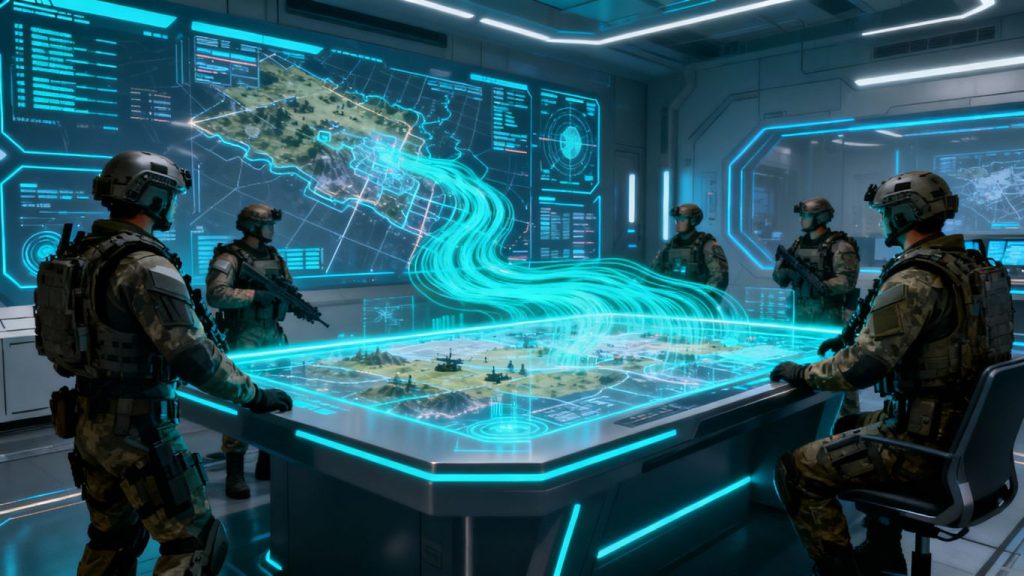
The War Department has significantly narrowed its technology development focus to six key areas, aiming to accelerate the delivery of advanced capabilities to American warfighters. This strategic shift is designed to ensure the U.S. military maintains its technological edge and can rapidly respond to evolving global threats.
Key Takeaways
- The War Department has reduced its critical technology development areas from 14 to six.
- The new focus areas are intended to deliver the "greatest impact, the fastest results and the most decisive advantage on the battlefield."
- This initiative aligns with President Trump’s AI Action Plan and aims to ensure American technological superiority.
Strategic Focus on Six Imperatives
Undersecretary of War for Research and Engineering Emil Michael announced the consolidation of technology development efforts into six critical areas. This move is a direct response to the rapid pace of technological advancement by adversaries, with the goal of ensuring warfighters have immediate access to cutting-edge tools. "Our adversaries are moving fast, but we will move faster," stated Michael. "The warfighter is not asking for results tomorrow; they need them today. These six critical technology areas are not just priorities; they are imperatives."
The six prioritized technology areas are:
- Applied Artificial Intelligence (AAI)
- Biomanufacturing
- Contested Logistics Technology
- Quantum Battlefield Information Dominance (Q-BID)
- Scaled Directed Energy (SCADE)
- Scaled Hypersonics (SHY)
Driving Innovation and Lethality
Secretary of War Pete Hegseth emphasized that this focused approach will provide a distinct battlefield advantage and secure America’s future technological dominance. "Our nation’s military has always been the tip of the spear," Hegseth remarked. "Undersecretary Emil Michael’s six critical technology areas will ensure that our warriors never enter a fair fight and have the best systems in their hands for maximum lethality."
Applied AI is expected to fundamentally transform the department, from enterprise operations to intelligence synthesis and warfighting, aligning with President Donald J. Trump’s "Winning the Race: America’s AI Action Plan." Biomanufacturing will leverage living systems to produce critical materials and capabilities at scale, enhancing resilience and addressing supply chain vulnerabilities. Contested logistics technology aims to enable operations and resupply in austere environments.
Furthermore, the focus on scaled directed energy will accelerate the development and deployment of high-energy lasers and high-power microwave systems, offering low-cost-per-shot responses. Similarly, scaled hypersonics will concentrate on increasing production, reducing costs, and fielding these advanced weapons systems more broadly across the force. These initiatives are designed to deliver actionable, tangible solutions to current warfighter challenges, emphasizing rapid deployment rather than long-term development cycles.
Sources
- War Department Narrows Technology Development Focus to Half Dozen Areas > U.S. Department of War > Defense
Department News, U.S. Department of War (.gov). - Pentagon pares down list of critical emerging technology areas, DefenseScoop.

Founder Dinis Guarda
IntelligentHQ Your New Business Network.
IntelligentHQ is a Business network and an expert source for finance, capital markets and intelligence for thousands of global business professionals, startups, and companies.
We exist at the point of intersection between technology, social media, finance and innovation.
IntelligentHQ leverages innovation and scale of social digital technology, analytics, news, and distribution to create an unparalleled, full digital medium and social business networks spectrum.
IntelligentHQ is working hard, to become a trusted, and indispensable source of business news and analytics, within financial services and its associated supply chains and ecosystems










