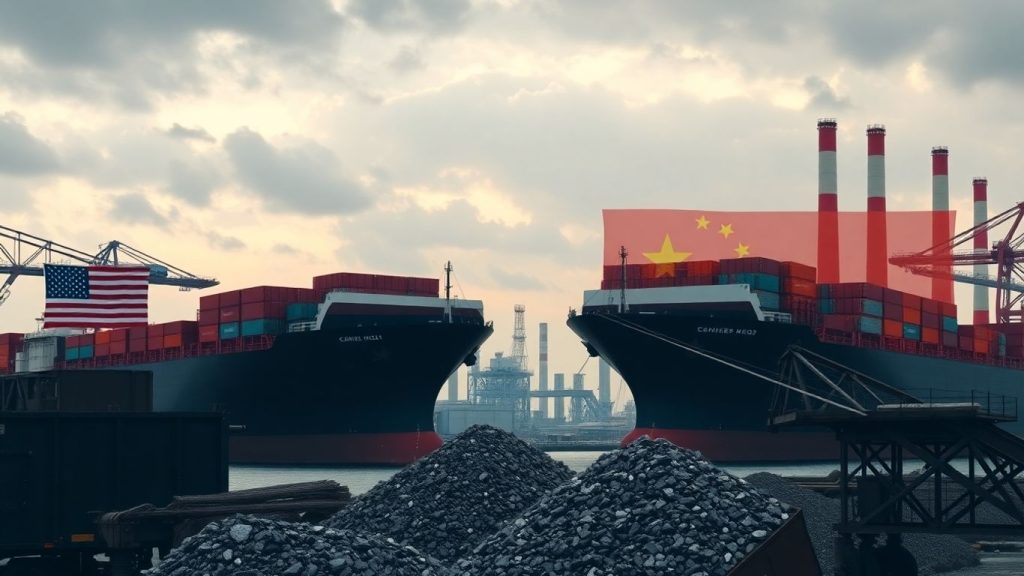
The United States has unveiled tighter restrictions on Chinese technology firms, just as China announced sweeping new export controls on rare earth elements and critical tech. These simultaneous moves escalate the ongoing technological and economic tensions between the world’s two largest economies, with significant ramifications for global industries.
Key Takeaways
- US expands tech restrictions targeting subsidiaries of major Chinese firms.
- China extends strict export controls on rare earths and related technologies.
- Both actions intensify the ongoing US-China trade and tech rivalry.
- Global industries face greater supply chain risk and uncertainty.
US Expands Technology Sanctions
The US Department of Commerce has extended sanctions on Chinese technology companies to include their subsidiaries. This enhanced rule targets subsidiaries at least 50% owned by blacklisted companies such as Huawei, YMTC, and DJI. The move is intended to close loopholes and prevent restricted technologies from being accessed through related entities. Now, tens of thousands of businesses worldwide could face new compliance burdens.
US officials emphasized these changes are necessary to protect national security, especially as concerns linger about critical technologies—semiconductors, advanced AI, robotics—falling into military use. Though the rule isn’t China-specific, a majority of affected firms have connections to China and Russia. Beijing quickly condemned the expanded sanctions, promising unspecified countermeasures to defend Chinese interests.
China Responds With Rare Earths Export Controls
Days after the US move, China announced new and far-reaching export restrictions on rare earth elements and mining technologies. These minerals are vital for everything from smartphones and laptops to fighter jets and electric vehicles. Under the new rules, any company wishing to export goods containing even trace amounts of Chinese-sourced rare earths must obtain special approval from Beijing.
China dominates approximately 70% of global rare earth mining and close to 90% of refining. The new export regime not only affects material supply but also restricts exporting technology for mining, smelting, recycling, and magnet-making—areas crucial to high-tech manufacturing and military hardware. Applications linked to military use are almost certain to be denied.
Implications for Global Supply Chains
The dual moves have rattled manufacturers and policymakers across the globe. US and allied countries heavily depend on China for rare earths, and sudden export controls may trigger shortages and raise costs in electronics, automotive, and defense sectors. Meanwhile, the US actions against Chinese subsidiaries could disrupt tech industry supply chains and slow development in fields like AI and advanced microchips.
Industry analysts predict a surge in efforts to build independent supply chains. Recent investments include hundreds of millions directed toward US-based rare earth mining and magnet-making. Still, experts warn that creating resilient alternatives will take years and require significant policy support.
A New Chapter in US-China Tech Rivalry
These developments underscore a rapidly intensifying contest for technological dominance. Both Washington and Beijing see secure supply chains and tech leadership as matters of national security. As both sides dig in, the path toward stability in global trade and tech sectors remains uncertain—especially with high-level US-China talks on the horizon.
Sources
- US imposes new restrictions on Chinese technology companies, angry China says: Would take …, Times of India.
- China outlines more controls on exports of rare earths and technology, NBC News.
- China outlines more controls on exports of rare earths and technology | Ap, Santa Fe New Mexican.
- China outlines more controls on exports of rare earths and technology, ABC News – Breaking News, Latest News and Videos.
- China outlines more controls on exports of rare earths and technology, FOX40 News.

Founder Dinis Guarda
IntelligentHQ Your New Business Network.
IntelligentHQ is a Business network and an expert source for finance, capital markets and intelligence for thousands of global business professionals, startups, and companies.
We exist at the point of intersection between technology, social media, finance and innovation.
IntelligentHQ leverages innovation and scale of social digital technology, analytics, news, and distribution to create an unparalleled, full digital medium and social business networks spectrum.
IntelligentHQ is working hard, to become a trusted, and indispensable source of business news and analytics, within financial services and its associated supply chains and ecosystems