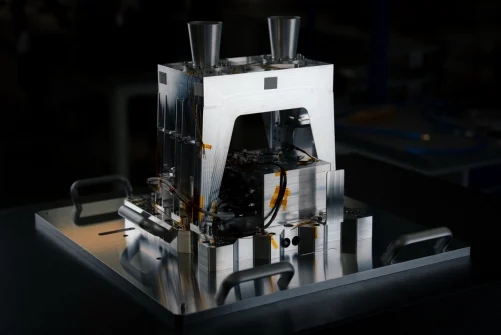
The uniSpark mission has established a fully bidirectional 5G non-terrestrial network link between a ground terminal and an onboard satellite base station, validating a new approach to extending terrestrial telecom networks into space.
French space-connectivity company UNIVITY has announced the successful completion of its first in-orbit technology demonstration, establishing what it describes as the world’s first 5G NTN connection using Time Division Duplexing (TDD) in millimeter-wave frequencies from space.
The milestone was achieved through the company’s uniSpark mission, launched in June 2025. According to UNIVITY, the test created a fully bidirectional 5G connection between a ground terminal and a 5G base station operating onboard a satellite in orbit.
The demonstration combines three technical elements that are usually associated with terrestrial mobile networks: onboard regenerative 5G processing, millimeter-wave spectrum and TDD operation. Together, they form part of UNIVITY’s broader plan to help telecom operators extend their networks beyond the ground without building a completely separate satellite communications stack.
Bringing Terrestrial 5G Architecture Into Orbit
UNIVITY’s approach is based on using technologies derived from terrestrial 5G networks rather than creating a parallel satellite-only ecosystem.
The uniSpark test connected to a standard 5G core network using a protocol similar to terrestrial 5G TDD networks operating in millimeter-wave frequencies. During the test campaign, engineers validated synchronization, registration and communication between the ground terminal and the satellite payload.
Charles Delfieux, Founder and CEO of UNIVITY, described the achievement as a move from concept to proof in orbit.
“With uniSpark, we are moving from technological promise to proof in orbit,” he said. “Space can finally become a natural extension of terrestrial 5G networks.”
Making 5G Work at Orbital Speed
Running a 5G link from orbit introduces challenges that do not exist in a terrestrial mobile network.
The satellite is moving at orbital velocity several hundred kilometres above Earth, meaning the distance between the spacecraft and the ground terminal is constantly changing. UNIVITY says the system had to compensate for propagation delay and the Doppler effect while maintaining precise synchronization in both time and frequency.
TDD adds another layer of complexity because uplink and downlink traffic use the same frequency resource at different moments in time. That requires ground and space equipment to alternate transmission and reception with very tight synchronization.
According to the company, successive test campaigns were used to fine-tune these mechanisms until a complete bidirectional connection was achieved.
Why TDD Matters for Satellite Connectivity
Most conventional satellite communications rely heavily on Frequency Division Duplexing, where uplink and downlink use separate spectrum resources.
UNIVITY is instead focusing on TDD, which shares the same spectrum over time between uplink and downlink. The company says this matters because the millimeter-wave 5G bands already used by terrestrial telecom operators are themselves based on TDD.
That could allow future satellite systems to integrate more naturally with existing mobile networks.
Laurent Bouscary, CTO of UNIVITY, said the demonstration confirms that satellite infrastructure can be built using technologies derived from terrestrial 5G rather than requiring operators to adopt a completely separate technical architecture.
26 GHz Could Open New Spectrum for NTN
Another important part of the test is spectrum.
Satellite communications traditionally depend heavily on Ku and Ka bands, which are becoming increasingly congested. UNIVITY says the uniSpark mission demonstrates the technical feasibility of using the 26 GHz band for high-speed non-terrestrial communications.
If this approach scales, it could give telecom operators access to additional spectrum resources for satellite connectivity while maintaining closer technical alignment with terrestrial 5G.
That is particularly relevant as demand grows for broadband coverage beyond the limits of fibre and conventional mobile infrastructure.
From uniSpark to uniShape and uniSky
uniSpark represents the first phase of a three-stage roadmap.
The next step is uniShape, a programme involving two demonstration satellites designed to validate connectivity performance, system architecture and end-to-end 5G NTN services. The project is being developed with support from CNES under the France 2030 programme.
After that, UNIVITY plans to move toward uniSky, the commercial constellation that would industrialise the architecture and provide space-based connectivity services at scale.
Laurence Clarac, Head of Innovative Concepts and Satcom Applications at CNES, said the uniSpark milestone completes the first phase of UNIVITY’s roadmap and will be followed by a 5G service demonstration project.
Toward a Shared Space Layer for Telecom Operators
UNIVITY’s broader strategy is to build what it describes as a neutral and shared space infrastructure for telecom operators.
The model would allow operators to retain control over their services, spectrum and customer relationships while using satellites as an additional network layer.
That approach differs from vertically integrated satellite broadband models where the satellite provider owns both infrastructure and the customer relationship.
If successful, the architecture could make satellite connectivity feel less like a separate technology category and more like an extension of terrestrial mobile infrastructure.
For telecom operators, that could mean broader coverage without giving up control of the network experience.
About UNIVITY
UNIVITY, formerly Constellation Technologies & Operations, is developing a satellite constellation designed to provide high-speed, low-latency internet access from space as a complement to terrestrial networks.
The company’s model uses Very Low Earth Orbit satellites and spectrum associated with telecom operators’ 5G networks to create a shared connectivity layer.
About CNES
CNES, the French space agency, is responsible for shaping and implementing France’s space policy. It supports satellite development, space-system innovation and new services through national and European programmes.