The rise of pre-trained models reflects a major shift in how companies build AI, instead of training every model from scratch, teams can start from reusable AI foundations and adapt them to business needs. In this article, FPT AI Factory will explore how this shift is reshaping enterprise AI adoption
1. The growing demand for faster AI development
AI adoption is expanding quickly across industries as companies look for better automation, customer support, search, analytics, and decision-making tools. McKinsey’s 2025 global survey reported that 88% of respondents said their organizations use AI regularly in at least one business function. This growth creates pressure for teams to deploy AI faster while keeping cost, reliability, and governance under control.
Building large models from scratch is expensive and time-consuming because it requires massive datasets, specialized engineering skills, and high-performance compute. Stanford AI Index estimates show that frontier model training costs have reached tens or even hundreds of millions of dollars in compute for some leading systems. For many businesses, reusable model foundations are therefore more practical than starting from a blank model.
2. What is a pre-trained model and why has it become so popular?
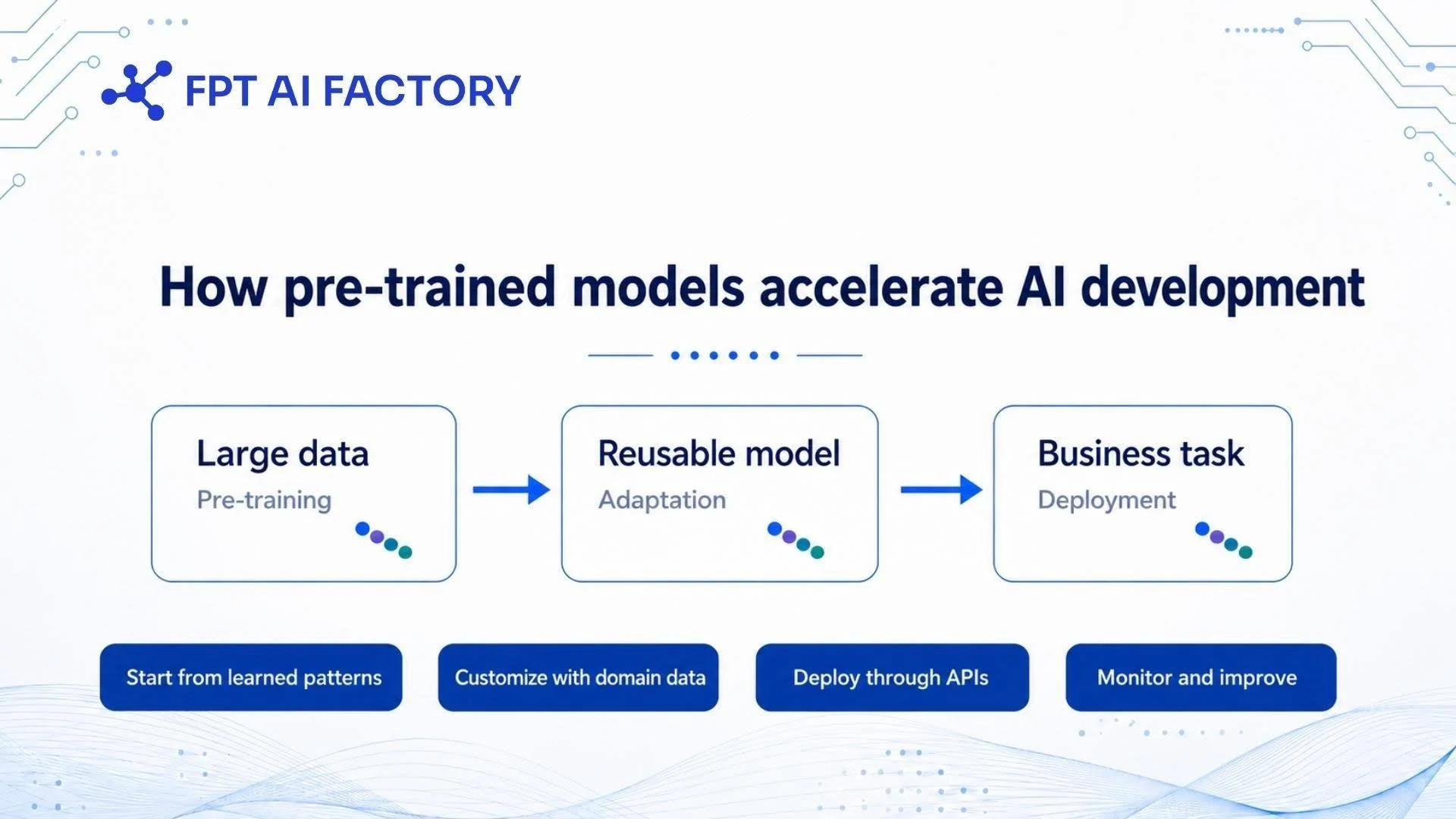
A pre-trained model is an AI model that has already learned general patterns from a large dataset before being adapted to a specific task. Instead of learning language, images, or relationships from the beginning, the model starts with broad capabilities and can then be prompted, fine-tuned, evaluated, or connected to enterprise applications.
Pre-training typically happens on large-scale datasets using self-supervised or supervised learning methods. In language AI, models learn patterns in text and then generate, summarize, classify, or answer questions. In computer vision, models may learn visual features from large image datasets and later support tasks such as object detection, quality inspection, or document understanding.
Popular examples include GPT-style models, Meta’s Llama models, Claude, and vision models used for image recognition or multimodal AI. GPT-3, for example, was introduced as a 175-billion-parameter language model, while Meta released Llama 3.1 405B as an openly available foundation model.
3. How pre-trained models help organizations scale AI initiatives
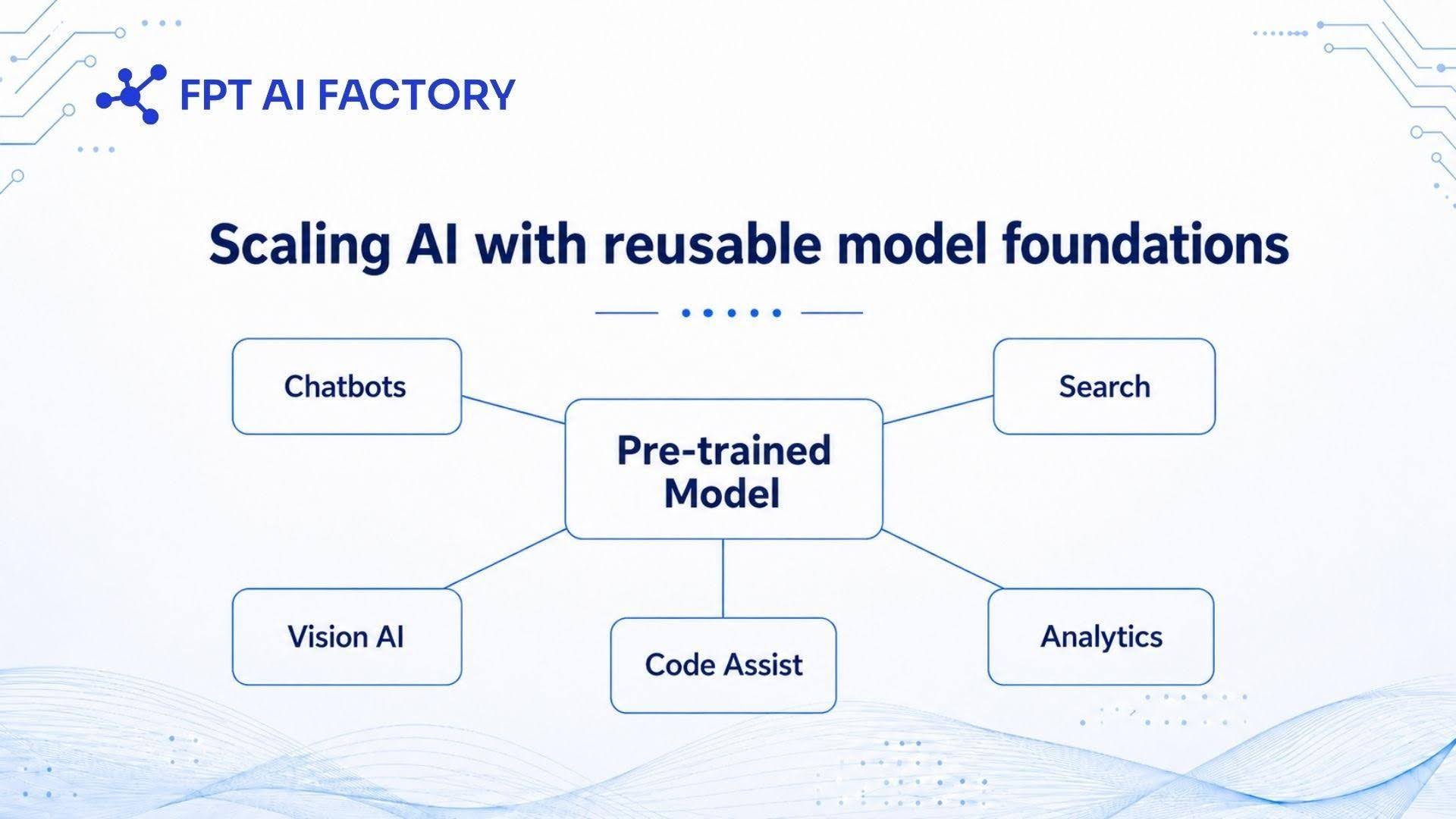
Pre-trained models help organizations move AI from isolated pilots to repeatable business workflows. They provide a foundation that can be adapted across teams, departments, and products, making AI development more scalable than one-off model builds. However, scaling still requires careful decisions around data, governance, customization, infrastructure, and model operations.
3.1. Faster development cycles
The biggest advantage of pre-trained models is speed. Product teams can start with a model that already understands general language, vision, or multimodal patterns, then adapt it through prompting, retrieval-augmented generation, evaluation, or domain-specific tuning. This shortens the path from proof of concept to business testing.
3.2. Reduced compute and training costs
Training a foundation model from scratch requires large-scale compute, long training time, and experienced machine learning teams. Pre-trained models reduce this barrier because businesses can reuse existing capabilities and invest compute only where it creates additional value, such as fine-tuning, evaluation, or inference optimization.
3.3. Improved accessibility for enterprise AI projects
Pre-trained models make AI more accessible because they lower the technical and financial threshold for experimentation. A company can test a customer support assistant, search assistant, document workflow, or image classification system without owning the full pre-training pipeline. This makes AI projects easier for smaller teams and business units to start.
3.4. Considerations around governance, customization, and infrastructure
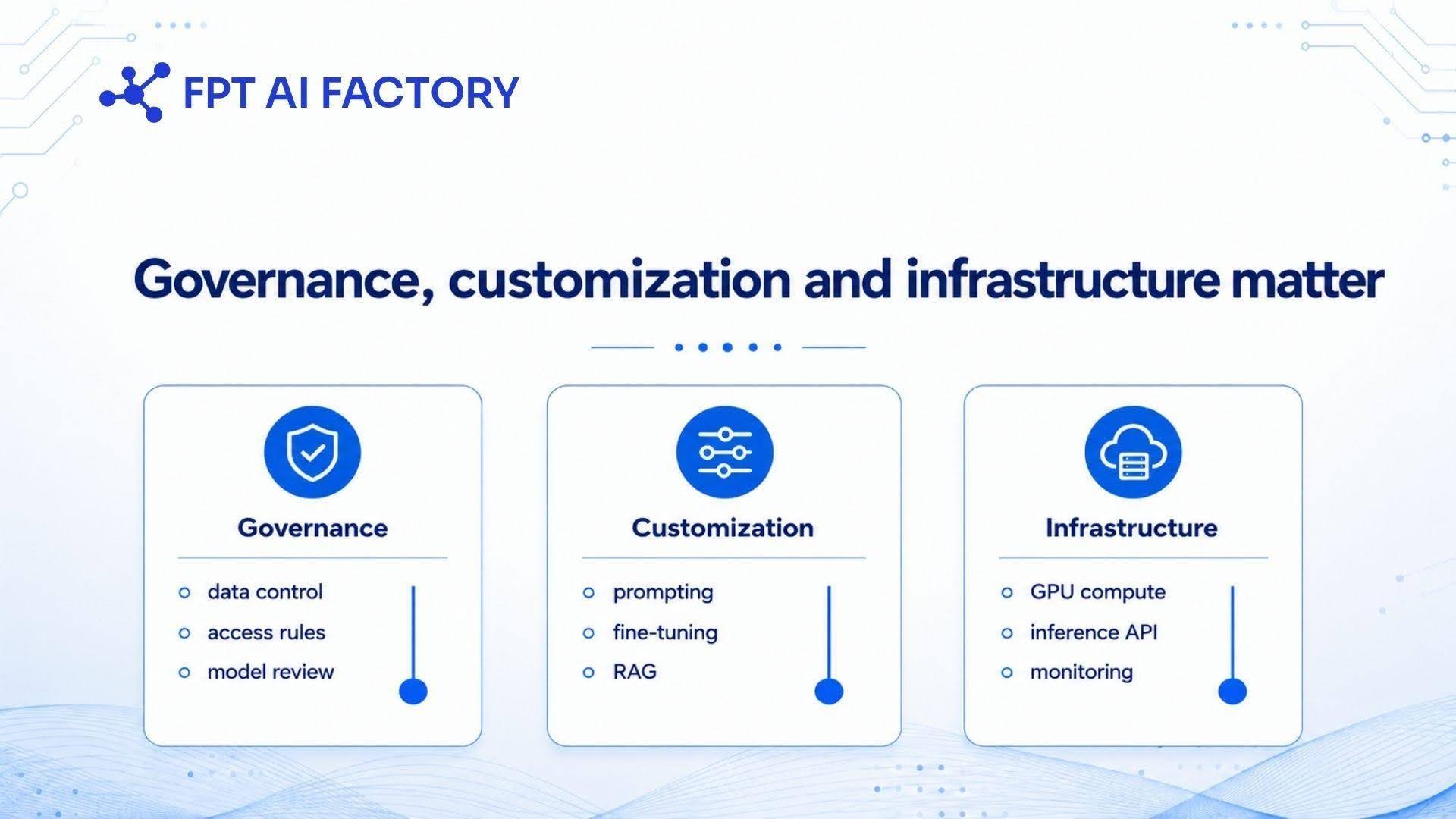
Pre-trained models are powerful, but they are not automatically ready for every enterprise environment. Teams need to check data privacy, access control, bias, output quality, cost, latency, and compliance requirements. They also need to decide whether the model should be used as-is, connected to internal knowledge, or customized for a domain-specific task.
Pre-trained models are making AI more accessible by reducing the need to build every capability from scratch. They help businesses move faster, control experimentation costs, and test more AI use cases with reusable foundations. Still, successful deployment depends on evaluation, governance, customization, and reliable infrastructure.
For organizations not ready to build and maintain their own model training infrastructure, pre-trained models offer a more accessible starting point, cutting both the cost and technical complexity of building AI from scratch. Solutions such as FPT AI Factory let enterprises tap into ready-to-use GPU infrastructure, AI Notebook, Model Testing, and Serverless Inference to fine-tune and deploy pre-trained models quickly
Contact Information:
- Hotline: 1900 638 399
- Email: support@fptcloud.com