With progressing generative AI capabilities, developers, product teams and digital businesses are facing a fundamental question: how can you turn rapidly improving video models into dependable product features?
Creating a hyper-realistic clip in a browser could require multiple iterations expending way more credits than expected. On the other hand, building an application that can generate thousands of clips. Besides this, an AI video generator API accepts different input formats, switches between models, handles asynchronous jobs, and evolves as the underlying AI market changes.
The AI video ecosystem now reflects several different approaches to this challenge. Synthesia has built an end-to-end environment around AI presenters, localisation and business video. Creatomate focuses on programmable, template-driven media automation. Shotstack approaches video as developer infrastructure, combining generation with programmatic editing and rendering.
Meanwhile, newer foundation models are pushing text-to-video, image-to-video, reference-driven generation and multimodal production further into territory that previously required conventional production workflows.
This expanding ecosystem creates opportunities, but it also introduces a less glamorous engineering problem: fragmentation.
What is an AI video generator API?
A development team shipping AI video inside a real product has a very defined checklist:
How will the application authenticate with the model provider? How are generation jobs submitted and monitored? What happens when video creation takes longer than an ordinary HTTP request? How are generated files retrieved? What changes when the team decides that a different model is better suited to a particular workflow?
In some production workflows, video is only one component of the application.
A modern generative-media workflow might use:
- a language model to interpret a user request,
- an image model to produce reference artwork,
- a video model to animate it, and
- an audio model to produce another part of the finished experience.
This workflow further connects each capability directly to a different provider, allowing engineering teams to maintain multiple authentication schemes, SDKs and API conventions.
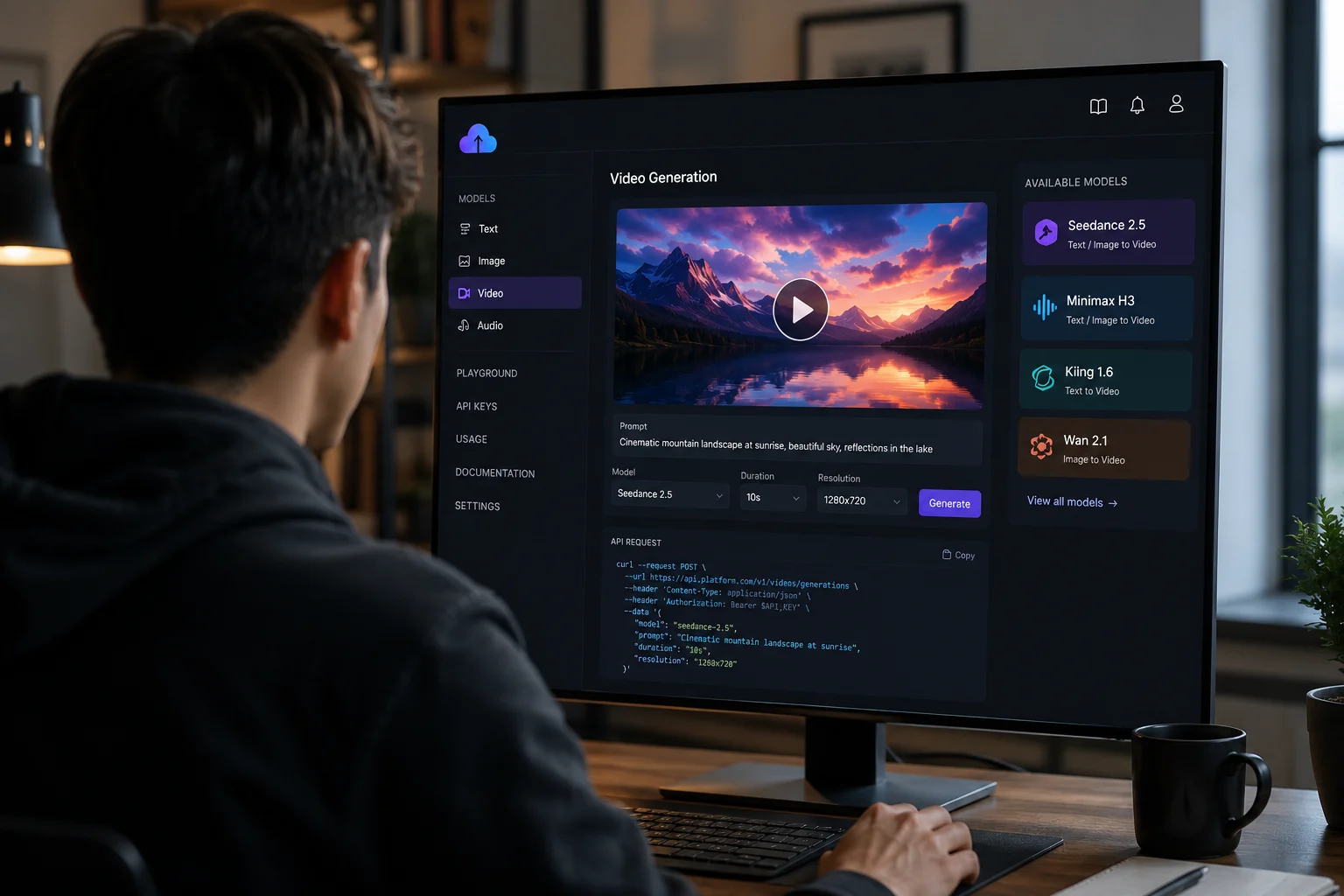
Atlas Cloud is an AI inference API platform providing access to more than 400 models spanning text, image, video and audio generation through one platform. Its documentation describes a unified API architecture, with its LLM endpoints compatible with the OpenAI SDK.
For developers, it is important to evaluate the underlying AI Video Generator API infrastructure so that it fits into a broader AI application without requiring the application architecture to be redesigned every time the model layer changes.
Types of AI video APIs
There is no single definition of an “AI video API”.
Shotstack, for example, approaches the problem largely as programmable video infrastructure. Its APIs let developers:
- define media edits using JSON
- generate assets, and
- render videos in the cloud.
Its own comparison of AI video APIs distinguishes between generative models and the broader problem of assembling AI-generated images, voiceovers, avatar footage and other assets into finished videos.
Creatomate takes another approach:
- REST API can render videos or images from templates populated with application data.
- Tooling also supports no-code integrations and browser-based previews.
This makes template automation particularly relevant for applications producing repeatable, data-driven creative formats.
Synthesia illustrates a third category. It has developed a business-oriented AI video environment around avatars, scripts, localisation and presentation-style production. Its current platform can create video from prompts, scripts, URLs and documents, while supporting multilingual voiceovers and translation.
This is why developers need to define the layer they actually require.
The requirement could be video rendering, templating, or just an avatar presenter, or it could be a direct programmatic access to foundation models capable of generating new footage.
Choose your model wisely
AI video models can differ substantially in their preferred inputs and creative strengths. One model may be useful for turning a product photograph into motion, while another may be better suited to cinematic text-to-video generation. A third may become attractive when reference material, audio or editing capabilities are central to the workflow.
Consequently, hard-wiring an entire product to one model can become an architectural constraint.
Atlas Cloud’s model catalogue, for instance, is designed around a different idea: expose multiple model families behind one access layer. Its documentation currently lists video-generation families including Kling, Vidu, Seedance, Wan and Hailuo alongside LLM and image-generation models.
For example, ByteDance’s Seedance family. Developers following the next generation of the technology can examine the Seedance 2.5 API as part of that wider model-access strategy rather than treating the model as an isolated service.
Seedance 2.5 enables longer-form generation and richer reference-based control. It offers text-to-video, image-to-video, and reference-driven workflows, with longer continuous scenes. Atlas Cloud’s own Seedance 2.5 material similarly describes 30-second generation, multimodal reference inputs and synchronised audio-visual generation.
For developers, however, the architectural lesson is more durable than any individual model feature. Video models are improving quickly enough that the model a team chooses during prototyping may not be the model it wants six months later.
The ability to evaluate and introduce alternatives without rebuilding the application’s entire integration layer can therefore have significant engineering value.
MiniMax H3’s multimodal production
MiniMax describes H3 as an omni-modal generation model capable of understanding context across text, images, video and audio. The model can generate video with native stereo audio and supports workflows including text-to-video, image-to-video, multimodal reference and editing, and video-to-video motion transfer.
Developers exploring the model through Atlas Cloud can find the Minimax H3 API alongside other model families rather than implementing a completely separate provider stack simply to test another generation approach.
This matters because “video generation” is gradually becoming too narrow a description for what these systems do.
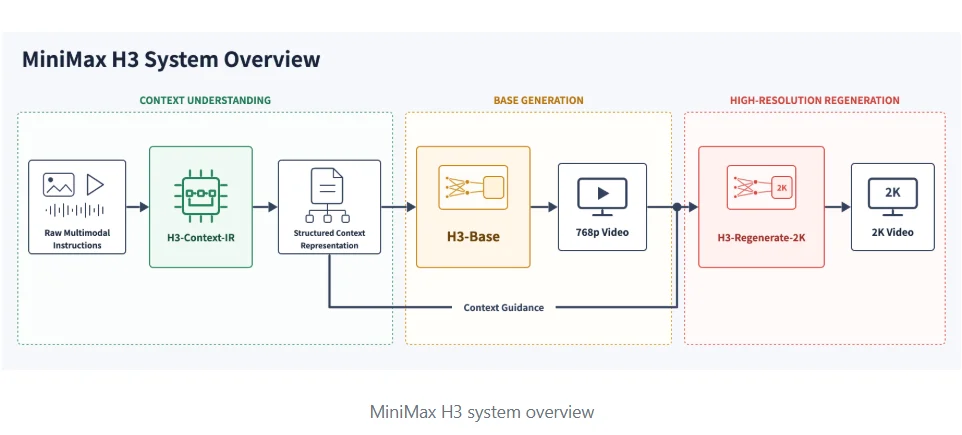
The emerging workflow is multimodal. A user might provide a photograph, written instructions and existing video or audio references. The system interprets those materials together and produces a new media asset. MiniMax itself describes the direction as moving beyond simply generating a clip towards models participating more broadly in the content-production process.
As those capabilities converge, developers may increasingly care less about maintaining a dedicated “video API” and more about having a flexible inference layer capable of exposing whichever multimodal models best fit the task.
Why an OpenAI-compatible approach is useful
OpenAI API format is one of the most familiar interface for developers.
Atlas Cloud’s LLM chat-completions interface is OpenAI-compatible, allowing developers using the OpenAI SDK to point their applications towards Atlas Cloud by changing the base URL and API key. Its broader platform uses consistent API patterns across its different model categories.
However, compatibility should not be confused with identical capabilities across every model. Video generation, image generation and language-model inference naturally require different parameters and often different execution patterns.
Video generation in particular is frequently asynchronous: an application submits a task, receives an identifier, waits for processing and then retrieves the resulting asset. This requires application-level handling for states such as queued, processing, completed, and failed.
But a unified platform can still reduce the surrounding operational complexity. Authentication, account management and model discovery can remain more consistent even when the individual generation calls differ.
Integrating evolving AI video API models
Suppose a product is designed around one video provider. The application may eventually accumulate provider-specific request objects, error handling, job polling, storage logic, and business rules. Switching AI video generator API models later can then become a migration project rather than a model-selection decision.
An abstraction layer does not eliminate model-specific differences, nor should it. Teams still need to evaluate output quality, latency, moderation behaviour, supported inputs, reliability, and commercial terms for their own workload.
What it can do is reduce how deeply provider-specific infrastructure becomes embedded in the rest of the application.
This is arguably the more interesting aspect of platforms such as Atlas Cloud. The practical benefit is optionality: being able to experiment with different model families while keeping more of the surrounding infrastructure consistent.
What developers should evaluate before choosing an AI video API
Visual quality remains important, but it should not be the only evaluation criterion.
Teams building production systems should test how well a model follows prompts across repeated generations, what input types it accepts, how asynchronous jobs are managed and how errors are surfaced.
They should examine whether reference images can preserve subjects or visual identity sufficiently for their use case and whether generated outputs fit naturally into downstream editing, storage and distribution systems.
The surrounding API also matters. Documentation quality, authentication design, webhook support, and the ease of moving from prototype code to production architecture can affect engineering effort as much as the generation model itself.
Further, applications involving identifiable people, cloned voices or synthetic presenters need appropriate consent and usage policies. Developers should examine provider terms and safeguards rather than assuming that technical capability automatically implies permission to use someone’s likeness or voice.
Finally, teams should test multiple models with their own material.
AI video remains highly dependent on the prompt, source imagery, motion requirements and desired visual style. A model that performs impressively in a cinematic demonstration may not necessarily be the strongest option for product visualisation, education, advertising or another specialised workflow.