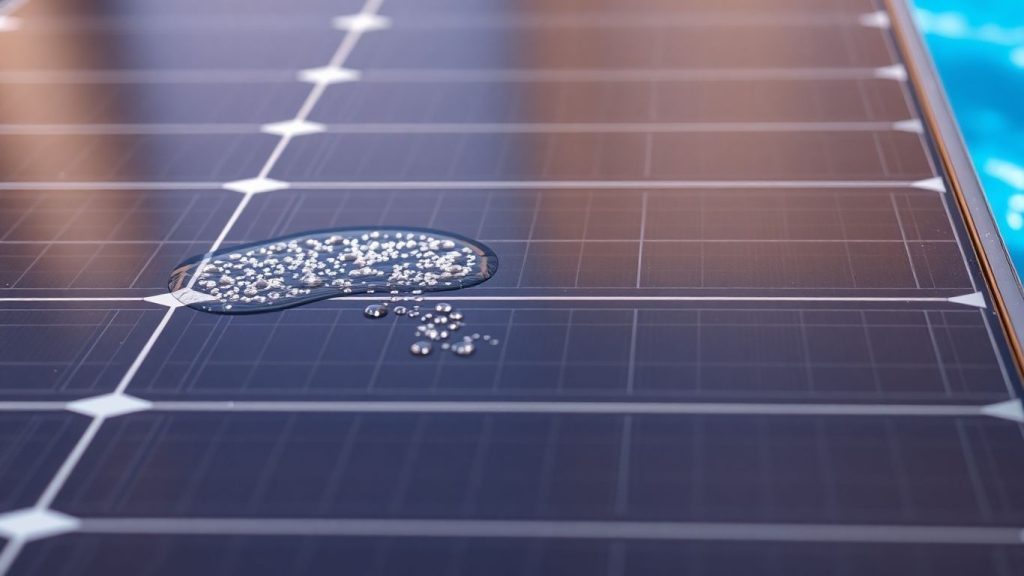
A groundbreaking solar desalination technology developed by researchers at UNIST is set to revolutionize freshwater production. This innovative system efficiently converts sunlight into potable water by evaporating seawater, crucially operating entirely without external electricity. It also tackles the persistent challenge of salt accumulation, ensuring sustained performance and offering a vital solution for water-stressed regions globally.
Key Takeaways
- A novel inverse-L shaped evaporator design prevents salt buildup.
- Utilizes a perovskite-based material (LSMO) for highly efficient solar energy conversion.
- Achieves evaporation rates significantly higher than conventional methods.
- Demonstrates long-term durability in highly saline conditions.
- Offers potential for eco-friendly resource recovery, including salt harvesting.
The Technology Behind the Breakthrough
The core innovation lies in a unique inverse-L-shaped paper structure that acts as the solar evaporator. This paper, with its water-absorbing properties, draws seawater upwards. At the top, a photothermal material, specifically La₀.₇Sr₀.₃MnO₃ (LSMO), a perovskite-based semiconductor, rapidly converts the water into vapor when exposed to sunlight. This material boasts high thermal efficiency, leading to evaporation rates that are an impressive 8 to 10 times faster than traditional methods.
Overcoming Salt Buildup for Longevity
A significant advancement of this technology is its built-in mechanism to manage salt accumulation. The inverse-L geometry directs salt ions towards the edges of the device, where they crystallize and can be easily collected or reused. This process effectively prevents the photothermal surface from becoming fouled, ensuring the device maintains optimal performance over extended periods. This feature is particularly important for deployment in developing nations where consistent operation is critical.
Performance and Future Potential
The system has demonstrated a remarkable evaporation rate of 3.40 kg m⁻² h⁻¹, translating to approximately 3.4 liters of fresh water per hour. This far exceeds the typical 0.3–0.4 kg/m²/h achieved under natural sunlight with conventional systems. Durability tests have shown stable operation for two weeks even in solutions with 20% salt content, which is higher than that of normal seawater. Lead author Dr. Saurav Chaule highlighted the system’s potential for "eco-friendly resource recovery, such as salt harvesting," in addition to freshwater production. Professor Ji-Hyun Jang, who led the research, emphasized that the "cost-effective, electricity-free device capable of producing 3.4 kg of freshwater per hour" represents a "practical and scalable solution to the global water scarcity crisis."
Sources
- Solar desalination technology converts sunlight into fresh water without external power, Tech Xplore.

Founder Dinis Guarda
IntelligentHQ Your New Business Network.
IntelligentHQ is a Business network and an expert source for finance, capital markets and intelligence for thousands of global business professionals, startups, and companies.
We exist at the point of intersection between technology, social media, finance and innovation.
IntelligentHQ leverages innovation and scale of social digital technology, analytics, news, and distribution to create an unparalleled, full digital medium and social business networks spectrum.
IntelligentHQ is working hard, to become a trusted, and indispensable source of business news and analytics, within financial services and its associated supply chains and ecosystems