A leader’s years of business records may be worth licensing for AI. For coaches, the real question is whether raising it strengthens the trust it depends on.
Picture a founder you have coached for two years, three months away from handing over the keys. The buyer wants the customers and the brand. Nobody wants the fourteen years of support tickets, project files and sales notes sitting in systems she is still paying for. She mentions it in passing, almost as a joke: it feels like throwing away the company’s memory.
Coaches hear moments like that constantly. Most of them are about identity and legacy, and they should stay there. Occasionally, one also points to a practical opportunity the leader hasn’t considered, because that operating history may be worth licensing.
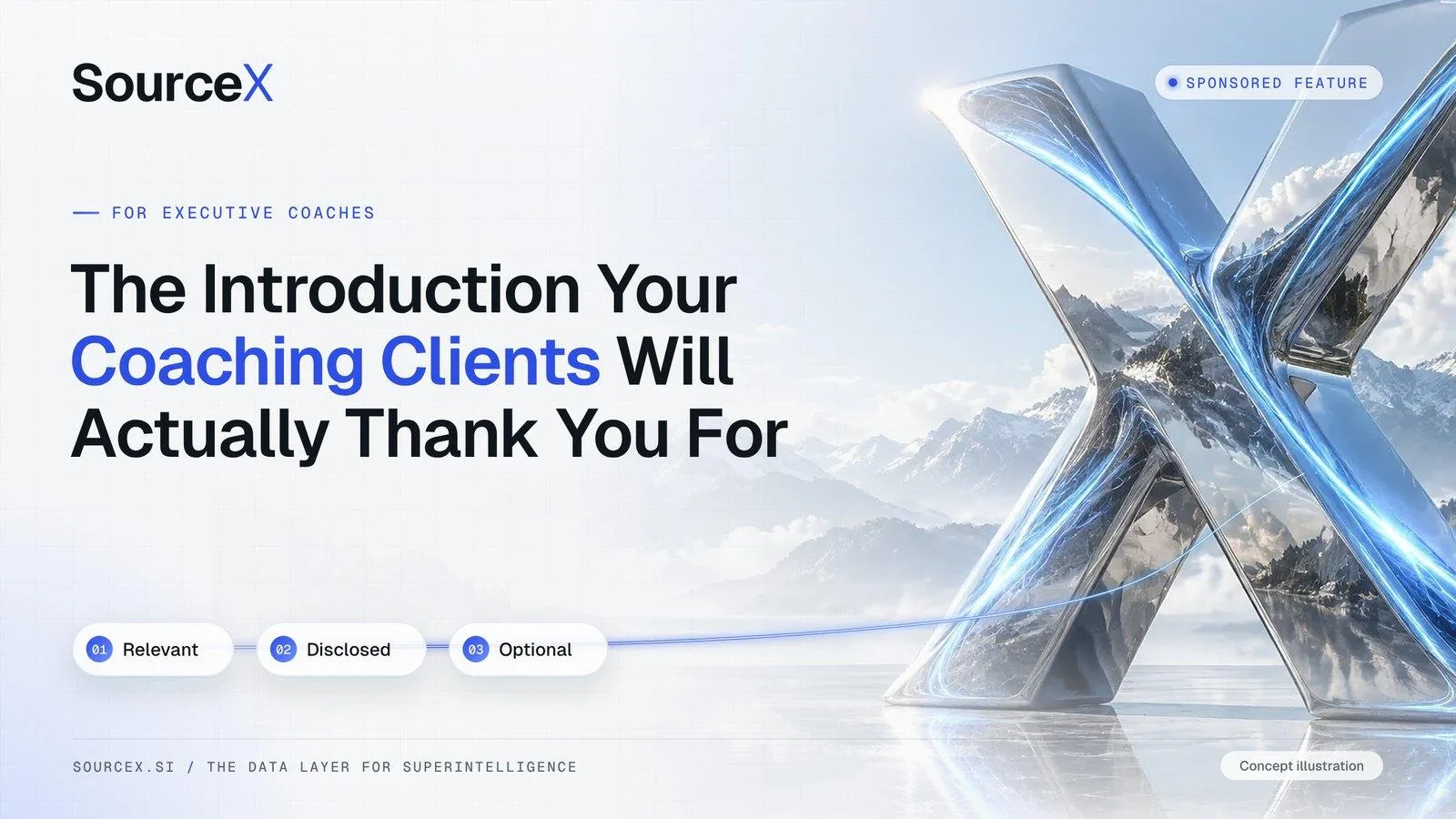
That is the heart of an executive coaching referral partnership with SourceX, a Los Angeles company that licenses business data directly from companies for AI training and evaluation, and pays them for it.[1] It is also a test of something coaches care about more than any fee: whether an introduction strengthens the trust it relies on.
Why a company’s memory now has a market
AI developers trained their early systems on the open web, and much of that openly available text has already been used. The next useful material lives inside businesses: how teams resolve customer problems, make decisions, write proposals and ship code. Very little of it is public. Many AI developers prefer data licensed with the owner’s agreement, which puts the business owner in the deciding seat.
The records in question are ordinary ones. Support conversations, workflow histories, internal documents, CRM records and engineering tickets can all be in scope.[1] Knowledge-work companies that reached 50 or more full-time employees at their peak are the strongest fit, and operating, acquired or wound-down companies can all qualify. Not every company does, and a short fit check with no uploads and no commitment is the way to find out.
For a leader in the middle of an exit, that reframes the archive. Instead of a line item to switch off, it may be one last source of revenue.
Run the trust test first
Before you mention anything, ask yourself three honest questions.
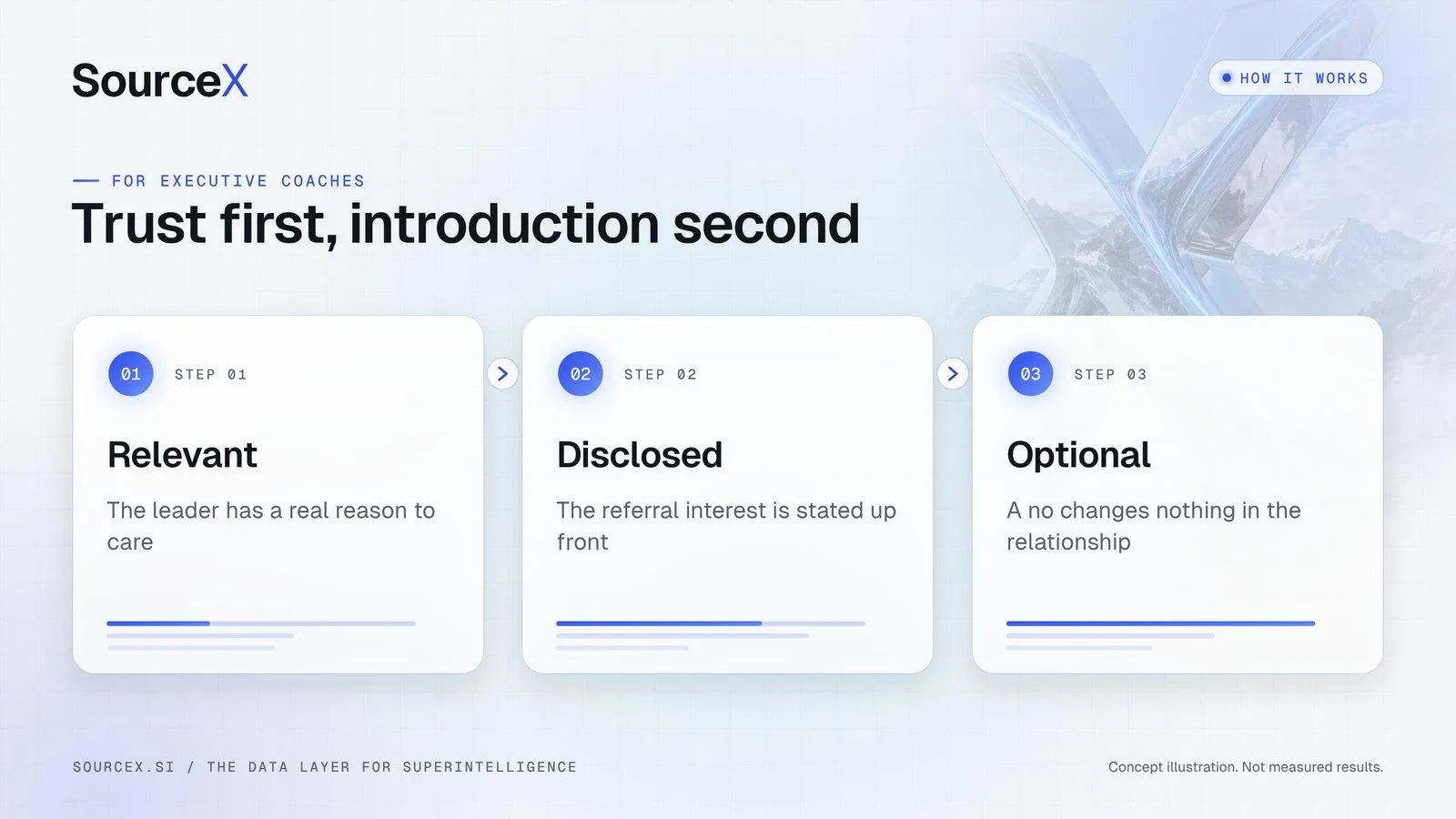
Would this leader genuinely want to know? Relevance comes from their situation, not from your interest in a reward. A founder fretting about legacy records is a natural fit. A chief executive in the middle of a crisis is not, however large the company.
Can you raise it without breaching confidence? What a client tells you in a session belongs to them. Raising an idea back to that same client is fine. Repeating their story to a third party is not. The introduction should carry nothing more than the leader chooses to share.
Could they say no and feel nothing change? If the honest answer is “maybe not,” wait. The coaching relationship is the asset. The referral is optional.
What the reward looks like, plainly
SourceX pays approved partners 25% of the actual supplier payout, meaning the compensation SourceX actually pays the referred company, up to $100,000 cumulative per company.[2] Separately itemized taxes and expense reimbursements are excluded. SourceX pays the reward on its own, and it never reduces what the company receives.
For illustration, a company paid $140,000 for a licensed dataset would mean a $35,000 reward for the coach who made the introduction. Companies themselves can earn up to $4M, and that figure is an upper bound for the largest enterprise datasets, not a typical or guaranteed outcome.
A few conditions keep the program clean. You need an approved partner account and a signed Channel Partner Agreement before introducing anyone.[3] There is a 90-day attribution window, one partner is credited per company, and an existing application or relationship can block credit. A submitted lead, a meeting or a signed agreement alone does not trigger payment. The reward is payable after SourceX has paid the referred company and the remaining conditions are met. If you hold a professional license or follow a code of ethics, check its rules on referral fees before you sign.
How to raise it without changing the room
Tell the client you are a referral partner and would be paid if a deal went ahead. Say it early and in plain words. Leaders are used to advisers with commercial interests. What unsettles them is discovering one later.
Then describe the process accurately, because accuracy is what reassures people. The company signs with SourceX, not with an AI lab, and it decides which systems, records and date ranges are in scope. Nothing is delivered until the agreements are signed and SourceX gives the go-ahead. Data is de-identified through approved processing routes before it is used or shared, and because no method is perfect, the agreement records that re-identification may still be possible. The company can back out at any point before signing, at no cost.
Keep your own role small. You don’t value the archive, collect samples or chase the deal. You connect the leader, or whoever they nominate, and step back. If they decline, the next session feels exactly like the last one.
The question they will remember
Good coaches are remembered for the questions that reframed something. “Have you thought about what your records might be worth to someone else?” can be one of those, if it comes at the right moment with nothing hidden behind it.
Timing usually announces itself. A sale, a merger, a wind-down, a new chief executive inheriting a decade of systems, a board asking for fresh revenue without fresh headcount. Those are the moments when a leader is already thinking about what the company has accumulated and what to do with it. Raised then, the idea feels like insight. Raised in the middle of a hard conversation about burnout, it feels like a pitch, and it costs you something no reward can repay.
Coaches and professional connectors who want to offer that question to the right leaders can review the SourceX referral program and get approved before making a single introduction. Choose the leader first. The reward, if it comes, follows the trust.
About the founder
Noah Loul is a four-time founder and the founder and CEO of SourceX, which licenses business data directly from companies for AI training and evaluation. He previously founded B2B Rocket, acquired by Blackpearl Group. His work focuses on building permission-based data infrastructure for AI.
Sources
1. SourceX: License your business data for AI
2. SourceX company referral program
3. SourceX referral partner program terms (version 2026-10-22.2)