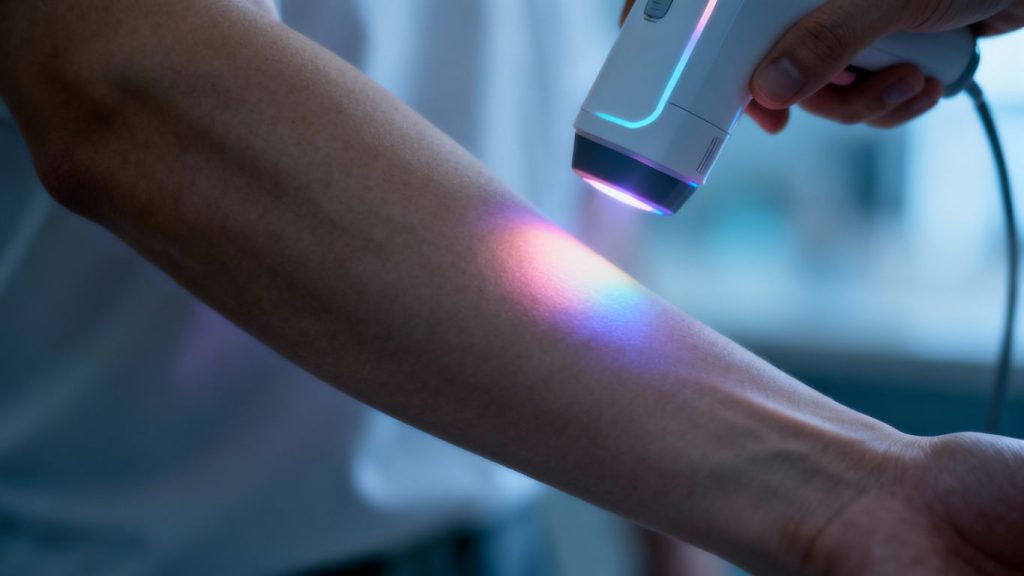
Managing diabetes can be a daily challenge, often involving painful finger pricks or uncomfortable under-the-skin sensors for glucose monitoring. However, researchers at MIT are developing a groundbreaking technology that could soon make these invasive methods a thing of the past, offering a pain-free alternative.
Key Takeaways
- MIT researchers are developing a needle-free glucose monitor using light technology.
- The device employs Raman spectroscopy to analyze light scattered by molecules in the skin.
- Early prototypes have shown accuracy comparable to commercial glucometers.
- The long-term goal is a wearable, watch-sized device.
How the Light-Based Scanner Works
The innovative device utilizes Raman spectroscopy, a technique that examines how light scatters when interacting with molecules. By shining near-infrared light onto the skin and analyzing the subtle shifts in the returning light’s wavelength, the device can identify and quantify glucose levels without breaking the skin’s surface.
Initially developed as a shoebox-sized apparatus, the current setup requires a 30-second scan with the arm resting on a glass window. The light beam penetrates the skin, and the scattered light provides data about the molecules present. The MIT team has refined the process, discovering that only three spectral bands are necessary for accurate glucose calculation, which significantly reduces the device’s size, cost, and processing time.
In a recent study, the scanner’s readings closely matched those of two commercial glucometers worn by a volunteer who consumed glucose drinks. This accuracy, achieved during early development, has surprised the researchers and offers strong promise for the technology’s potential.
Progress Toward a Wearable Device
Building on the success of the larger prototype, MIT engineers have created a cellphone-sized unit that is currently undergoing clinical testing with healthy individuals and those with prediabetes. A larger trial involving participants with diabetes is anticipated next year.
The ultimate vision is to miniaturize the technology further, potentially leading to a watch-sized glucose monitor. Key next steps include confirming the system’s accuracy across diverse skin tones and ensuring its reliability in real-world conditions.
Comparison to Other Needle-Free Attempts
This light-based approach is part of a growing trend in developing noninvasive glucose monitoring solutions. While other methods, such as chest straps using ECG signals, have shown promise, they are still some time away from consumer availability. The persistent demand for less painful alternatives fuels the ongoing research in this field.
What This Means for You
For individuals managing diabetes, the advent of a needle-free glucose monitor could significantly alleviate the daily stress associated with blood draws or sensor insertions. The early accuracy data suggests that noninvasive tools are becoming a tangible reality, potentially enabling faster detection of glucose level fluctuations and offering greater comfort in managing this chronic condition.
Future Outlook
The development of a handheld or watch-sized glucose scanner represents a significant leap forward in diabetes care. MIT’s light-based technology is bringing this future closer, with upcoming clinical trials poised to validate its performance in diverse scenarios. The success of these trials could usher in a new era of convenient and pain-free diabetes management.
Sources

Founder Dinis Guarda
IntelligentHQ Your New Business Network.
IntelligentHQ is a Business network and an expert source for finance, capital markets and intelligence for thousands of global business professionals, startups, and companies.
We exist at the point of intersection between technology, social media, finance and innovation.
IntelligentHQ leverages innovation and scale of social digital technology, analytics, news, and distribution to create an unparalleled, full digital medium and social business networks spectrum.
IntelligentHQ is working hard, to become a trusted, and indispensable source of business news and analytics, within financial services and its associated supply chains and ecosystems