
In late 2025, secure file transfer moved from a background utility and made its way onto corporate agendas as a strategic priority. A widely shared article by Progress.com emphasised that managed file transfer (MFT) will become an “invisible but indispensable” layer enabling AI‑driven workflow automation across industries. While accurate, if we look beyond this, there is a bigger picture in the background.

The forces transforming managed file transfer (MFT) are the same ones reshaping the enterprise: widespread adoption of generative AI, the need for trust and security, escalating regulatory scrutiny, and severe skill shortages. To illuminate this shift, let us compare current research from Harvard, Stanford and Deloitte, survey data from McKinsey and PwC, and case studies from leading organisations such as Royal Bank of Canada (RBC), Coca‑Cola and IQVIA.
The result is a synthesis of how file transfer, AI orchestration and cybersecurity intersect to enable automation and resilience in 2026.
From Experimentation to Accountability: A Snapshot of AI Adoption
The Wharton/GBK AI Adoption Report found that by October 2025:
- 82% of business leaders were using generative AI at least weekly, with 46% using it daily, a 17‑point increase from 2024.
- 89% of these leaders believe generative AI enhances employee skills, although 43% worry about declining proficiency.
- 72% are now measuring return on investment (ROI) and three out of four report positive returns.
This marks a shift from “FOMO‑driven pilots” to accountable acceleration; budgets are being reallocated from pilots to performance‑proven programmes.
The McKinsey Global Survey 2025 corroborates this trend. It reports that
- 88% of organisations use AI in at least one business function; however, nearly two‑thirds remain in experimentation or pilot phases.
- 62% are experimenting with agentic AI, but only 23% have begun to scale agents.
- High performers use AI to drive growth and innovation, yet only 39% report enterprise‑level EBIT impact.
Obstacles include redesigning workflows and managing employment impacts—32% expect workforce reductions, 43% expect no change and 13 % expect increases.
These datasets reveal a paradox: adoption is surging, but scale, trust and governance remain nascent.
Enterprises are now moving from experimentation toward accountable acceleration, but they must address data movement, security and integration as core barriers.
Why File Transfer Matters in the AI Era
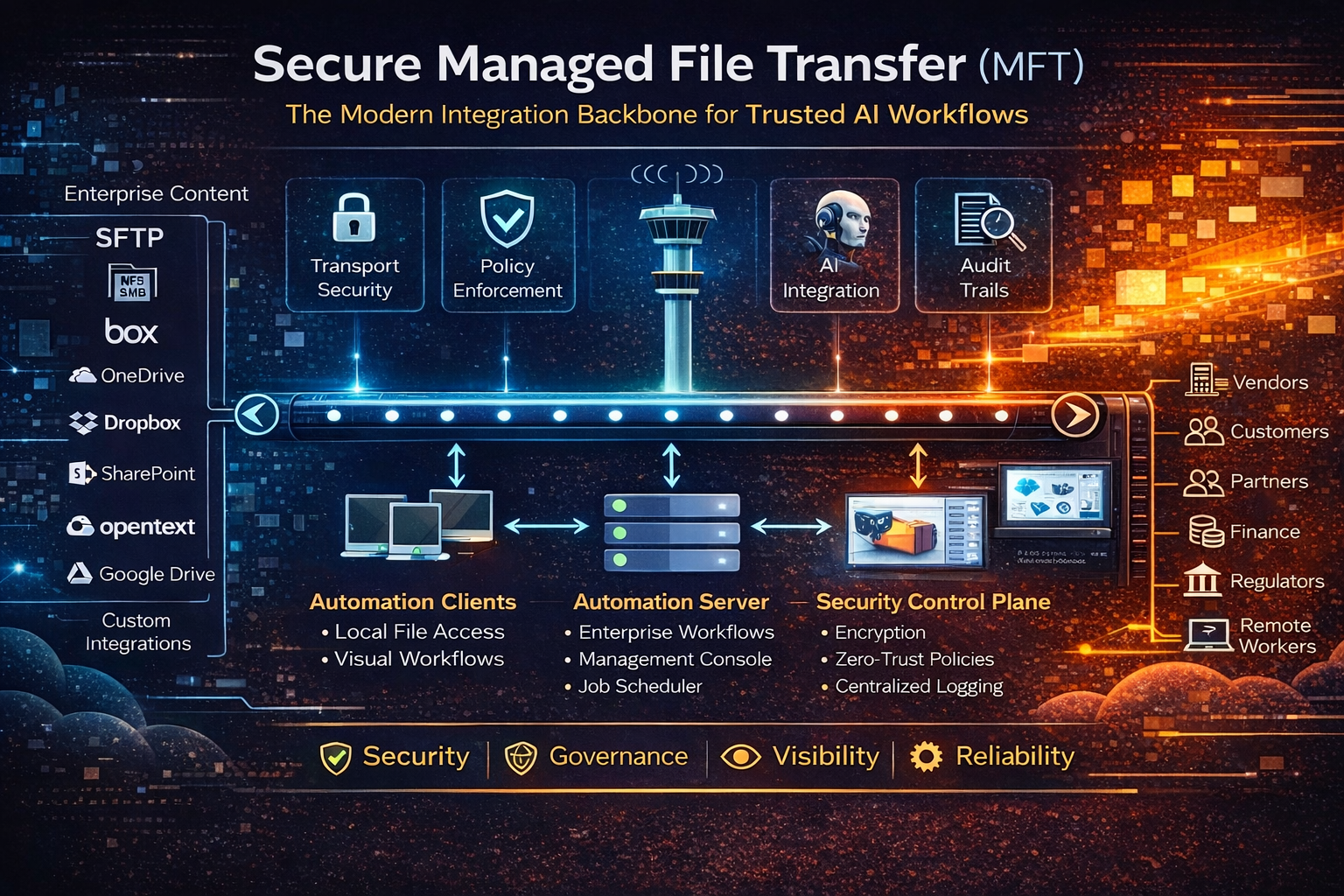
Managed file transfer has long been considered “plumbing.” However, with AI automating decision processes and generating data, secure file transfer becomes a strategic integration layer. In a December 2025 blog post, Progress.com outlines five predictions that align with the broader research:
- AI‑Enabled MFT with Responsible Guardrails – Instead of applying generative AI directly to confidential files, AI enhances the MFT workflow itself—creating automated reports, flagging anomalies and prioritising urgent transfers. This aligns with Harvard research urging responsible AI adoption because 34.8% of employees’ ChatGPT inputs contained sensitive data, up from 11% in 2023. Controlled integration allows businesses to exploit AI insights while protecting sensitive information.
- Unified, Policy‑Based Platforms over Point‑to‑Point Scripts – Legacy File Transfer Protocol (FTP) scripts and siloed servers are brittle. As supply chains and partner ecosystems expand, enterprises need scalable, event‑driven platforms that handle millions of transfers under strict SLAs. PwC’s Digital Trends in Operations Survey notes that 92% of operations leaders have already integrated AI into selected functions or across their organisation; 53% use AI to anticipate supply‑chain disruptions, with another 31% testing it. However, integration complexity and data issues are top reasons tech investments under‑deliver (47% and 44%). Modern MFT platforms address these pain points by unifying policies and automating workflows.
- File Transfer as a Cybersecurity Control Plane – As attack surfaces expand, organisations adopt zero‑trust principles across data movement. Encryption in transit and at rest, multi‑factor authentication, single sign‑on and web application firewalls are now baseline requirements. In RBC’s 2025 investor presentation, the bank reports 99.99% critical systems availability and highlights the role of hybrid cloud and internal AI platforms in helping maintain secure, resilient operations. RBC employs 1,700+ technologists and has filed 1,000+ patents since 2019. They handle 12 billion API calls monthly and capture over 1 billion business events per day, supported by a unified event engine and one of Canada’s largest GPU farms—demonstrating how file transfer and event streaming underpin AI‑driven banking.
- Consumer‑Grade Ease of Use – With scarce technical talent, organisations demand no‑code workflow builders and SaaS deployments. Deloitte’s Davos Survey reveals that two‑thirds of executives expect only 30% or fewer generative AI experiments to reach full scale within six months. They cite regulatory compliance and complexity as top obstacles. By modernising and centralising the managed file transfer process with purpose‑built, intuitive tools and strong governance safeguards, organisations can accelerate deployment and free specialists to focus on higher‑value innovation..
- Automation Across Hybrid and Distributed Endpoints – Hybrid IT is the norm: cloud platforms, on‑premises servers and partner networks must coexist. RBC’s unified platform uses hybrid cloud to integrate acquisitions like HSBC Canada, enabling business volume growth of 11% since 2019 with relatively flat operational costs. Their event‑driven architecture supports credit decisioning, algorithmic trading and personalised advice across channels. Similarly, health‑data company IQVIA reportedly deployed 50+ AI agents trained on 1.2 billion records to automate clinical trial processes; this yielded a 12% reduction in trial costs year‑over‑year. These examples illustrate how modern MFT systems act as automated backbones connecting disparate environments.
Case Studies
Royal Bank of Canada (RBC)
According to its 2025 Investor Day presentation, RBC has built a data and platform scale that supports over 12 billion API calls monthly and a 20‑fold increase in daily events since 2019. It hired 1,700+ technologists in 2024 and holds 1,000+ patents. The bank’s hybrid‑cloud infrastructure ensures 99.99% availability and leverages one of Canada’s largest GPU farms. RBC also set a target of generating $700 million to $1 billion in enterprise value from AI by 2027. These investments enable services like real‑time credit decisioning, mortgage re‑adjudication and algorithmic trading—all dependent on secure, scalable file transfer and event streaming.
RBC’s success underscores the importance of treating data movement as critical infrastructure. By unifying policies across its global operations and building an AI‑ready platform, RBC has achieved 11% business volume growth while keeping operational costs relatively flat. The bank’s emphasis on training and patents indicates a long‑term commitment to innovation and self‑reliance in AI models.
Coca‑Cola
In April 2024, Coca‑Cola announced a $1.1 billion partnership with Microsoft to migrate core workloads to Azure and experiment with generative AI. The company is testing Azure OpenAI Service and Copilot for Microsoft 365 across marketing, manufacturing and supply‑chain functions. Coca‑Cola’s employees use AI‑powered digital assistants to summarise emails and build slide decks, aiming to improve productivity and reduce time‑to‑answer. By embedding AI into internal workflows and customer engagement, the company seeks to personalise experiences and optimise resource use—activities that rely on secure file transfer between marketing systems, ERP platforms and production plants. Coca‑Cola’s investment signals that consumer‑grade brands view AI‑enabled MFT not as a back‑office tool but as a competitive differentiator.
IQVIA
Health‑data giant IQVIA offers a glimpse into agentic AI at scale. According to a Deloitte‑cited case study, IQVIA deployed more than 50 AI agents trained on 1.2 billion records to automate clinical trial tasks. The agents orchestrate study design, patient recruitment and data analysis, reducing clinical trial costs by 12% year‑over‑year. Managing such sensitive health data demands stringent security and regulatory compliance, which is why IQVIA emphasises encryption and layered controls. Their success demonstrates that scaling AI agents without modernising file‑transfer pipelines would be impossible; MFT becomes the gating layer that ensures privacy and auditability while enabling AI‑driven efficiency.
Additional Evidence from Surveys and Reports
- Stanford’s AI Index 2025 notes that U.S. private AI investment reached $109.1 billion in 2024 and that 78% of organisations were using AI (up from 55% the year before). Generative AI investment alone accounted for $33.9 billion.
- PwC’s 2025 survey reports that 98% of operations leaders find AI effective in creating value and 96 % say the same for cloud. Yet 92 % cite at least one reason for tech investments under‑deliver, with integration complexity (47%) and data issues (44%) leading the list—highlighting the importance of robust data‑transfer and integration platforms.
- Deloitte’s Davos survey reveals that 78% of executives plan to increase AI spending and 26% are heavily investing in autonomous agents. However, 69% expect governance strategies to take over a year, and regulatory compliance is the main hurdle. This underscores the need for MFT platforms with built‑in compliance and audit capabilities.
- United Nations’ Technology and Innovation Report 2025 warns that AI could affect 40 % of jobs worldwide; in advanced economies 27% of jobs could be enhanced rather than replaced. Inclusive policies and investment in digital infrastructure—including secure data transfer—are therefore essential to ensure AI benefits are equitably shared.
Strategic Implications and Thought Leadership
Elevate File Transfer to a Strategic Capability
The data and case studies reveal that file transfer is no longer a commodity. It is a control point for AI, a chokepoint for scalability, and a frontline for cybersecurity. Leaders should view managed and secure file transfer as an enterprise integration service with the following strategic mandates:
- Establish a Zero‑Trust Data‑Movement Architecture – Apply encryption by default, enforce multi‑factor authentication and centralise logging. Every file movement should be treated as a security event, supporting forensic auditing and compliance. RBC’s near‑perfect uptime and adoption of large‑scale event streaming illustrate the potential benefits.
- Deploy Policy‑Driven, Event‑Based Platforms – Replace fragile scripts with platforms that orchestrate automated, managed file transfers based on business events, service‑level agreements and compliance policies. This approach supports scalability across hybrid environments and accelerates integration of acquisitions.
- Embed AI Responsibly in MFT Workflows – Use AI to prioritise transfers, detect anomalies and auto‑generate compliance reports, but maintain human oversight. Given the high incidence of sensitive data in AI inputs, organisations must ensure that AI models never access raw files without proper controls.
- Prioritise Ease of Use and Democratisation – No‑code/low‑code MFT tools and intuitive workflow builders enable non‑technical teams to connect systems quickly. This reduces reliance on scarce specialists and accelerates time to value.
- Align Investment with Measurable Outcomes – As AI adoption moves toward accountability, CIOs should link MFT investments to metrics such as transfer success rates, cycle‑time reductions and downstream business value. Surveys show that 72 % of leaders are now measuring ROI; MFT metrics should feed into these dashboards.
Reimagine Workflows Around Data Movement
Beyond technical upgrades, organisations must redesign processes to harness AI and managed, secure file transfer synergistically:
- Integrate Data Governance – Data quality and provenance are critical when AI models rely on transferred files. Establish metadata tagging and lineage tracking within MFT platforms so AI algorithms ingest trustworthy data.
- Automate Regulatory Compliance – Build compliance checks into file transfer workflows to automatically enforce privacy regulations (e.g., GDPR, HIPAA). Given that regulatory compliance is the top obstacle to scaling AI, automating these controls can free resources for innovation.
- Enhance Cross‑Functional Collaboration – MFT platforms should support collaboration across IT, legal, operations and business units. The Wharton study found that adoption varies by department; unified platforms can close the gap in creating an enterprise-wide approach to secure file movement.
Prepare for an Agentic Future
As AI agents mature, secure file transfer will become the orchestrator for multi‑step processes. Deloitte predicts that 25% of enterprises using generative AI will pilot agentic AI in 2025, rising to 50% by 2027. The World Economic Forum reports that 82 % of executives plan to adopt AI agents within one to three years. In this context:
- MFT Should Expose APIs for Agents – Agents will need to fetch, transform and upload files autonomously; MFT platforms must provide secure APIs and granular permissions.
- Human Oversight and Explainability – Agents should generate logs and explanations for each file movement. This ensures accountability and supports compliance.
- Continuous Monitoring for Anomalies – Given the potential for agents to amplify errors, real‑time monitoring and anomaly detection are critical. AI can support this but must be governed.
Conclusion
Managed file transfer has evolved from a silent utility to a strategic integration layer that underpins AI‑driven automation, cybersecurity and digital transformation. As generative AI becomes mainstream—82 % of business leaders now use it weekly—the ability to move data securely and efficiently becomes an existential capability. Case studies from RBC, Coca‑Cola and IQVIA demonstrate that organisations capturing AI’s benefits invest heavily in modern MFT platforms, hybrid cloud architectures, and robust governance. Surveys from Harvard, McKinsey, Deloitte and PwC reveal that adoption is surging but scale and trust remain fragile; only 20 % of companies feel their infrastructure is ready for AI agents, and regulatory compliance is a major hurdle. CIOs and IT leaders must therefore reframe file transfer as critical infrastructure, integrate AI responsibly, harden security, simplify usability and align investments with measurable outcomes. Those who do will build resilient, adaptive enterprises ready for an agentic future.

Dinis Guarda is an author, academic, influencer, serial entrepreneur, and leader in 4IR, AI, Fintech, digital transformation, and Blockchain. Dinis has created various companies such as Ztudium tech platform; founder of global digital platform directory businessabc.net; digital transformation platform to empower, guide and index cities citiesabc.com and fashion technology platform fashionabc.org. He is also the publisher of intelligenthq.com, hedgethink.com and tradersdna.com. He has been working with the likes of UN / UNITAR, UNESCO, European Space Agency, Davos WEF, Philips, Saxo Bank, Mastercard, Barclays, and governments all over the world.
With over two decades of experience in international business, C-level positions, and digital transformation, Dinis has worked with new tech, cryptocurrencies, driven ICOs, regulation, compliance, and legal international processes, and has created a bank, and been involved in the inception of some of the top 100 digital currencies.
He creates and helps build ventures focused on global growth, 360 digital strategies, sustainable innovation, Blockchain, Fintech, AI and new emerging business models such as ICOs / tokenomics.
Dinis is the founder/CEO of ztudium that manages blocksdna / lifesdna. These products and platforms offer multiple AI P2P, fintech, blockchain, search engine and PaaS solutions in consumer wellness healthcare and life style with a global team of experts and universities.
He is the founder of coinsdna a new swiss regulated, Swiss based, institutional grade token and cryptocurrencies blockchain exchange. He is founder of DragonBloc a blockchain, AI, Fintech fund and co-founder of Freedomee project.
Dinis is the author of various books. He has published different books such “4IR AI Blockchain Fintech IoT Reinventing a Nation”, “How Businesses and Governments can Prosper with Fintech, Blockchain and AI?”, also the bigger case study and book (400 pages) “Blockchain, AI and Crypto Economics – The Next Tsunami?” last the “Tokenomics and ICOs – How to be good at the new digital world of finance / Crypto” was launched in 2018.
Some of the companies Dinis created or has been involved have reached over 1 USD billions in valuation. Dinis has advised and was responsible for some top financial organisations, 100 cryptocurrencies worldwide and Fortune 500 companies.
Dinis is involved as a strategist, board member and advisor with the payments, lifestyle, blockchain reward community app Glance technologies, for whom he built the blockchain messaging / payment / loyalty software Blockimpact, the seminal Hyperloop Transportations project, Kora, and blockchain cybersecurity Privus.
He is listed in various global fintech, blockchain, AI, social media industry top lists as an influencer in position top 10/20 within 100 rankings: such as Top People In Blockchain | Cointelegraph https://top.cointelegraph.com/ and https://cryptoweekly.co/100/ .
Between 2014 and 2015 he was involved in creating a fabbanking.com a digital bank between Asia and Africa as Chief Commercial Officer and Marketing Officer responsible for all legal, tech and business development. Between 2009 and 2010 he was the founder of one of the world first fintech, social trading platforms tradingfloor.com for Saxo Bank.
He is a shareholder of the fintech social money transfer app Moneymailme and math edutech gamification children’s app Gozoa.
He has been a lecturer at Copenhagen Business School, Groupe INSEEC/Monaco University and other leading world universities.