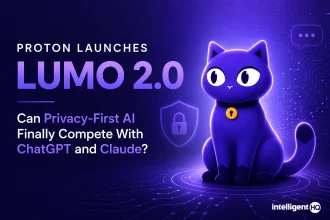
Proton, the Swiss company best known for Proton Mail and Proton VPN, has just raised the stakes in the AI assistant market. On June 30, 2026, the Geneva-based firm introduced Lumo 2.0, its biggest upgrade since the assistant first launched last year, and one that aims to close the performance gap with the likes of ChatGPT and Claude while holding firm on a promise its rivals can’t match: zero-access encryption.
For businesses and individuals increasingly uneasy about where their AI conversations end up, that distinction matters. Lumo remains the only major AI assistant built so that Proton itself cannot read user conversations, and nothing typed into it is used to train future models.
A genuine intelligence jump
The headline numbers are hard to ignore. Lumo 2.0 Max now scores 240% higher than its predecessor, Lumo 1.4, on the Artificial Analysis Intelligence Index, while the lighter Lumo 2.0 Lite model scores 127% higher. Andy Yen, Proton’s founder and CEO and a former CERN physicist, says the assistant has been “re-engineered from the ground up,” with a new thinking mode giving it reasoning capabilities that, in user testing, are reportedly no longer perceptibly different from the latest models out of OpenAI and Anthropic for many everyday use cases.
That’s a notable claim from a company that has historically positioned itself as the privacy-conscious alternative rather than a frontier-AI contender. With Lumo 2.0, Proton is arguing it no longer has to be one or the other.
What’s actually new
Beyond the raw intelligence gains, Lumo 2.0 introduces a set of features that bring it closer to feature parity with mainstream assistants:
- Image recognition and generation, now handled inside the same encrypted conversation
- User-controlled memory, encrypted Projects, and customisable “Custom Lumos” for more personalised workflows
- Enhanced web search with live results and source citations for more transparent, up-to-date answers
All of it sits behind the same zero-access encryption architecture Proton uses across its product suite, and the service remains open source, allowing independent verification of its privacy claims.
The sovereignty angle
The timing isn’t incidental. Proton’s announcement leans into a broader conversation around AI sovereignty and dependence on US technology providers, pointing to growing concerns about AI firms monetising user data through advertising and to recent friction around international access to American AI models. Proton frames Lumo as a European alternative built on independent European infrastructure, meaning data is not subject to US Executive Orders or American data collection requests.
That pitch extends to the enterprise side. Lumo for Business is already used by thousands of companies, according to Proton, offering administrative controls over team access alongside the same zero-access encryption guarantees. For organisations wary of employee queries becoming training data or confidential documents sitting on infrastructure subject to foreign legal jurisdiction, Proton is positioning Lumo as the lower-risk choice.
Scale and availability
Since its debut last year, Lumo has been adopted by more than 10 million users. Lumo 2.0 is available immediately across three tiers: a free plan covering core AI capabilities, Lumo Plus for unlimited chats, Projects, and advanced image generation, and Lumo Professional for teams needing secure AI collaboration.
Whether Lumo 2.0 truly closes the gap with the dominant US assistants will ultimately be judged by users putting it through its paces. But the bet Proton is making is clear: as AI becomes more central to work and communication, privacy and capability won’t need to be traded off against each other and the company that proves it first stands to win a meaningful share of a market still searching for a trustworthy, non-US alternative.
Sources
- Proton Blog, “Lumo 2.0”: https://proton.me/blog/lumo-2






![7 Best AI Development Companies for Data AI Solutions: Comprehensive Overview [2026]](https://www.intelligenthq.com/wp-content/uploads/2026/10/7-Best-AI-Development-Companies-for-Data-AI-Solutions-Comprehensive-Overview-2026-330x220.webp)