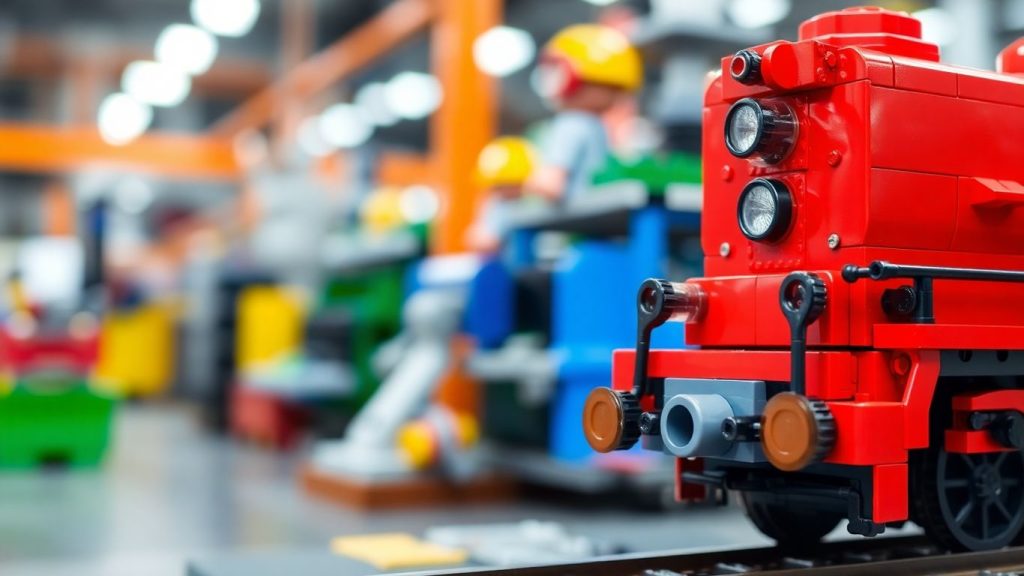
LEGO has unveiled its latest holiday offering, the LEGO Icons Holiday Express Train, marking a significant milestone as its first set to feature a mass-produced 3D printed component. This innovative train piece seamlessly integrates traditional LEGO connectors with a design made possible by advanced additive manufacturing.
Key Takeaways
- LEGO’s Holiday Express Train is the first set to include a mass-produced 3D printed part.
- The component utilizes EOS 3D printing with Fine Detail Resolution (FDR) technology for high precision.
- This advancement signifies LEGO’s commitment to exploring additive manufacturing for scaled production.
A New Era for LEGO Production
The 956-piece LEGO Icons Holiday Express Train is designed as a festive centerpiece, complete with a 16-piece circular track. Ronen Hadar, Head of Additive Design & Manufacturing at LEGO, highlighted the use of an EOS 3D printer employing FDR technology. This system leverages an ultra-fine CO₂ laser to achieve exceptional accuracy and intricate details, meeting LEGO’s stringent quality and safety standards.
"The elements were produced using a Fine Detail Resolution platform, giving high accuracy and quality to the element, on par with our standard quality and safety requirements. This is only possible thanks to our incredible engineering teams. What an amazing job," stated Hadar.
While LEGO previously introduced a 3D printed piece in 2022 for a limited event, the Holiday Express Train represents the company’s first foray into offering 3D printed components at a commercial scale.
The set is scheduled for release to LEGO Insiders on October 1, 2025, with a general release on October 4, 2025. It will be priced at $129.99 USD (approximately €119.99).
The Growing Influence of 3D Printing in the Toy Industry
LEGO’s adoption of 3D printing aligns with a broader trend within the toy sector. Additive manufacturing is increasingly being explored for its potential to enhance product design, customization, and sustainability.
Initiatives like Dagoma’s Operation Toy Rescue demonstrate how 3D printing can extend the life of toys by providing replacement parts, thereby reducing waste. Similarly, independent designers are leveraging the technology to create unique educational toys, such as Nicolas Tokotuu’s figurine series, which aims to foster creativity and imaginative play, particularly in regions with limited access to traditional toys.
Sources
- LEGO Debuts Mass-Produced 3D Printed Train with Precision FDR Technology, 3D Printing Industry.

Founder Dinis Guarda
IntelligentHQ Your New Business Network.
IntelligentHQ is a Business network and an expert source for finance, capital markets and intelligence for thousands of global business professionals, startups, and companies.
We exist at the point of intersection between technology, social media, finance and innovation.
IntelligentHQ leverages innovation and scale of social digital technology, analytics, news, and distribution to create an unparalleled, full digital medium and social business networks spectrum.
IntelligentHQ is working hard, to become a trusted, and indispensable source of business news and analytics, within financial services and its associated supply chains and ecosystems