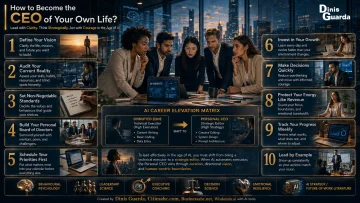
“Vision without action is a daydream. Action without vision is a nightmare.” — Japanese Proverb“If you want to go fast, go alone. If you want to go far, go together.” — African Proverb
“Your time is limited, so don’t waste it living someone else’s life… Have the courage to follow your heart and intuition.” Steve Jobs (Co-Founder of Apple)
Most people live their lives as passive employees within their own skin. They wake up to react to external notifications, execute tasks handed down by circumstances, spend their attention currency on distracting platforms, and wonder why their long-term dreams remain locked in a perpetual state of stagnation. They are trapped in a reactive employee mindset, managing day-to-day survival rather than driving long-term enterprise growth.
To achieve genuine autonomy, professional dominance, and internal peace, you must undergo a fundamental psychological paradigm shift: You must become the Founder and CEO of your own life.
Running your life like a high-performing enterprise allows you to replace temporary comfort with structural, long-term freedom. This strategic shift is no longer a luxury; it is an urgent survival requirement. We are living through an unprecedented inflection point driven by Artificial Intelligence. When execution becomes automated, infinite, and practically free, the market value of a pure “executioner” plummets to zero. The individuals who thrive are those who pivot from being technical executors to strategic editors.
This comprehensive masterclass outlines the core structural framework for auditing, organizing, protecting, and scaling your personal life enterprise in the age of intelligence.
The Core Foundations of the Personal Life Enterprise
“The best time to plant a tree was 20 years ago. The second best time is now.” — Chinese Proverb
“Just because you are CEO, don’t think you have landed. You must continually increase your learning, the way you think, and the way you approach the organization.” Indra Nooyi, Former CEO of PepsiCo
Before building the operational infrastructure, a Personal CEO must understand the multi-disciplinary sciences that support high-performance leadership. You do not operate a business in a vacuum; you build it upon verified frameworks:
- Behavioral Psychology: Understanding cognitive biases, habit loops, and the root causes of self-sabotage to optimize personal behavior.
- Leadership Science: Applying corporate organizational dynamics, vision cascading, and strategic alignment to individual daily life.
- Executive Coaching: Cultivating self-awareness, asking radical questions, and holding yourself to institutional-grade accountability.
- Decision Science: Utilizing mental models, probability matrices, and velocity frameworks to mitigate risk and choose high-leverage pathways.
- Emotional Resilience: Building psychological capital, regulating emotional bandwidth, and maintaining a calm inner core amidst chaotic market conditions.
- AI Strategy & Future-of-Work Literature: Understanding technological displacement, human-machine collaboration models, and skill-stacking mechanics.
Section 1: The Life Enterprise Board (The Framework)
Every elite multinational corporation is governed by a board of directors that oversees distinct, specialized departments. To run your life with similar precision, you must map your existence into The Life Enterprise Board, consisting of four foundational pillars:
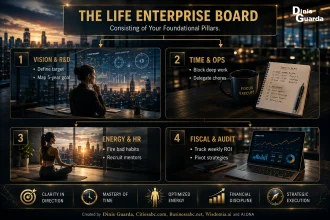
- Vision & Strategy (Research & Development)
“The only way to do great work is to love what you do.” — Steve Jobs, Stanford University commencement address, 2005
The R&D department of your life is responsible for looking down the horizon, identifying emerging threats, and drafting the blueprints for future expansion. Without a clear macro destination, your daily operations default to trivial, low-leverage busyness.
- The 5-Year Macro Dream: Define a crystal-clear, non-negotiable north star. Where is the enterprise heading? This vision must balance bold ambition with structural realism.
- Micro-Milestone Cascading: Break the 5-year vision down into 1-year operational targets, which are further divided into highly actionable 3-month (90-day) sprints.
- The Ten Major Life Departments: Establish explicit key performance indicators (KPIs) across your distinct life divisions—most critically your Professional development, Financial health, Physical/Mental wellness, and Personal Growth trajectory.
- Corporate Non-Negotiables: Document three daily behaviors that are mandatory for your self-respect (e.g., 60 minutes of uninterrupted reading/skill stacking, daily physical training, rigorous financial tracking) and explicitly list three toxic behaviors you will no longer tolerate.
2. Time Management (Operations)
“Efficiency is doing things right; effectiveness is doing the right things.” — Peter Drucker, The Effective Executive, 1966
Operations is where vision meets execution. An inefficient operations engine wastes capital, burns out talent, and misses crucial market windows.
- The Morning MIT (Most Important Task): Every morning, before checking email, social media, or Slack, identify the single task that drives the highest leverage for your long-term goals. Execute this task immediately. Protect your morning from external noise.
- CEO vs. Operating Tasks: You must strictly categorize your calendar. CEO tasks involve deep strategy, creative visioning, system building, and critical relationship nurturing. Operating tasks involve administrative maintenance, emails, standard scheduling, and transactional chores.
- Ruthless Operational Delegation: Identify everything on your schedule that can be automated via software, outsourced to virtual assistants, or eliminated entirely. Your goal is to maximize your deep-work blocks, keeping your mind focused on high-margin creative output.
3. Boundary Control (Human Resources & Culture)
“It takes 20 years to build a reputation and five minutes to ruin it.” — Warren Buffett
Your life enterprise cannot scale if your internal corporate culture is toxic, chaotic, or easily disrupted by low-value inputs.
- Build Your Personal Board of Directors: You are the average of the people you consult most. Proactively recruit a core council of 3 to 5 mentors who are substantially ahead of you in life, business, and character. Treat their guidance as your board-level governance.
- Calendar Financialization: Treat your schedule like a premium, high-value asset. Stop being universally available to everyone who requests your attention. When you gatekeep your calendar, you force the world to respect your time.
- Culture Maintenance (“Firing” Energy Drains): Protect your internal peace as if it were your company’s proprietary intellectual property. Promote supportive, high-vibrational, strategic peers into your inner circle, and decisively “fire” or distance yourself from individuals who introduce chronic drama, cynicism, or emotional drainage.
4. Continuous Optimization (Fiscal & Audit)
“Success breeds complacency. Complacency breeds failure. Only the paranoid survive.” — Andy Grove, former Chairman and CEO of Intel
A company that fails to analyze its financial statements goes bankrupt. A person who fails to analyze their habits goes nowhere.
- Weekly ROI Auditing: Run a deep diagnostic assessment every weekend. Evaluate which specific habits, relationships, and operational tasks yielded a positive emotional or financial return on investment, and which ones resulted in a net loss.
- The Sunday Executive Review: Dedicate 15 to 30 minutes every Sunday afternoon to review your metrics. Ask yourself three simple questions: What worked beautifully? What failed or caused friction? How must we adjust our strategic roadmap for the upcoming week?
- Velocity Over Perfection: Make decisions with speed. In organizational design, most decisions are Type 2—meaning they are reversible. Do not let overthinking paralyze your momentum. Progress, iteration, and rapid adjustments will beat a perfect, unexecuted strategy every single time.
Section 2: The 10 Pillars of Personal Life Leadership
To operationalize the macro strategy, a Personal CEO must systematically implement the 10 Pillars of Life Leadership. These pillars act as the standard operating procedures for your daily existence, ensuring that your actions consistently match your ultimate vision.
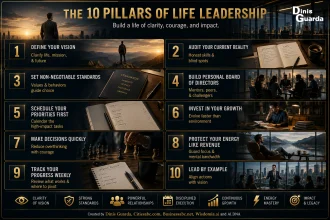
Pillar 1: Define Your Vision
“It always seems impossible until it’s done.” — Nelson Mandela
- The Philosophy: You cannot hit a target that you haven’t defined. Vagueness is the absolute enemy of execution.
- The Action: Clarify the precise life, mission, and future you want to build. Write down exactly what your optimal day looks like, what assets your enterprise controls, and what legacy you are constructing. Review this document daily to prime your subconscious mind for opportunities.
Pillar 2: Audit Your Current Reality
“Pain + Reflection = Progress.” — Ray Dalio, Principles: Life and Work
- The Philosophy: Radical honesty is the prerequisite for transformation. If you lie to yourself about your current financial balance sheet, health status, or skill deficiences, your strategy is built on sand.
- The Action: Perform a comprehensive inventory of your life. Assess your core skills, identify automated habits, calculate your net worth, map out your time leaks, and courageously shed light on your blind spots. Acknowledge where you are underperforming without self-flagellation; treat it simply as cold corporate data that requires immediate optimization.
Pillar 3: Set Non-Negotiable Standards
“There are no secrets to success. It is the result of preparation, hard work, and learning from failure.” — Colin Powell, former U.S. Secretary of State
- The Philosophy: Your life is not defined by what you want; it is defined by the absolute lowest standard of behavior that you are willing to tolerate.
- The Action: Codify the core values and daily behaviors that guide your choices. If integrity, discipline, and high-quality service are your corporate values, build operational guardrails around them. When a tempting shortcut or low-value distraction presents itself, your non-negotiable standards make the decision for you instantly.
Pillar 4: Build Your Personal Board of Directors
“You are the average of the five people you spend the most time with.” — Jim Rohn
- The Philosophy: Isolation breeds stagnation. Without external perspective, your blind spots will eventually cause your enterprise to crash.
- The Action: Intentionally surround yourself with a diverse, elite circle of mentors, peers, and challengers. Your board shouldn’t be a collection of “yes-men”—it must include individuals who love you enough to tell you when your strategy is flawed, when your ego is getting in the way, or when your execution is slipping.
Pillar 5: Schedule Your Priorities First
“The key is not to prioritize what’s on your schedule, but to schedule your priorities.” — Stephen Covey, First Things First
- The Philosophy: If you don’t schedule your priorities, other people will schedule theirs into your open slots. An empty calendar is an open invitation for exploitation.
- The Action: Shift from a reactive to-do list to a proactive calendar-driven life. Put your health (gym blocks), your deep strategy work, your family time, and your skill acquisition into your calendar first. Everything else must fit around these anchor blocks. If it isn’t on the calendar, it doesn’t exist.
Pillar 6: Invest in Your Growth
“Education is the passport to the future, for tomorrow belongs to those who prepare for it today.” — Malcolm X
- The Philosophy: The moment your rate of internal learning falls behind the rate of external change in the world, your obsolescence is guaranteed.
- The Action: Commit a fixed percentage of your time and financial capital to your personal development. Read books, take courses, attend mastermind groups, and acquire rare skill stacks. You must consciously evolve faster than your competitive environment changes. Treat self-education not as an expense, but as your highest-yielding capital investment.
Pillar 7: Make Decisions Quickly
“Make decisions with 70 percent of the information you wish you had.” — Jeff Bezos, founder of Amazon
- The Philosophy: Analysis paralysis is an expensive corporate tax. Sluggish decision-making kills momentum and projects insecurity.
- The Action: Cultivate informed courage. Gather roughly 70% of the available information needed to make a choice, calculate the downside risk, put a recovery plan in place, and pull the trigger. If the decision proves incorrect, pivot fast. Speed of iteration is vastly superior to prolonged agonizing.
Pillar 8: Protect Your Energy Like Revenue
“Energy, not time, is the fundamental currency of high performance.” — Jim Loehr and Tony Schwartz, The Power of Full Engagement
- The Philosophy: Time is a finite resource, but energy is a renewable, high-impact lever. If you have time but lack cognitive energy, your productivity is hollow.
- The Action: Guard your focus, boundaries, and emotional bandwidth with absolute ferocity. Treat sleep, nutrition, and mental decompression as operational imperatives. Say “no” to low-yield social obligations, toxic debates, and shallow digital loops that drain your battery without offering a meaningful return.
Pillar 9: Track Your Progress Weekly
“Without data, you’re just another person with an opinion.” — W. Edwards Deming
- The Philosophy: What gets measured gets managed; what gets tracked gets multiplied.
- The Action: Establish a baseline weekly tracking metric. Log your workouts, your deep-work hours, your financial savings rate, and your emotional satisfaction scores. review what works, dissect what does not work, and establish the exact strategic calibrations required for the subsequent week.
Pillar 10: Lead by Example
“Example is not the main thing in influencing others. It is the only thing.” — Albert Schweitzer
- The Philosophy: You cannot successfully manage others if you cannot successfully govern yourself. True authority is earned through disciplined self-mastery.
- The Action: Show up consistently every day so that your daily actions align perfectly with your articulated macro vision. When your execution matches your words, you build an iron-clad level of self-trust. This alignment radiates inward capability, command, and true leadership power to everyone in your sphere of influence.
Section 3: Leadership in the Age of AI
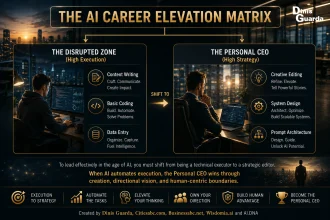
The emergence of foundational AI models has fundamentally rewritten the rules of personal leverage. In a pre-AI world, the primary differentiator between an employee and a executive was execution capability; the ability to grind out massive volumes of work hours.
In the modern landscape, AI has democratized execution.
Because an AI tool can draft a marketing campaign, write thousands of lines of functional code, or parse thousands of pages of financial data in mere seconds, the traditional competitive advantage of brute-force execution is dead. To lead effectively today, you must shift from being a technical executor to a strategic editor. The Personal CEO wins not by out-producing the machine, but by mastering curation, directional vision, and human-centric boundaries.
1. Career Trajectory: Shifting to High-Leverage Roles
AI systematically disrupts predictable, repetitive, high-execution tasks. However, it exponentially amplifies roles that require contextual judgment, deep curation, cross-disciplinary systemic thinking, and high emotional intelligence.
- Become the Editor: Do not try to compete with AI models on the speed or volume of output. You will lose. Instead, focus your energy on reviewing, refining, filtering, and injecting unique human storytelling, emotional nuances, and contextual business strategy into AI-generated frameworks.
- Master Prompt Architecture: Learn how to speak fluently to large language and multi-modal models. Treat these advanced neural networks as an unpaid, hyper-scalable army of elite interns waiting for your corporate direction. The value is no longer in knowing the answers; it is in knowing how to ask the highly sophisticated questions.
- Stack Unique Skills: The modern professional must combine deep, industry-specific knowledge with absolute AI fluency and behavioral psychology. Stacking these disparate elements makes your specific insights rare, impossible to replicate, and highly valuable to the market.
2. Time Management: Managing Attention, Not Hours
Because technological tools compress the execution time of tasks from hours down to seconds, traditional time-tracking systems are obsolete. You must transition your core focus from hours spent to energy and attention management.
- Protect Deep Strategy Blocks: Block out a minimum of two uninterrupted hours every single day for high-level creative visioning, deep strategic architectural design, and high-impact relationship building. Let automation workflows handle your administrative maintenance.
- Automate First Drafts: Ban the blank page from your life enterprise. Never start any project, essay, code base, or research summary from scratch. Use AI engines to instantly generate initial outlines, structural frameworks, or cross-disciplinary research summaries so you can jump straight into the high-leverage editing phase.
- Audit Your Friction points: Track your workflow to identify the repetitive tasks you dread most each week. Treat these friction points as immediate targets for automation. Systematically research or engineer an AI agent, software integration, or automated workflow to offload those operational burdens entirely.
3. Personal Boundaries: The Premium of Disconnection
When advanced tools make cognitive work continuous, hyper-efficient, and globally accessible 24/7, the ultimate competitive advantage becomes your ability to disconnect, preserve your mental machinery, and prevent cognitive burnout.
- Set Firm Availability Blocks: Establish distinct operational windows where you are entirely dark—offline and unreachable. Constant, frantic availability does not signal value; it signals a low-leverage operator running on panic rather than a high-value strategist operating on design.
- Create Human-Only Spaces: Intentionally insulate your highest-level activities from digital interference. Keep critical relationship builders, creative brainstorms, and deep strategic reflections entirely text-and-screen-free.
- Decline Low-ROI Requests: Do not use the massive time savings granted by AI tools simply to fill your calendar with an expanded volume of low-value, transactional meetings. Use that newly recovered temporal equity to rest, ponder, scale your health, and think deeply about your long-term roadmap.
Section 4: Execution Matrix (The AI Leadership Audit)
To convert this comprehensive philosophical framework into immediate tactical reality, study the matrix below and execute the corresponding action steps this week:
| Strategic Focus | Traditional Employee Mindset | AI Personal CEO Mindset | Immediate Action Step |
| Career Trajectory | “I need to learn how to grind out more volume and work longer hours.” | “I need to learn how to direct, curate, and scale exponential output.” | Audit your current daily task list; identify and list three repetitive execution tasks to delegate to an AI workflow this week. |
| Time Management | “I need to pack my daily calendar to prove to myself and others that I am busy.” | “I need to ruthlessly clear my calendar to focus entirely on high-impact decisions.” | Hard-block a 90-minute, completely “no-device” strategic thinking session into your calendar to evaluate your 90-day targets. |
| Boundary Control | “I must answer every single notification, ping, and email instantly.” | “I tightly control my inputs to protect the quality of my strategic output.” | Turn off all non-essential push notifications on your devices and batch-check communications at fixed, deliberate intervals. |
Conclusion: The Ultimate Corporate Mandate
Becoming the CEO of your own life requires you to step away from the comforting warmth of victimization and passivity. It forces you to accept a radical, terrifying truth: You are entirely responsible for the success or failure of the life enterprise.
If your operations are chaotic, if your culture is toxic, if your strategy is non-existent, or if your technological capabilities are outdated, you cannot blame the market, your upbringing, or the economy. As the Founder and CEO, the buck stops with you.
Leverage the power of structural auditing, embrace the leverage of AI automation, guard your attention capital with ferocity, and step onto the field of life not as a replaceable cog in someone else’s machine, but as the undisputed ruler of your own destiny.
Your enterprise is waiting. Lead it with clarity, think with strategy, and execute with courage.
Sources
Speeches
- Steve Jobs, Stanford Commencement Address, June 12, 2005 — official transcript: https://news.stanford.edu/stories/2005/06/youve-got-find-love-jobs-says
Books referenced
- Ray Dalio, Principles: Life and Work (Avid Reader Press/Simon & Schuster, 2017) — publisher page: https://www.simonandschuster.com/books/Principles/Ray-Dalio/Principles/9781668010198
- Peter Drucker, The Effective Executive (Harper & Row, 1966) — publisher page: https://www.harpercollins.com/products/the-effective-executive-peter-f-drucker
- Stephen Covey, A. Roger Merrill, Rebecca R. Merrill, First Things First (Simon & Schuster, 1994) — publisher page: https://www.simonandschuster.com/books/First-Things-First/Stephen-R-Covey/9780743482169
- Jim Loehr & Tony Schwartz, The Power of Full Engagement (Free Press, 2003) — publisher page: https://www.simonandschuster.com/books/The-Power-of-Full-Engagement/Jim-Loehr/9781476785763