India accounts for roughly 49% of global real-time payment transaction volume, according to ACI Worldwide’s Prime Time for Real-Time research. For a software company in London or a subscription business in Austin, that is not an exotic frontier market; it is a large, digitally mature customer base that increasingly expects to pay the way it pays domestically.
The difficulty is that most global payment stacks handle India poorly, for structural reasons rather than configuration ones. Understanding them determines which of the eight platforms below is right.
Why Accepting Payments From India Is Different
- Cross-border transactions get declined far more often: When an Indian customer pays a foreign-registered merchant, the issuing bank sees a domestic cardholder paying abroad and applies stricter risk scoring. Payments industry sources put domestic decline rates in the region of 1–5% against 15–25% cross-border, and industry research has reported authorisation improvements in the range of 5 to 12 percentage points for merchants shifting to local acquiring in markets including India. These figures come from payment providers rather than neutral bodies, so treat them as directional but every source points the same way.
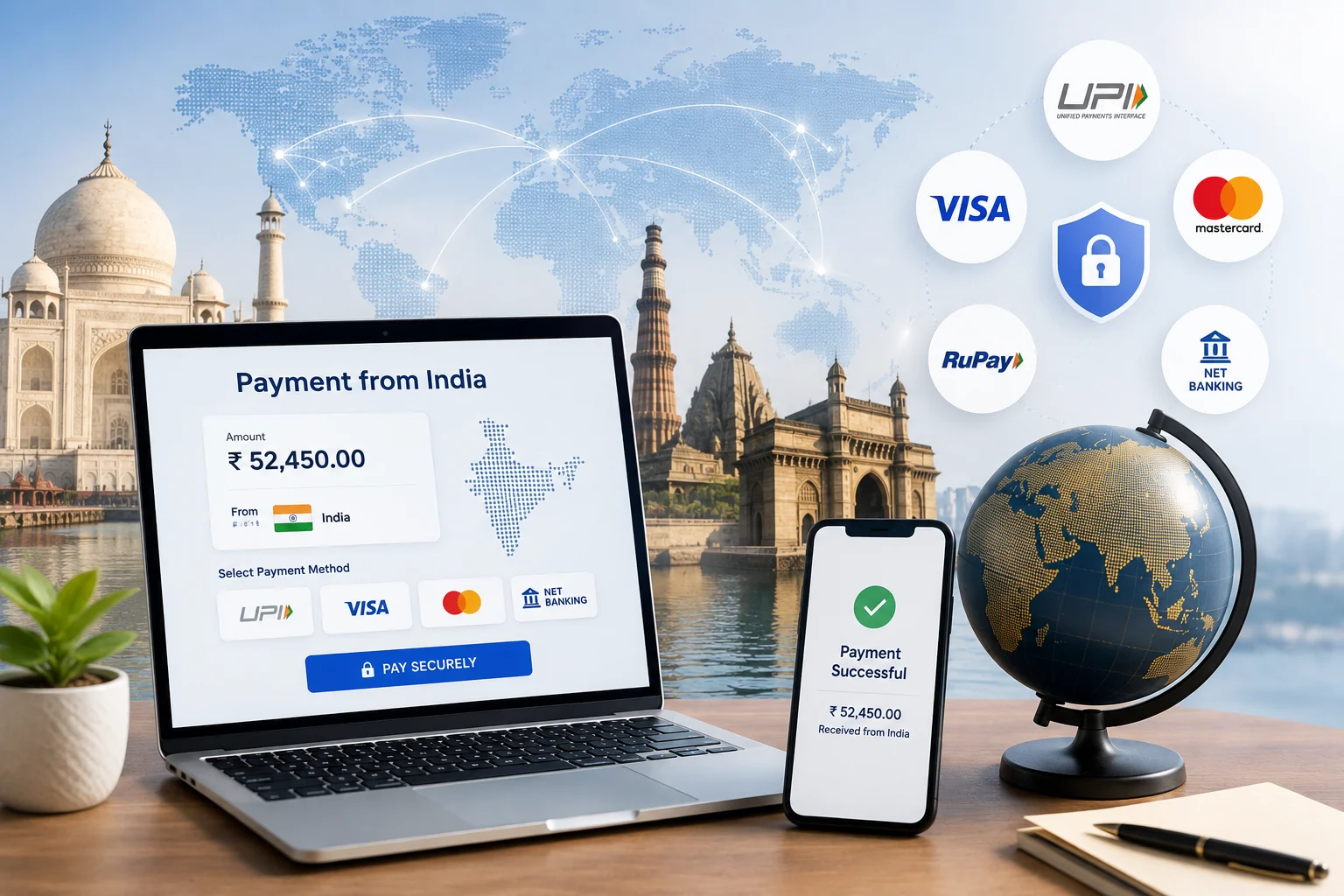
- Cards are not the default instrument: UPI accounts for roughly 85% of India’s digital payment transactions by volume. A checkout offering Visa and Mastercard with UPI buried below is optimising for a minority of buyers.
- Recurring payments follow different rules: India’s e-mandate framework, consolidated by the RBI in 2026, requires additional factor authentication at mandate registration, on the first transaction, and on higher-value recurring charges. Merchants cannot store raw card credentials. The silent auto-renewal underpinning most Western subscription models does not exist in the same form.
3 Ways to Accept Payments From Indian Customers
- Cross-border acquiring keeps your existing global processor and switches India on. Simplest, and the option that produces the decline rates above.
- Local acquiring via a PA-CB licensee a provider holding the RBI’s cross-border payment aggregator authorisation collects in rupees domestically, converts through an authorised dealer bank, and remits to your overseas account. No Indian entity required.
- Merchant of record third party merchant becomes the legal seller and takes on local tax obligations. More expensive and less control, but removes compliance burden. Common for SaaS and digital goods.
6 Payment Platforms for Collecting Payments From India
| Platform | Model | Indian entity needed? | UPI for your buyers | Best for |
| Stripe | Global processor | Yes, for a Stripe India account (invite-only) | Not on Stripe India accounts; available to some non-India business locations | Companies already on Stripe with modest India volume |
| Adyen | Global processor with Indian licence | No | Yes | Enterprises already on Adyen elsewhere |
| Checkout.com | Global processor | Cross-border | Confirm current coverage | Card-centric global merchants |
| PayPal | Global wallet | No | No native UPI | Low-volume, wallet-familiar buyers |
| Cashfree Payments | PA-CB licensee | No | Yes | Collecting locally without incorporating |
| PayU | Online, offline and cross-border PA | Varies | Yes | Established merchants with negotiating volume |
Which Payment Platform Is Right for Your Business?
Stripe
Excellent developer experience and the default for a large share of global SaaS. The India picture is more restrictive than most teams expect: a Stripe India account requires a registered Indian business and is invite-only, and UPI is not supported on Stripe India accounts; it is enabled for a defined set of non-India business locations instead. Check which of those applies to you before assuming India is a configuration change.
Adyen
The cleanest path for an enterprise already processing on Adyen. It holds an RBI online payment aggregator authorisation permitting local acquiring, alongside cross-border coverage on the import side, so you keep one integration and one reporting model while transactions route domestically. Typically priced for enterprise volumes, which makes it a weaker fit for smaller merchants.
Checkout.com
Strong card processing and a reasonable fit for merchants whose India volume is genuinely card-based. Confirm its current local-method coverage against your requirements, since in India local methods are most of the market.
PayPal
Widely recognised and simple to enable, but no native UPI for Indian buyers, which caps its usefulness. Reasonable as a secondary option, weak as a primary one.
Cashfree Payments
The most direct answer to the specific problem of collecting from India without setting up there. It was the first Indian entity to receive the RBI’s PA-CB authorisation, in July 2024. Indian customers pay in rupees through UPI, RuPay, cards or net banking; funds route into a collection account maintained with an authorised dealer bank, get converted, and are remitted to your overseas account. No Indian entity, local bank account or GST registration is required.
The practical advantages are that your Indian buyers see a domestic checkout with their normal payment methods, and the transaction is acquired locally rather than crossing a border at authorisation.
The trade-offs are worth stating. You are adding a second processor and a second reconciliation stream alongside your existing global stack. Cashfree’s product surface is built primarily for the Indian market, so the developer experience is oriented toward Indian merchants rather than global multi-market operations. And per-transaction limits apply across the PA-CB framework, a regulatory feature affecting every licensee which large-ticket B2B merchants should check against their average order value.
PayU
Cleared across online, offline and cross-border payments in November 2025. Pricing is negotiated, which favours merchants with volume.
How to Choose the Right Payment Platform for India
- India is under 5% of revenue with no plans to grow it. Stay on your global processor and accept the decline rate. The integration cost is not justified.
- India is growing and you want to avoid incorporating. A PA-CB licensee is the intended answer; this is the case the licence category was created for.
- You already run Adyen globally. Use its Indian licensing before adding a vendor.
- You sell digital goods and tax exposure is the primary worry. Merchant of record.
- You expect an Indian entity within a year. Choose the provider you would want after incorporation, and start there.
Measure Your India Payment Performance Before Switching Providers
Whichever route you take, instrument first. Getting authorisation rate and payment method mix segmented for India onto a dashboard before changing anything a blended global figure will hide an India problem for exactly as long as India stays small, which is when fixing it is cheapest.
Then run the alternative in parallel on a slice of traffic rather than switching wholesale, and compare authorisation rates on matched cohorts. The improvement will be uneven across issuers, which is itself useful routing information. If the uplift lands in the range the industry research suggests, the revenue case usually clears the integration cost comfortably. If it does not, your decline problem lives elsewhere and you have saved yourself as a vendor.