The Hidden Cost on the Production Floor
Precious metal manufacturing sits at the intersection of industrial process and extraordinary material value. A gold refinery, silver processing plant, or platinum catalyst manufacturer deals daily with raw materials that are simultaneously essential to operations and extraordinarily vulnerable to theft. Unlike finished retail products, which can be tagged, logged, and tracked at the unit level, raw and semi-processed precious metals exist in forms – dust, granules, small bars, wire spools – that are difficult to inventory precisely and easy to conceal.
This creates a loss environment unlike almost any other industrial setting. Employee theft in precious metal manufacturing is frequently categorized under the euphemistic term “shrinkage,” but the actual financial impact can run to hundreds of thousands or millions of dollars annually for a mid-sized facility. The methods used are often mundane: a handful of gold dust carried out in a shirt cuff, a few grams of platinum concealed in a work boot, a small silver casting slipped into a lunch box.
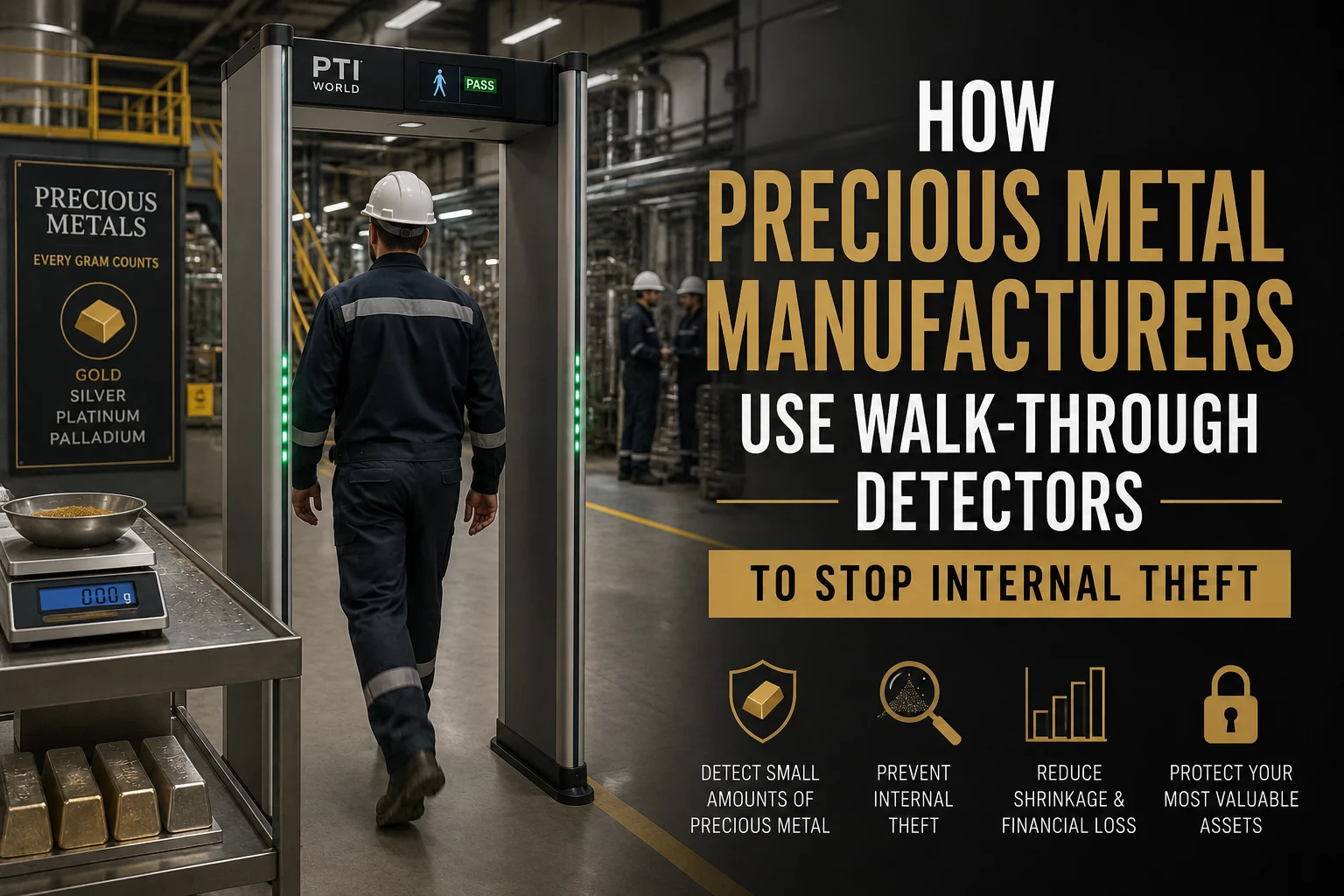
Walk-through metal detectors designed for the precious metals industry address this threat at the exit point. PTI World’s walk-through metal detectors are built specifically for this application, with detection sensitivity calibrated to identify quantities of precious metal that standard security portals would miss entirely.
Why Standard Security Detectors Fall Short
The walk-through metal detectors installed at airports and government buildings are designed to detect weapons – handguns, knives, improvised devices. Their sensitivity thresholds are calibrated accordingly. A small quantity of gold dust, a ring, or a thin platinum strip would not reliably trigger these systems under normal settings. In an airport, that is a reasonable design choice. In a gold refinery, it renders the detector functionally useless.
Purpose-built precious metal detectors operate on fundamentally different sensitivity parameters. Systems designed for this industry can detect fractions of a troy ounce – quantities far below the threshold of any security-grade portal. Some advanced systems used in high-value processing environments can detect even smaller targets, making them effective against the most common theft methods: small amounts of material removed incrementally over many working days.
Common Theft Vectors in Precious Metal Manufacturing
Understanding how theft occurs in a manufacturing environment is essential to positioning detection equipment effectively. The most common vectors include concealment on the body – precious metal hidden in clothing, hair, or undergarments – and concealment in personal items such as food containers, bags, and personal electronics.
Secondary vectors include removing material in waste streams (legitimately generated process waste that is diverted before it reaches authorized recovery channels) and manipulation of process records to mask material disappearances in the accounting of production yield. Walk-through detectors address the first category directly. Their presence also has a deterrent effect on all other methods, because staff who know that exit screening is rigorous and consistent tend to be less confident about any theft method that requires carrying material out of the facility.
Placement Strategy Within Manufacturing Facilities
The effectiveness of walk-through detection in a manufacturing environment depends significantly on placement. The ideal configuration creates unavoidable screening points at every exit from production areas – not just building exits, but transitions between the production floor and break rooms, locker areas, and administrative spaces.
Some facilities use a zone-based approach: detectors at the production area exits, again at the locker room exits, and once more at the final building exit. This layered screening catches concealment attempts that might evade a single checkpoint. Security managers who want to understand how walk-through detectors fit within a broader screening strategy may find value in reviewing resources like PTI World’s guide to walk-through vs. handheld detector selection, which outlines when each technology type is most appropriate.
Managing False Alarms
In a manufacturing environment, false alarms carry a real operational cost. A system that triggers frequently on belt buckles, steel-toed boots, or tools that employees carry legitimately creates alert fatigue and frustration. Operators begin to treat alarms as routine noise, which undermines the entire purpose of the system.
Modern walk-through detectors address this through programmable discrimination features that can distinguish between the metallic signature of common personal items and the signatures associated with precious metals. Some systems allow selective zone activation – a detector might be configured to screen primarily for the specific metals processed in a facility while tolerating the common ferrous metals found in standard work gear.
The Human Element: Policy and Culture
Walk-through detection is most effective when it is part of a broader organizational culture around material accountability. Facilities that communicate clearly about their screening practices, apply them consistently across all personnel (including management), and pair them with transparent inventory management tend to see the strongest loss reduction outcomes.
Arbitrary or inconsistent application undermines both the deterrence value and the legal defensibility of detection-based loss prevention. When a detector alert leads to an investigation and potential disciplinary or legal action, the consistency of the screening process becomes critical documentation.
Conclusion
Precious metal manufacturers operate in an environment where the theft exposure is structural, not circumstantial. The value of the materials handled creates an ongoing temptation that no management approach alone can fully neutralize. Walk-through metal detectors calibrated for precious metal detection change the risk equation fundamentally – not by eliminating the temptation but by making the act of removing materials from the facility reliably detectable. To learn more about detection systems built for this industry, visit PTI World.