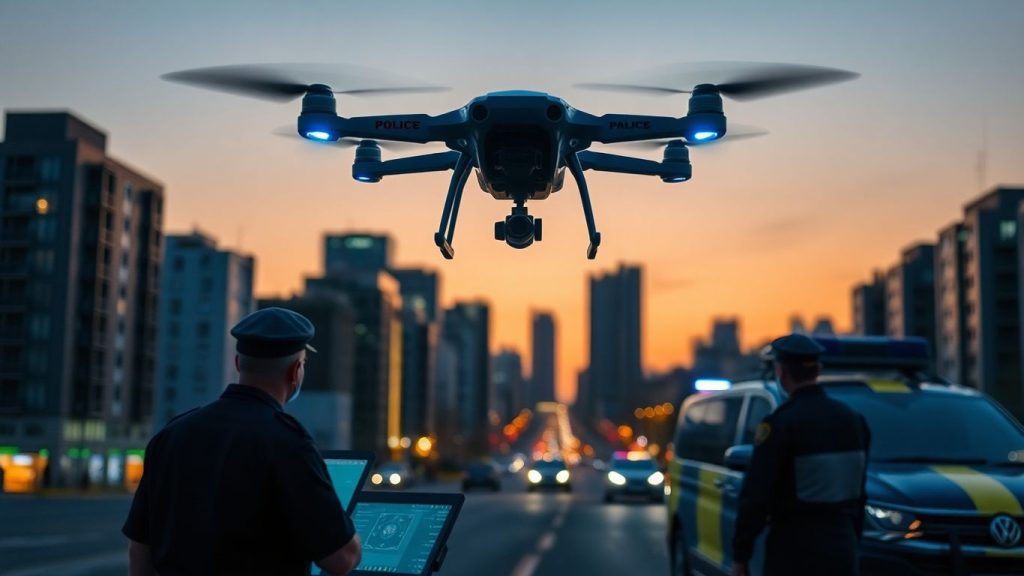
Police departments across the United States are rapidly embracing emerging technologies to enhance their capabilities in crime prevention and public safety. Drones, facial recognition, and innovative restraint tools are redefining policing methods and delivering notable results in communities large and small.
Key Takeaways
- Drone fleets are increasingly used for surveillance, search-and-rescue, and event management.
- Facial recognition technology is being considered and regulated as an investigative aid.
- Modern technology contributes to faster suspect identification and arrest.
- Investment in specialized training and equipment is a growing trend.
Aerial Advantage With Drones
Departments in cities such as New Ulm, Midland, and Newark have integrated drone fleets into their daily operations. These drones offer real-time aerial views during emergencies, search-and-rescue missions, and large gatherings. For example, the Midland Police used drones for crowd control and emergency oversight at major public events, significantly improving response times and situational awareness.
Newark’s program, featuring docked and handheld drones, allows officers to assess volatile situations before arriving at the scene. By leveraging live video feeds, officers gain critical insights to protect themselves and civilians alike. Since adoption, Newark has reported hundreds of successful deployments aiding in both active investigations and suspect apprehensions.
Meanwhile, interior-use drones are proving invaluable for searching buildings and securing dangerous locations, reducing risk to officers.
Facial Recognition: Promise and Controversy
The Aurora Police Department is moving towards adopting facial recognition tools to help identify suspects and support ongoing investigations. This technology compares images against vast databases, dramatically accelerating the investigative process. Advocates argue it functions similarly to DNA or fingerprints, providing leads that help crack tough cases.
However, the move is not without criticism. Community advocates and some lawmakers raise concerns over privacy, data misuse, and potential for misidentification, especially among vulnerable populations. Strict legal guardrails in states like Colorado mandate transparency, accountability, and limitations on usage, reflecting the need for balance between innovation and civil liberties.
Swift Justice: Tech-Enabled Crime Solving
Advanced technology plays a crucial role not only in prevention but also in solving crimes at record pace. In Columbus, law enforcement credited modern investigative tools with the rapid apprehension of a homicide suspect—an outcome that would have been more difficult just a few years ago. Enhanced data analysis, surveillance footage, and digital evidence accelerated the process, ensuring community safety while upholding due process.
Investment in Tools and Training
As the demand for high-tech policing grows, so too does investment in equipment and specialized training. Police departments are allocating budget resources toward acquiring advanced drones and training officers in their safe and effective use. Ongoing training ensures these tools are leveraged responsibly, maximizing public benefit while minimizing risks.
Further Reading
- Local police departments make technology upgrades, KEYC News Now.
- Newark police utilizing drone technology to help fight crime, News 12 – Long Island.
- Aurora PD eyeing facial recognition technology to help solve crimes, Denver7.
- Midland police take flight with drone technology – Catalyst Midland, Concentrate.
- Columbus police assistant chief credits advanced technology on swift apprehension of suspect accused of fatal
home invasion, WRBL.

Founder Dinis Guarda
IntelligentHQ Your New Business Network.
IntelligentHQ is a Business network and an expert source for finance, capital markets and intelligence for thousands of global business professionals, startups, and companies.
We exist at the point of intersection between technology, social media, finance and innovation.
IntelligentHQ leverages innovation and scale of social digital technology, analytics, news, and distribution to create an unparalleled, full digital medium and social business networks spectrum.
IntelligentHQ is working hard, to become a trusted, and indispensable source of business news and analytics, within financial services and its associated supply chains and ecosystems