Google has folded its AI research tool NotebookLM into the Gemini brand, giving it a new name — Gemini Notebook — and a secure cloud computer that lets it write and run code against a user’s own sources.
Google has renamed NotebookLM as Gemini Notebook and started rolling out native code execution through a secure cloud computer built into every notebook. The change, confirmed on 16 July 2026, folds one of Google’s fastest-growing AI products more tightly into the Gemini ecosystem while keeping it a standalone tool rather than a feature buried inside the main Gemini app.
Josh Woodward, VP for Google Labs, the Gemini app and AI Studio, framed the move as an evolution rather than a relaunch:
“We’re renaming NotebookLM to Gemini Notebook. It’s the same standalone product, now doing more across the Google ecosystem and updated with a secure cloud computer.”
From Project Tailwind to a 30-Million-User Product
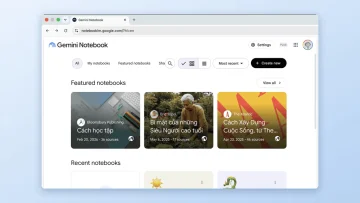
Gemini Notebook’s roots go back to Google I/O 2023, where it debuted under the working title Project Tailwind. Since then, the tool has grown into one of Google’s more significant AI products: the company says more than 30 million people and over 600,000 organizations now use it, spanning individual researchers, students, and business teams. Google has not broken down how many of those users come from education specifically, nor disclosed active-account or paid-subscriber figures.
The product’s core idea has stayed consistent since launch, users upload their own documents, and the AI reads, summarizes, and answers questions about them, with citations tying each answer back to the original source. What has changed is how far that idea now reaches across Google’s ecosystem.
What the Secure Cloud Computer Actually Does
The headline technical upgrade is a secure cloud computer attached to every notebook, giving Gemini Notebook the ability to write and execute code natively rather than simply summarizing or organizing text. Google says this is designed to support complex data analysis grounded directly in a user’s uploaded sources, along with new output formats such as charts, spreadsheets, and slide decks.
Access is rolling out in stages rather than to every account simultaneously:
- Available now: Google AI Ultra subscribers and Workspace business customers with AI Ultra Access or AI Expanded Access
- Coming in the following weeks: all Pro users on the web
- Timeline unconfirmed: free-tier access to code execution
Google has not disclosed which programming languages the cloud computer supports or published processing and usage limits, leaving some technical details for users to discover through hands-on testing.
Deeper Integration With the Gemini App and Search
Notebooks can already be created and accessed directly inside the Gemini app, with changes syncing across both the app and the standalone Gemini Notebook product. Google also intends to bring notebooks into AI Mode in Google Search, a move that would place the research tool inside the same AI-driven search interface used by a much larger audience — though the company has not set a date for that rollout.
The overlap between the Gemini app’s built-in “Notebooks” section, the standalone Gemini Notebook product, and the promised Search integration has already drawn some criticism for creating a confusing landscape of similarly named surfaces. Google has described the rebrand as reflecting the product’s growing footprint rather than a consolidation of these experiences into one.
Business and Education Use Cases
For Workspace customers, Google says Gemini Notebook and its Audio Overviews feature are now bundled into all plans by default. The tool can import Google Docs and Slides directly from Drive and supports shared notebooks for team collaboration. Google points to use cases including analyzing financial and market documents, building onboarding materials from training manuals and internal policies, and preparing meeting briefs from product specifications and research.
On the education side, Google says students can build notebooks from lecture recordings, textbook chapters, and research papers, using the tool to explain concepts, generate examples, and convert notes into audio or video summaries. Some commentary following the announcement has raised a caution alongside the convenience: code generated automatically and executed without inspection can look polished while containing errors that are easy to miss, a risk worth weighing for educators and analysts who rely on the output without checking the underlying logic.
Data and Privacy Commitments
Google states that data uploaded through an organization or school account is not used to train Gemini Notebook. For individual consumer accounts, the company says uploaded data is not used for training unless a user actively shares feedback on a response.
What Happens Next
Native code execution is live today for Google AI Ultra users and eligible Workspace business customers, with Google saying it will extend to all Pro users on the web over the coming weeks. The planned integration with AI Mode in Google Search remains without a confirmed date. As Google continues absorbing standalone AI experiments into the wider Gemini brand, Gemini Notebook’s expansion offers an early signal of how the company plans to unify research, productivity, and search around a single AI layer — while still testing how much users are willing to trust automated code and data analysis they haven’t personally verified.
Sources
- EdTech Innovation Hub — “Google renames NotebookLM as Gemini Notebook and adds native code execution”
- Pulse2 — “Google Renames NotebookLM As Gemini Notebook And Adds Native Code Execution”
- The Next Web — “Google renames NotebookLM to Gemini Notebook and expands code execution to Pro users”
- Slashdot / The Verge (via Slashdot) — “Google Renames NotebookLM to Gemini Notebook”
- Northeast Times — “Google renames NotebookLM to Gemini Notebook, adds code tools”
- Chrome Story — “NotebookLM Is Now Gemini Notebook: What Changed”
- Gagadget — “Google renames NotebookLM to Gemini Notebook — here’s what actually changed”