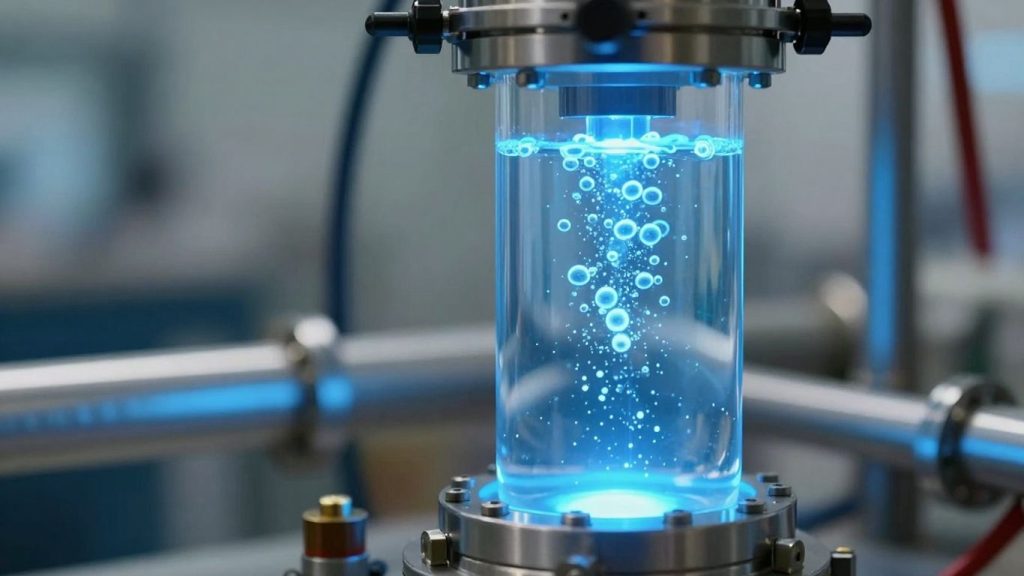
A German firm, Rheinmetall, has unveiled a groundbreaking electrode technology poised to significantly reduce the cost of green hydrogen production. This innovation is a crucial step towards a more sustainable energy future, with pilot production set to commence next year. The technology aims to enhance the power and efficiency of electrolyzer systems, making green hydrogen more accessible and contributing to energy independence.
Key Takeaways
- Rheinmetall’s new electrode technology significantly lowers green hydrogen production costs.
- The innovation boosts electrolyzer efficiency by over 10% and doubles power density.
- It utilizes noble metal-free catalysts, making it highly scalable and cost-effective.
- Pilot production is scheduled to begin next year at the St. Leon-Rot facility.
Advancing Green Hydrogen Production
Rheinmetall’s subsidiary, KS Gleitlager GmbH (KSG), has been at the forefront of this development through the German government-funded consortium project ‘Noble Metal-free Electrodes for the Next Generation of Alkaline Electrolysis’ (E²ngel). Over the past three years, the project has focused on increasing the power density and efficiency of water electrolysis for green hydrogen production, specifically by employing catalysts that do not rely on expensive noble metals.
Technological Breakthroughs
The company’s extensive expertise in special alloy material development, metallic coating processes, and various forming and joining technologies facilitated the rapid development of both the catalyst and the production process. The E²ngel consortium partners, including the German Aerospace Centre (DLR) and McPhy Energy Germany, played vital roles in the timely qualification and validation of the technology. The DLR Institute of Technical Thermodynamics tested numerous development variants, while McPhy conducted tests in the final project phase to ensure suitability for electrolyzer systems. These efforts successfully surpassed ambitious project goals for cell voltage and current density, proving the efficiency of the precious metal-free electrode technology compared to more complex, costly alternatives.
Path to Scalability and Production
Series production of the electrodes is now underway, with pilot production slated to begin at the St. Leon-Rot site in the coming year. The production line is designed to accommodate electrode dimensions of up to two meters, making it suitable for multi-megawatt electrolyzer systems. Rheinmetall emphasized that the process and production technology were selected with the necessary volume scaling for a successful energy transition in mind. This advancement is expected to make a substantial contribution to a sustainable and affordable energy transition, while also reducing reliance on imported fossil fuels and bolstering the resilience of the German and European energy supply.
Sources
- German firm’s new electrode technology delivers low-cost hydrogen, Interesting Engineering.

Founder Dinis Guarda
IntelligentHQ Your New Business Network.
IntelligentHQ is a Business network and an expert source for finance, capital markets and intelligence for thousands of global business professionals, startups, and companies.
We exist at the point of intersection between technology, social media, finance and innovation.
IntelligentHQ leverages innovation and scale of social digital technology, analytics, news, and distribution to create an unparalleled, full digital medium and social business networks spectrum.
IntelligentHQ is working hard, to become a trusted, and indispensable source of business news and analytics, within financial services and its associated supply chains and ecosystems