Investment banking has always attracted ambitious finance graduates. The combination of high-value transactions, corporate strategy, financial markets and complex deal-making makes it one of the most competitive areas of finance.
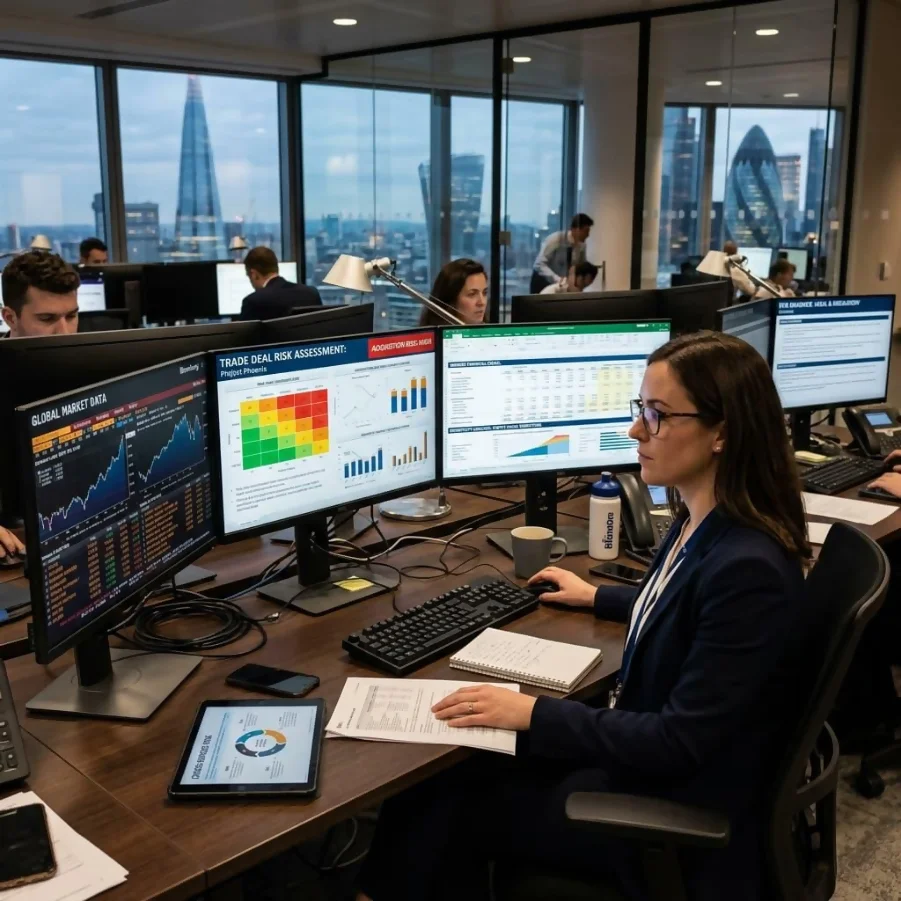
But there is a problem many students discover only after graduation.
Knowing finance and knowing how to work in investment banking are not necessarily the same thing.
A student may understand accounting principles, know how to calculate financial ratios and even perform well in finance examinations, yet struggle when asked to build a three-statement financial model, value a company using a DCF, prepare an M&A analysis or explain a transaction to a senior banker.
That gap between academic knowledge and practical ability is one reason professional investment banking education has become increasingly important.
But with hundreds of courses, certifications and training programmes available online and offline, how do you identify the best investment banking course for your career?
The answer is not simply the programme with the most impressive title or the longest list of certifications. The right programme should help you develop skills that investment banking teams actually use.
What Does an Investment Banking Analyst Really Need to Know?
Before choosing a course, it helps to understand what analysts actually do.
At an entry level, investment banking involves much more than watching financial markets.
Analysts may spend their days researching companies and industries, analysing financial statements, building valuation models, preparing presentations, supporting due diligence and helping senior team members evaluate transactions.
Depending on the team, they may work on:
- Mergers and acquisitions
- Initial public offerings
- Debt and equity fundraising
- Company valuations
- Financial restructuring
- Industry research
- Comparable-company analysis
- Transaction analysis
- Pitch books
- Financial modelling
This explains why a good investment banking course needs to be practical.
Reading about a DCF model is different from actually building one.
Understanding the concept of an acquisition is different from modelling how the transaction could affect the combined company’s earnings.
Knowing what EBITDA means is different from being able to analyse EBITDA trends across a company’s historical financial statements and forecast period.
The closer training gets to these real tasks, the more useful it becomes.
The Most Important Skill: Financial Modelling
If there is one technical skill aspiring investment bankers should take seriously, it is financial modelling.
Financial models turn assumptions about a business into a structured representation of its potential financial performance.
A beginner may start with historical financial statements before moving into forecasts. From there, the model can incorporate revenue growth, operating expenses, working capital, capital expenditure, debt and other assumptions.
A strong programme should eventually teach students how the three primary financial statements connect:
Income Statement → Balance Sheet → Cash Flow Statement
That connection is fundamental.
It also provides the foundation for more advanced work such as discounted cash flow valuation, transaction modelling and M&A analysis.
This is why prospective students should look beyond programmes that simply advertise “Excel training.” The real question is whether the course teaches students to use Excel to solve finance problems.
Valuation Is More Than Memorising Formulas
Another essential component of investment banking education is valuation.
A company’s value can be assessed in several ways, depending on the situation and the information available.
Common approaches include:
Discounted Cash Flow Analysis
DCF valuation estimates the present value of a company’s expected future cash flows.
It introduces students to concepts such as:
- Free cash flow
- Terminal value
- Discount rates
- WACC
- Growth assumptions
- Sensitivity analysis
Comparable Company Analysis
This approach compares a company with similar publicly traded businesses.
Students may analyse multiples such as:
- EV/EBITDA
- EV/Revenue
- P/E
But the important part is understanding why companies trade at different multiples rather than simply calculating them.
Precedent Transactions
In M&A, analysts may examine previous transactions involving similar companies to understand how the market has valued comparable businesses.
A good investment banking certification should therefore teach the reasoning behind valuation, not just the mechanics.
M&A Training Makes the Learning More Practical
Mergers and acquisitions are one of the areas most closely associated with investment banking.
An M&A assignment can bring several skills together.
Imagine that Company A wants to acquire Company B.
An analyst may need to understand both businesses, examine their financial statements, estimate an appropriate valuation, consider the purchase price, model financing assumptions and assess the potential effect on the combined company.
That single exercise can involve accounting, valuation, financial modelling, corporate finance and strategic analysis.
This is why practical case studies can be more valuable than isolated theoretical exercises.
A student who has completed several transaction-based projects can enter an interview with something more useful than a certificate: an understanding of how the pieces fit together.
Don’t Ignore Capital Markets
Investment banking is also closely connected to capital markets.
Companies need capital to expand, acquire other businesses, invest in technology or refinance existing obligations.
That capital can come through equity or debt markets.
Students should therefore understand the basics of:
- IPOs
- Follow-on offerings
- Debt issuance
- Bonds
- Equity markets
- Credit markets
- Capital raising
- Market conditions
This knowledge becomes particularly useful when evaluating how a company might finance a transaction.
It also helps students understand why investment banking sits at the intersection of corporate finance and financial markets.
Technology Is Changing Investment Banking
There is another reason today’s investment banking education looks different from programmes of the past: technology.
Excel remains fundamental, but modern finance teams increasingly work with data analytics, automation, AI tools and business intelligence platforms.
Professionals may use technology to:
- Analyse large datasets
- Automate repetitive tasks
- Screen companies
- Organise financial information
- Build dashboards
- Research industries
- Improve reporting
Python and data analytics are not necessarily substitutes for core investment banking skills, but they can become valuable complements.
This is particularly relevant as artificial intelligence becomes more integrated into financial workflows.
The goal should not be to turn every investment banker into a software developer.
Instead, the goal is to create finance professionals who understand how technology can improve analysis without losing sight of financial judgement.
What Should the Best Investment Banking Course Include?
There is no universal course that is automatically the best for every student.
A programme that works for a commerce graduate may not be ideal for a software professional transitioning into finance.
However, there are several criteria that can help candidates compare programmes.
Financial Modelling
Look for hands-on modelling rather than only recorded lectures about Excel.
Valuation
The curriculum should cover DCF, comparable companies and transaction-based valuation.
M&A
Students should have opportunities to understand how acquisition analysis works in practice.
Financial Statements
A strong foundation in accounting and financial statement analysis is essential.
Capital Markets
Students should understand how companies raise debt and equity.
Practical Projects
Projects allow students to turn theoretical knowledge into demonstrable skills.
Industry Exposure
Experienced practitioners can provide context that textbooks cannot always offer.
Interview Preparation
Investment banking recruitment can be highly technical. Training should therefore include technical questions, financial modelling tests and communication skills.
Technology
Modern programmes can add value by introducing analytics, automation and relevant finance technology.
Career Support
Resume guidance, interview preparation, mentorship and career support can be useful, particularly for candidates entering the industry for the first time.
Where Does Certification Fit In?
An investment banking certification can be useful, but the certificate itself should not be the primary objective.
Think of certification as evidence of structured learning.
Recruiters ultimately want to know whether a candidate can perform the work.
Can you build a financial model?
Can you explain your valuation assumptions?
Can you walk through a balance sheet?
Can you explain why one company might trade at a higher multiple than another?
Can you discuss an M&A transaction intelligently?
Those abilities are more meaningful than the certificate sitting at the top of a resume.
The strongest programmes therefore combine certification with practical assignments and industry-oriented learning.
An Example of a Practical Investment Banking Learning Model
Among programmes available to students and professionals, Boston Institute of Analytics offers an Investment Banking and Financial Analytics programme that combines investment banking concepts with financial analytics.
Its curriculum includes financial analysis, corporate finance, equity and fixed income, derivatives, equity research, financial modelling and M&A valuation, alongside tools such as Excel, Python, Power BI and Tableau. The programme also incorporates practical assignments and case studies.
For someone comparing the best investment banking course options, this type of curriculum illustrates an important principle: finance education becomes more useful when technical concepts are connected to practical application.
The programme is offered through different learning paths, including certification, diploma and master diploma formats, according to BIA’s current course information.
Students should nevertheless compare any programme against their own goals, schedule, existing finance knowledge and preferred learning format before making a decision.
Do You Need an MBA to Enter Investment Banking?
Not necessarily.
An MBA from a strong business school can provide access to investment banking recruitment, but it is not the only possible route.
Candidates can also build careers through finance degrees, professional qualifications, relevant internships, financial modelling training, valuation experience and entry-level finance roles.
What matters is whether the candidate can demonstrate relevant skills.
For a graduate without an MBA, practical investment banking training can help bridge the gap between academic finance and the technical work expected in analyst roles.
For someone already working in accounting, consulting, corporate finance or another financial role, targeted training may help build the specific modelling and valuation skills required for a transition.
What About CFA?
The CFA programme can also complement an investment banking career, particularly for professionals interested in investment analysis, valuation, portfolio management and financial markets.
However, CFA preparation and investment banking training serve somewhat different purposes.
CFA study provides a broad and rigorous foundation across areas such as economics, financial reporting, quantitative methods, equity investments, fixed income and portfolio management.
Investment banking training tends to be more focused on transaction-oriented skills such as financial modelling, valuation, M&A and deal analysis.
For some candidates, the combination can be valuable.
The important point is to understand what skill gap you are trying to solve.
The Right Course Depends on the Career You Want
One of the easiest mistakes is choosing a programme because it sounds prestigious rather than because it matches your career objective.
If your goal is M&A, prioritise valuation, financial modelling and transaction analysis.
If you are interested in equity research, focus on financial statement analysis, valuation and industry research.
If capital markets interest you, look closely at debt, equity and market-related modules.
If financial analytics is your preferred direction, consider programmes that combine finance with data tools and business intelligence.
The “best” programme is therefore not necessarily the one with the longest syllabus.
It is the one that closes the biggest gap between where you are now and the skills your target role requires.
The Investment Banking Classroom Is Changing
Investment banking itself is changing, and education needs to change with it.
The analyst of the future will still need to understand accounting, valuation and corporate finance. Those fundamentals are unlikely to disappear.
But the workflow around them will continue to evolve.
AI may accelerate research.
Automation may reduce repetitive spreadsheet work.
Data analytics may make financial information easier to interpret.
Cloud-based platforms may change how teams collaborate.
Yet technology does not remove the need for financial judgement.
If anything, it increases its importance.
When information becomes easier to generate, the ability to decide which information matters becomes more valuable.
That is why the strongest investment banking education should develop both technical capability and analytical thinking.
Final Thoughts
Choosing an investment banking course is ultimately an investment in skills, not simply a purchase of a certificate.
The right programme should help you move from understanding finance concepts to applying them.
You should finish knowing how to read financial statements, build a model, value a company, analyse a transaction and communicate your conclusions clearly.
You should also understand where technology fits into modern finance and how investment banking connects businesses with capital markets.
For students and professionals comparing their options in 2026, the question should therefore not simply be:
“Which is the best investment banking course?”
A better question is:
“Which investment banking course will give me the practical skills, financial knowledge and industry exposure needed for the role I actually want?”
That shift in thinking can make the difference between collecting another qualification and genuinely becoming job-ready.
And in an industry as competitive as investment banking, being able to demonstrate what you can do will always matter more than simply being able to say what you studied.
FAQs
- What should I look for in the best investment banking course?
Look for a course that combines financial modelling, company valuation, M&A, financial statement analysis, capital markets and practical case studies. Industry exposure, hands-on projects and interview preparation can also make a course more useful for building job-ready skills.
- Can I pursue an investment banking course without a finance degree?
Yes. Graduates from commerce, economics, business, mathematics, engineering and other backgrounds can learn investment banking. A structured course can help you build the required foundation in finance, accounting, valuation and financial modelling.
- Is financial modelling important for an investment banking career?
Yes. Financial modelling is one of the core technical skills used in investment banking. Analysts use models for forecasting, valuation, M&A analysis, transaction evaluation and understanding a company’s financial performance.
- Is CFA useful for an investment banking career?
Yes, CFA can complement investment banking training by developing knowledge of financial analysis, accounting, economics, equity investments and fixed income. However, candidates targeting investment banking roles should also develop practical skills in financial modelling, valuation and M&A.
- Does completing an investment banking course guarantee a job?
No course can guarantee employment. However, a practical investment banking certification or training programme can help candidates develop relevant technical skills, build project experience and prepare for investment banking interviews.