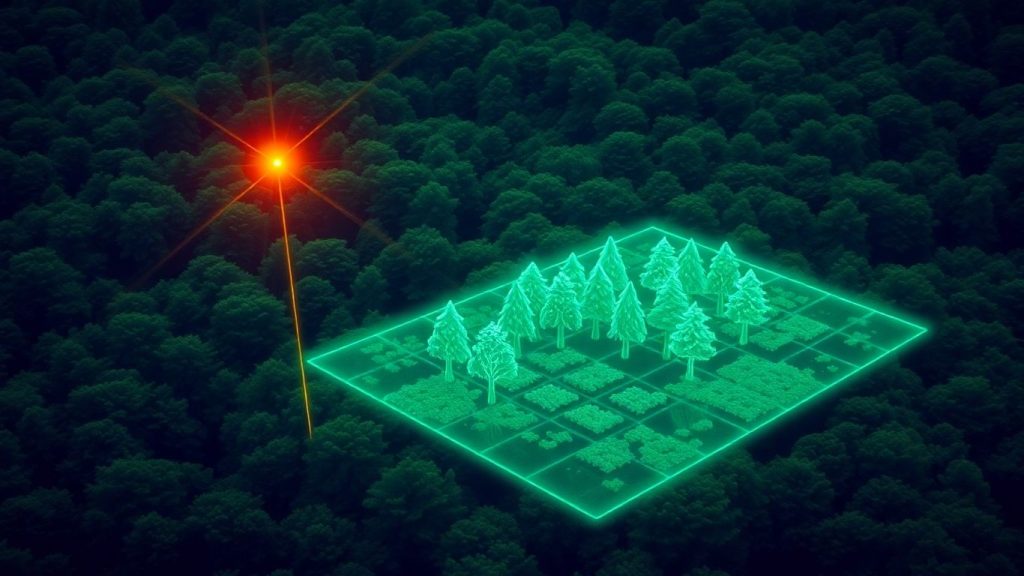
A team of researchers from the University of Helsinki has revolutionized forest study by developing a digital twin of forests using groundbreaking terrestrial laser scanning (TLS) technology. This advancement offers a fresh, immersive way to analyze forest ecosystems, potentially transforming how forests are managed and conserved worldwide.
Key Takeaways
- Innovative laser scanning provides precise three-dimensional models of forests.
- Digital twins offer deeper insight into forest structure, health, and recovery.
- Applications span tropical rainforests to boreal forests, supporting global and local ecosystem management.
Transforming Forest Observation With TLS
Terrestrial laser scanning captures forests from the ground up, generating detailed three-dimensional representations. Unlike traditional aerial or satellite imaging, TLS allows researchers to virtually ‘walk inside’ the forest, examining the growth patterns and structural dynamics of individual trees and entire ecosystems.
Associate Professor Eduardo Maeda, who leads the Terrestrial Ecosystem Dynamics Research Group (Tree-D Lab) at the University of Helsinki, highlights the transformative nature of this innovation. According to Maeda, the technology enhances the ability to measure tree growth, monitor responses to natural or human-induced disturbances, and assess the relationship between forest structure and biodiversity.
Supporting Sustainable Forest Management
The TLS technology is not only advancing scientific understanding but is also instrumental in shaping sustainable forestry practices. In Finland, for example, the research has already yielded essential insights into how different management techniques impact forest growth and structure. These findings directly support the nation’s forest monitoring and sustainable management efforts.
Global Applications—from Boreal to Tropical Ecosystems
While much of the initial research focused on Finland’s boreal forests, the technology’s reach is global. The University of Helsinki team has employed TLS and complementary technologies—including drone-based sensors and satellite data—to study various ecosystems worldwide. In tropical regions such as Southeast Asia and the Amazon, the approach provides an unparalleled view of how logging and forest fragmentation alter fragile boundaries and impact ecological balance.
The Future of Ecosystem Monitoring
The creation of accurate digital twins enables scientists, policymakers, and communities to make better-informed decisions. With such precise models, it is possible to:
- Track Forest Recovery: Monitor the recovery of forests from disturbances such as storms or logging activities.
- Improve Biodiversity Assessments: Map variations in forest structure that influence plant and animal habitat.
- Support Climate Research: More accurately simulate the role of forests in carbon sequestration and climate regulation.
This integration of advanced laser technology and machine learning signals a significant leap forward for both environmental science and responsible resource management.
References

Founder Dinis Guarda
IntelligentHQ Your New Business Network.
IntelligentHQ is a Business network and an expert source for finance, capital markets and intelligence for thousands of global business professionals, startups, and companies.
We exist at the point of intersection between technology, social media, finance and innovation.
IntelligentHQ leverages innovation and scale of social digital technology, analytics, news, and distribution to create an unparalleled, full digital medium and social business networks spectrum.
IntelligentHQ is working hard, to become a trusted, and indispensable source of business news and analytics, within financial services and its associated supply chains and ecosystems