Progress and pressure are rising at the same time. That’s the story of inclusive finance in 2026.
Nearly 80% of adults worldwide now have a bank account (up from 50% in 2011), a mobile money account, or both, based on the latest World Bank Global Findex reporting. That is real progress. Yet donor support is tightening, grants are getting shorter, and many programs that helped reach rural and low-income users now face a funding gap.
So where does that leave the future of financial inclusion? In a simple place: technology and better data can help reach people faster and at lower cost, but only if growth stays fair, safe, and affordable for the people who need it most.
What is driving the funding gap, and who feels it most?
The funding gap is not abstract. It shows up when a lender stops serving remote areas, when a savings product never gets built, or when consumer support shrinks just as more first-time users come online.
Access has grown, but support systems are under strain. Public and donor funding has pulled back in many places during 2025 and 2026. At the same time, inclusion still needs investment in product design, fraud controls, financial education, and last-mile outreach.
Bottom line: opening an account is only the first step, not the finish line.
Low-income households feel this pressure first. So do women, small businesses, migrants, rural communities, and people with thin or no credit files. If services are hard to trust, too costly, or badly matched to daily life, people won’t use them for long.
Account ownership is up, but access does not always mean real financial inclusion
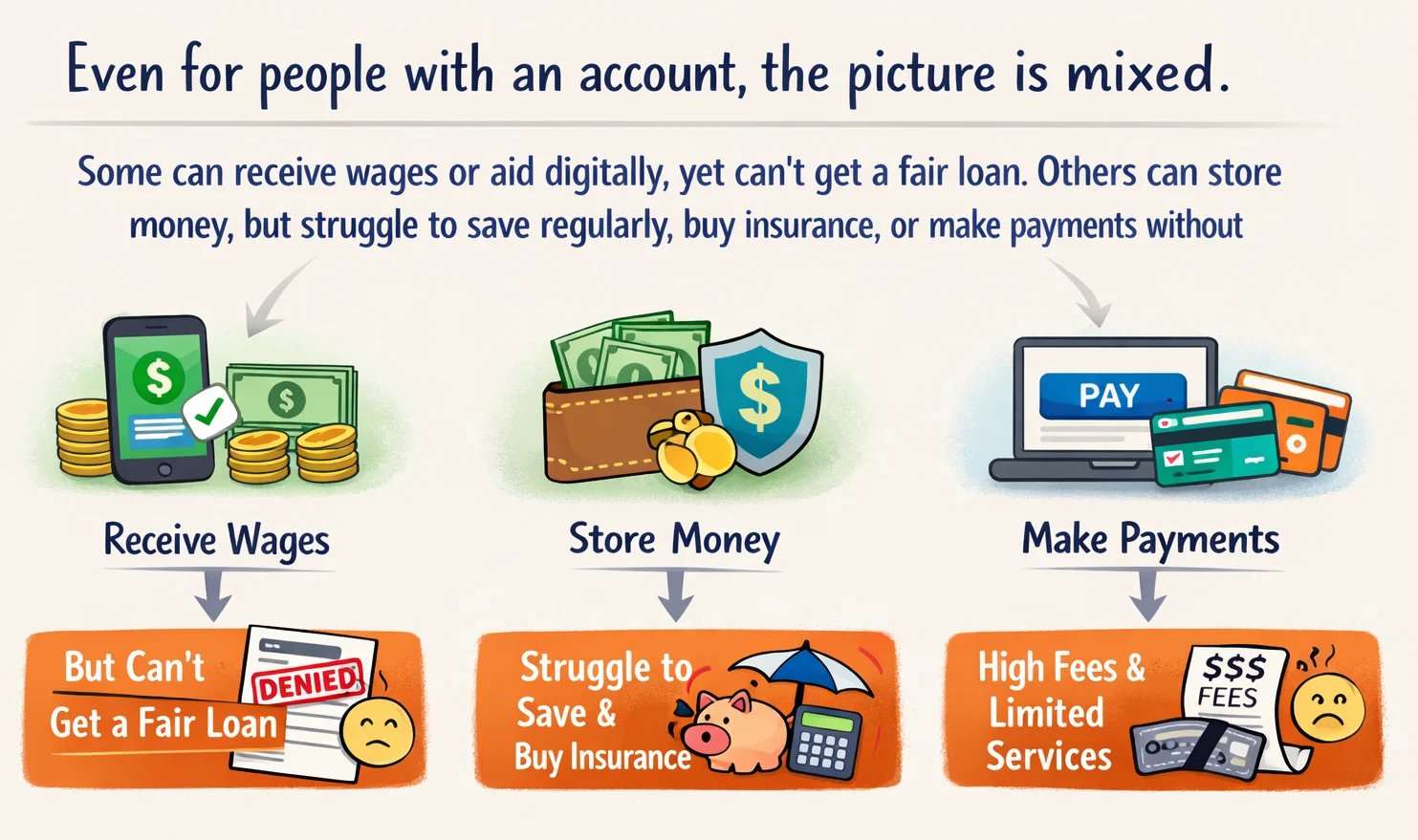
The headline number looks strong. As mentioned, almost 80% of adults have a bank account. Even in low and middle-income countries, account ownership reached 7%. Still, about 1.3 billion adults remain unbanked.
That’s the gap between access and use. A basic account can be like getting a front door key, but finding there’s no furniture inside. Real inclusion means people can save safely, borrow wisely, manage shocks, and move money when it matters.
Fragile and low-income settings face the biggest shortfall. Networks may be weaker there, products may be limited, and trust may be low. So the numbers can improve while daily financial life stays shaky.
Why lower donor support is pushing the sector to find new models
Donor pullbacks matter because grants often paid for the less visible parts of inclusion. Those funds helped with pilot programs, rural expansion, user protection, and tools for people who were harder to serve profitably.
Now the model is shifting. USAID funding has largely ended, several European donors have reduced aid, and many funders are directing money toward crisis response or blended finance rather than straight grants. As a result, providers need models that can stand on their own faster.
That is one reason CDFI lenders and other mission-driven finance providers keep coming up in this conversation, because they can help bridge gaps that traditional funding models no longer cover as easily.
That shift is pushing the sector toward private capital, platform partnerships, and embedded finance. In plain English, financial services are showing up inside apps and channels people already use.
How technology is helping close the gap faster and at lower cost
Technology can lower delivery costs, widen reach, and speed up service. Still, it’s not magic. A bad product on a phone is still a bad product.
The best tools work because they reduce friction. They cut travel time, shrink paperwork, and let providers serve smaller customers without losing money.
Mobile banking and fintech are making basic services easier to reach
For many users, the mobile phone is now the bank branch. That matters because 900 million unbanked adults already own a phone. With a wallet app, an agent nearby, or a simple menu-based service, people can send money, pay bills, save small amounts, and receive wages or aid without traveling far.
That convenience changes behavior. It turns irregular cash handling into a more stable routine. In addition, agent networks help bridge the gap where full bank branches are scarce.
Fintech is part of this story too. Fintechs raised about 53 billion dollars across nearly 6,000 deals in 2025, a 21% increase on 2024 volumes, pointing to renewed investor appetite for digital financial services, especially in payments, lending, and mobile‑first tools.
Either way, the message is clear: investors still see room for digital financial inclusion, especially in payments, lending, and mobile-first tools.
AI and alternative data can open credit for people with no formal history
Traditional credit scoring often shuts people out. No credit card history? No past bank loan? Many borrowers never get a fair look.
That’s where AI and alternative data come in. Lenders can assess patterns from cash flow, bill payments, mobile use, sales history, or business activity. For a market trader or a first-time borrower, that can turn “no file” into a usable picture of repayment capacity.

This is especially useful for microbusinesses. A shop owner may not have formal collateral, but steady payment flows can still show stability. That opens the door to small loans, working capital, and better pricing. Just as important, it can help people manage debt earlier and more realistically, before short-term borrowing turns into a bigger long-term problem.