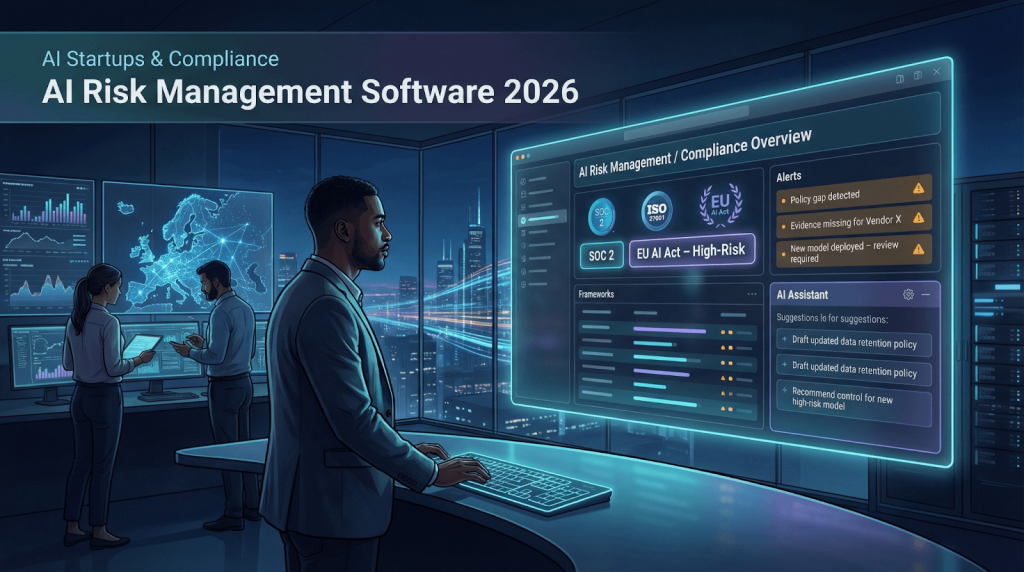
AI regulation is no longer coming—it’s here. The EU AI Act took effect in 2024 and became fully enforceable on August 2, 2026, so any “high-risk” system you ship must clear formal risk controls.
Investors and enterprise buyers already expect airtight evidence on day one. Thankfully, a fresh wave of risk management platforms does the heavy lifting. Take Vanta’s 2025 AI Agent: it drafts policies, flags gaps, and fixes issues that once swallowed entire weeks.
In the pages ahead, we’ll share our scoring criteria and compare 12 standout tools—each tagged “best for” a specific startup moment—so you can choose quickly and get back to building.
How we picked the winners
You’re busy shipping products, so we did the homework for you. We scanned more than forty GRC and AI-governance platforms, then zeroed in on the ones founders discuss in Reddit, Hacker News, and industry Slack channels. One thread summed up the frustration: “Most tools tick a compliance box but ignore real risk; I went back to spreadsheets.”
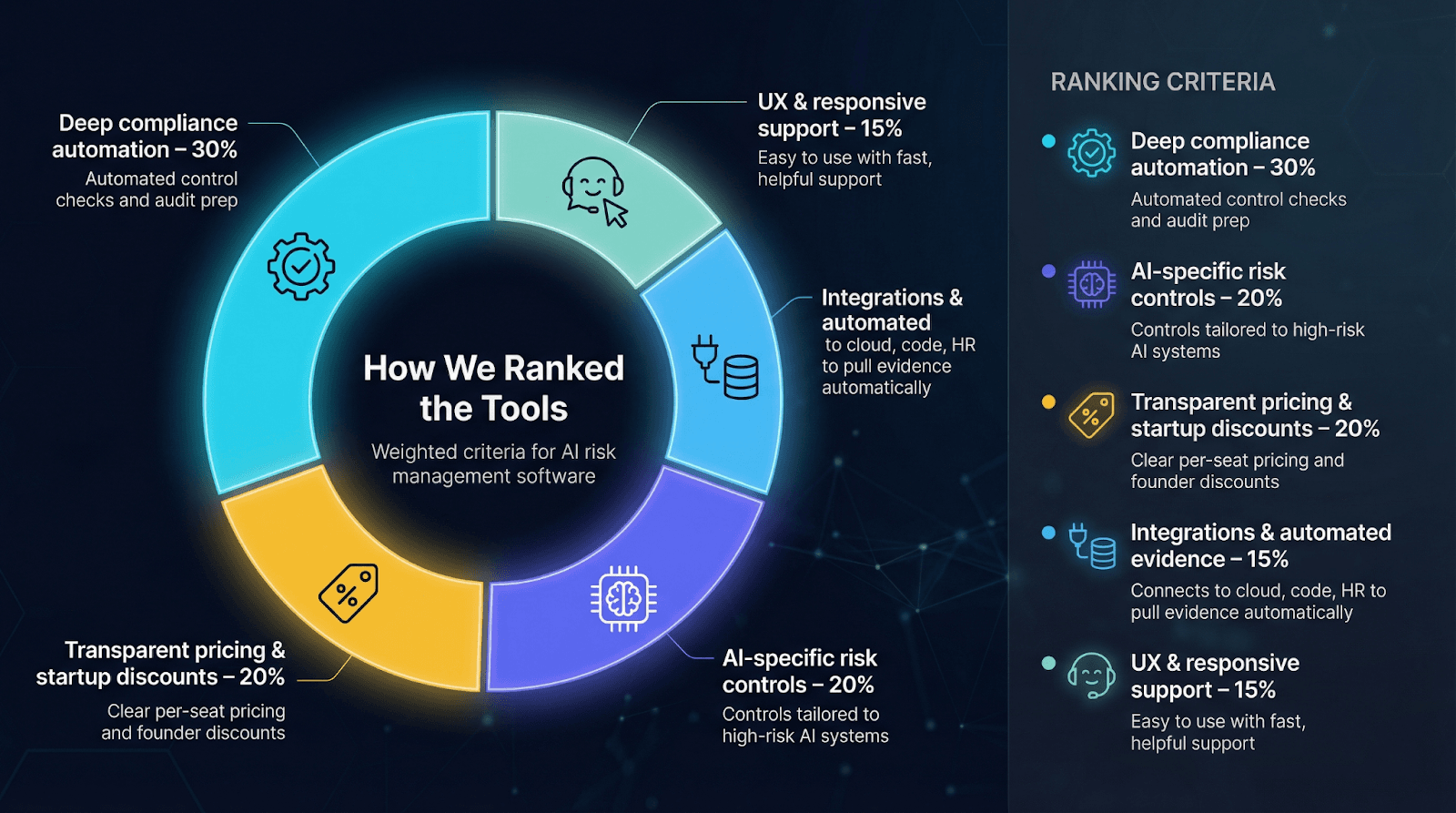
That pain shaped our scorecard. We weighed five factors: deep compliance automation (30 percent), AI-specific risk controls (20 percent), transparent pricing and startup discounts (20 percent), ready-made integrations that pull evidence without manual uploads (15 percent), and an intuitive experience with responsive support (15 percent).
We awarded points only for features that exist today, not promises on a roadmap. Before granting a “best for” label, we looked for proof through live demos, customer reviews, or hands-on testing. To keep the list useful at every growth stage, we mixed household names with open-source and emerging options. The result is a practical, founder-focused ranking you can trust.
Vanta – best overall for automated compliance and security
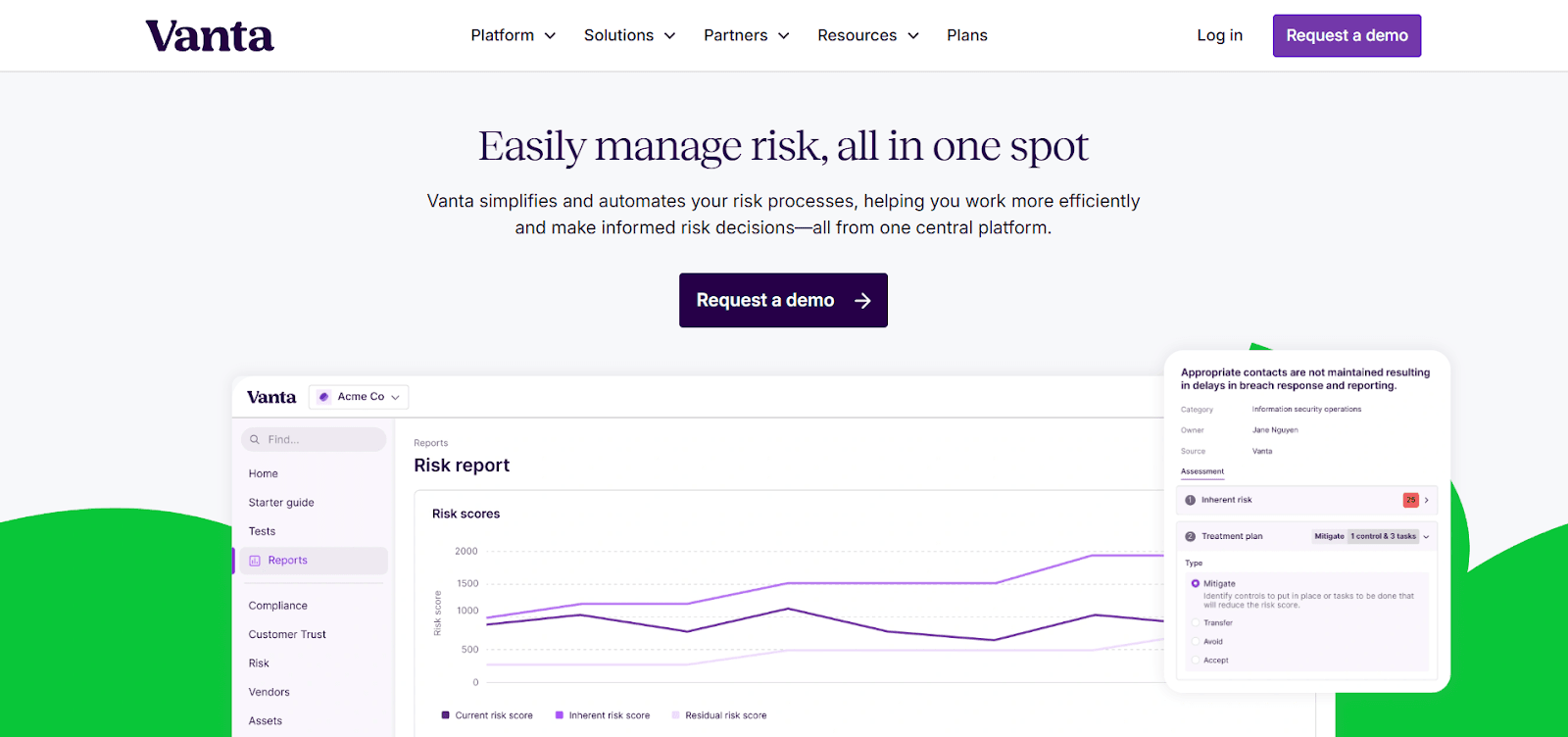
Vanta is an agentic trust platform that takes you from “we should probably get serious about compliance” to continuous audit readiness, without turning your engineers into part-time auditors. It is built to scale, so you can start with your first SOC 2 or ISO 27001 and keep the same system as you add frameworks, customers, and internal stakeholders. Vanta underscored that advantage in its 2026 leading risk management software guide, where it topped a five-vendor ranking thanks to automation depth and AI-driven, continuous monitoring that replaces brittle spreadsheet registers.
Vanta is best for AI startups that want the strongest mix of automation, integrations, and day-to-day security signals, especially if enterprise buyers expect evidence fast.
At its core, Vanta connects to your stack and keeps controls running in the background. Instead of chasing screenshots and one-off exports, you get a live view of what is passing, what is failing, and what needs attention. The 2025 Vanta AI Agent pushes that further by drafting policies, flagging missing evidence, and recommending specific fixes. For many technical failures, it can even produce AI-generated remediation steps and code snippets, including Terraform, AWS CLI, and CloudFormation.
Where Vanta stands out for go-to-market is how it handles buyer scrutiny. Its Questionnaire Automation (QAuto) is designed to reduce the drag of security reviews, with 80%+ question coverage and up to a 95% acceptance rate on AI-generated answers. The Trust Center adds a customer-facing layer, including an AI chatbot and CRM integrations (Salesforce and HubSpot) so security posture becomes part of your sales motion, not a recurring fire drill.
AI governance and framework coverage
Vanta is not only a SOC 2 tool. It supports a broad set of security and compliance frameworks, including SOC 2, ISO 27001, HIPAA, and PCI DSS, plus AI-relevant standards such as ISO 42001 and the NIST AI Risk Management Framework (AI RMF). If you need AI-specific controls that are not fully covered out of the box, you can create custom controls for requirements like prompt-injection testing or model governance reviews.
Integrations, automation, and time to value
Vanta offers 400+ integrations and continues to add more regularly. Depth matters as much as breadth here. On AWS alone, Vanta runs 130+ automated tests, and tests run hourly, so issues surface quickly instead of waiting for a daily check. If you want fast traction, the onboarding path is straightforward: connect your systems, map controls, and start collecting evidence. The platform is designed so you can connect roughly 15 integrations in about 30 minutes and reach audit readiness in weeks, not months.
Vanta also covers adjacent programs that most startups end up needing once deals get larger, including Vendor Risk Management (VRM), a risk register, access reviews, security awareness training, and vulnerability management. If you are trying to retire point tools and consolidate “trust work” into one platform, that breadth matters.
Pricing and fit
Packaging is tiered (Essentials, Plus, Professional, Enterprise) and pricing is quote-based, but a common starting point is around $10k per year for one framework. That typically lands well for teams using compliance to unlock enterprise revenue, and it becomes more compelling as you add frameworks and workflows.
Limitations to know up front
- Vanta is deep, so very early teams that only need a lightweight risk register may find it more platform than they need on day one.
- It is not a dedicated privacy operations suite (cookie consent and data-subject request automation) like OneTrust.
- It does not replace production model monitoring tools like Fiddler or Arthur for drift, bias, and performance observability.
Bottom line: If you want one system that automates core compliance, stays continuously audit-ready, and scales into AI governance and vendor risk as you grow, Vanta is the strongest “start here” choice.
OneTrust – best for privacy and comprehensive GRC
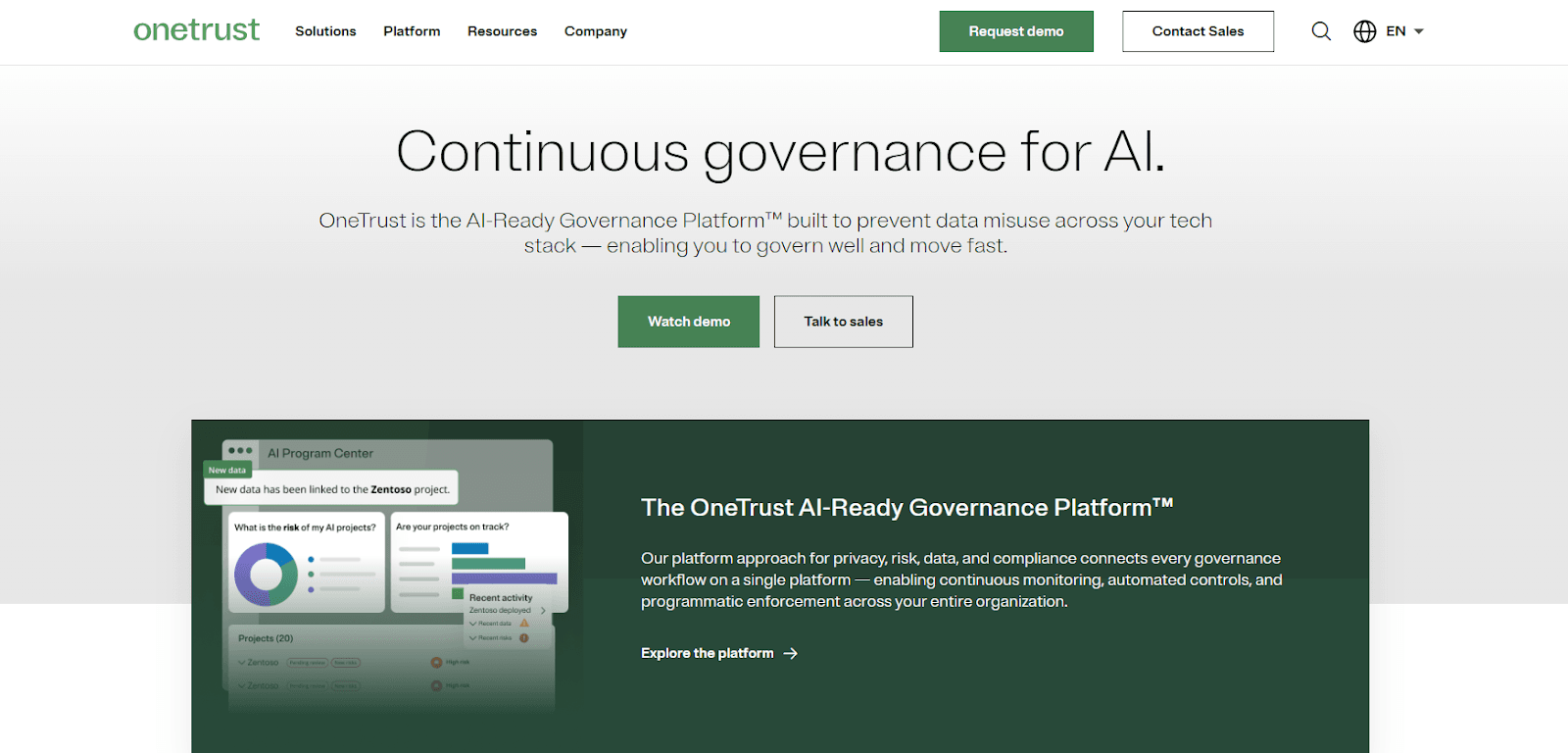
OneTrust is the platform you reach for when privacy is the main risk you need to control, not just a box on a security questionnaire. If your product processes a lot of personal data, sells into Europe, or is facing GDPR-driven procurement reviews early, OneTrust can become your system of record for privacy operations and broader governance.
OneTrust is best for AI startups that need mature privacy automation now and want the option to expand into third-party risk, tech risk, and AI governance in the same enterprise-grade platform.
What it does well
OneTrust’s core strength is privacy operations. It is built to automate cookie consent, handle data-subject requests (DSRs), and map data flows across your organization. For teams that need to answer “where does this data go?” with evidence, that mapping and workflow layer is often the difference between a manageable program and a constant scramble.
Because the platform is modular, you can start with privacy and add additional capabilities as requirements grow, including third-party risk management and broader GRC functionality. Reporting is another OneTrust advantage, with PowerBI-embedded dashboards and customizable reporting that enterprise stakeholders tend to expect.
AI governance support
For AI startups, OneTrust also offers a dedicated Responsible AI module aligned to the EU AI Act, ISO 42001, and the NIST AI Risk Management Framework (AI RMF). This is strongest as a governance and assessment layer—for example model inventory, risk classification, and impact assessments. It is not a substitute for technical model monitoring in production.
Framework coverage, integrations, and automation depth
OneTrust covers a wide range of regulations and frameworks, including major security standards (SOC 2, ISO 27001, HIPAA, PCI DSS), privacy regulations (GDPR, CCPA), and AI governance requirements tied to the EU AI Act.
Where teams should be cautious is security automation depth. Compared with compliance automation-first platforms, OneTrust offers fewer out-of-the-box vulnerability integrations, limited real-time cloud security alerting, no MDM integrations, and no hourly test cadence. Many controls will still rely on point-in-time evidence rather than continuous monitoring. OneTrust also does not offer a true Trust Center product, which can matter if your sales process depends on customer self-service.
Pricing, time to value, and fit
OneTrust pricing follows an enterprise model, based on admin users and asset inventory. Implementation can also be substantial. In practice, this is closer to a Salesforce-style purchase than a lightweight startup tool.
Time to value is usually measured in weeks to months, not days. Teams typically need a dedicated admin or implementation partner to get the most out of the platform, especially if you are rolling out multiple modules.
Bottom line: Choose OneTrust when privacy exposure, EU requirements, or enterprise procurement demands push you toward a comprehensive privacy-first governance stack. If your immediate goal is fast, automated SOC 2 or ISO 27001 with deep continuous monitoring, OneTrust is often heavier than you need, and less automated in day-to-day security control testing.
UpGuard – best for third-party and supply-chain risk
UpGuard is built for a specific pain: proving your supply chain is not the weak link. If your product depends on dozens of SaaS tools and external APIs, enterprise customers will eventually ask how you assess vendor security. UpGuard gives you a structured way to answer, without running every review through a spreadsheet.
UpGuard is best for AI startups that face frequent vendor security scrutiny, and need continuous third-party monitoring plus a repeatable questionnaire workflow.
What UpGuard does (and does not) do
UpGuard continuously monitors vendors by scanning their external attack surface and assigning easy-to-read security ratings (A through F). In the same workflow, you can send security questionnaires, track responses, and push remediation follow-ups until you get what you need.
It also uses AI document parsing to speed up vendor security profile assessment, which can help when you are collecting policies, SOC 2 reports, and security attestations across a large vendor set.
Just as important, UpGuard is not a compliance automation platform. It does not get you SOC 2 or ISO 27001 audit-ready on its own. It helps you evaluate vendors against standards like ISO 27001 and NIST, but you still need a separate GRC or compliance automation tool for your internal controls.
Integrations and time to value
UpGuard is fast to start because it does not require deep infrastructure integrations. You can add vendor domains and begin monitoring quickly. The heavier lift is operationalizing your questionnaire process and deciding what “good enough” looks like for different vendor tiers.
Pricing and scaling considerations
UpGuard pricing is vendor-based. The Standard plan is $1,750 per month (billed annually) for 50 vendors, with additional vendors priced at $79 per month each. Higher tiers (Professional, Corporate, Enterprise) are contact sales, and the per-vendor model can climb quickly if your stack is large.
Trade-offs to consider
UpGuard is a strong standalone choice when third-party risk is a board-level concern or an enterprise deal blocker. If your primary need is “lightweight vendor tracking” inside a broader compliance program, you may be able to cover enough with Vendor Risk Management features bundled into a trust management platform, including newer VRM offerings in the market.
Bottom line: Choose UpGuard when you need dedicated, continuous third-party monitoring and a real TPRM workflow. Treat it as a complement to your core compliance automation tool, not a substitute.
Hyperproof – best for scaling compliance programs
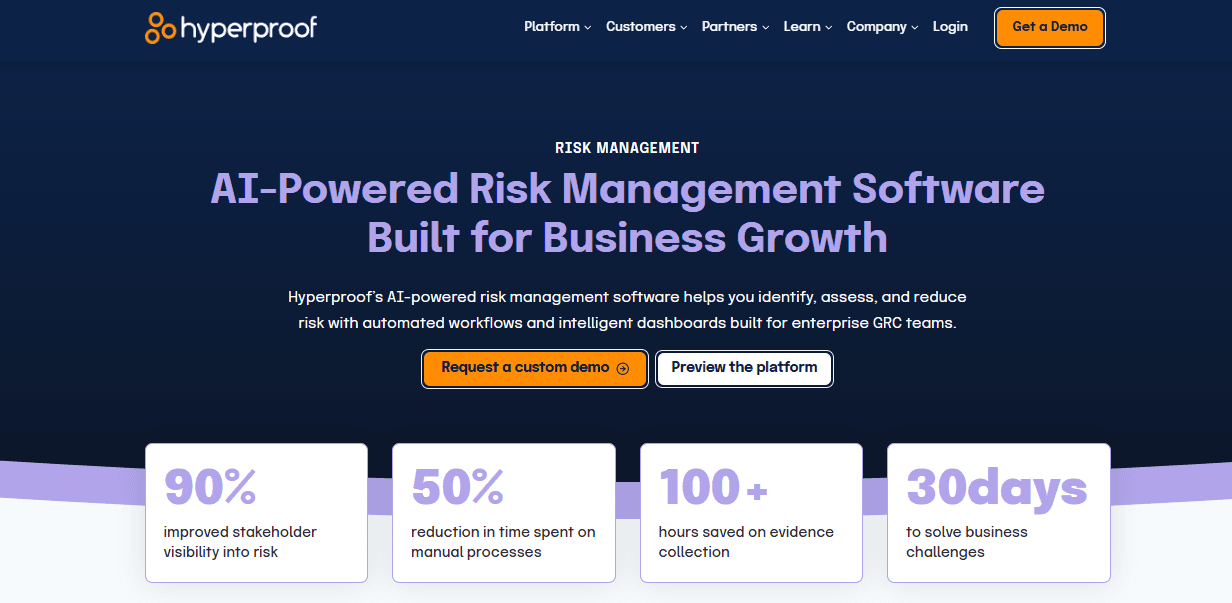
Hyperproof is a compliance operations platform built for the stage where “get SOC 2” turns into “run three frameworks at once and do not break the program.” If you are adding ISO 27001, expanding into regulated markets, or preparing for ISO 42001, Hyperproof’s main advantage is how it helps you organize controls and evidence across frameworks without duplicating work.
Hyperproof is best for Series B and later AI startups that need multi-framework structure and are willing to invest in configuration to get it.
Hyperproof is ideal for:
- Teams managing SOC 2 plus ISO 27001, ISO 42001, and additional frameworks in parallel
- Compliance leads who want one control library with strong cross-mapping
- Organizations that need custom controls for internal AI requirements and release processes
What it does well
Hyperproof’s control library and cross-framework mapping are the headline. You can map a single control across multiple frameworks, which reduces duplicated evidence requests and makes audits easier to run in parallel. It also supports custom controls, so you can formalize AI-specific requirements, such as running prompt-injection tests before a model release, and connect that work to tasks in tools like Jira.
As your program expands, Hyperproof can add modules for adjacent needs like internal audit or vendor management, without forcing you to migrate your underlying control and evidence structure.
AI governance fit
Hyperproof supports ISO 42001 mapping, and the platform’s custom control model makes it practical to document and enforce AI-specific policies and checks. That said, it does not offer the kind of AI-native automation you see in more agent-driven platforms. There is no AI agent, no AI policy generation, and no AI-generated remediation guidance or code to close technical gaps.
Integrations, automation, and setup expectations
This is where the trade-off shows up. Hyperproof typically offers fewer integrations than the most automation-forward compliance tools, and evidence collection tends to lean more heavily on manual uploads and task-based workflows. It also is not positioned around deep automated cloud testing. Think of Hyperproof more as an orchestration and system-of-record layer for compliance, not a tool that continuously validates your infrastructure controls at high cadence.
Because of that, time to value depends on having an owner. Expect a real learning curve and plan for weeks of setup, especially if you are building custom workflows and multi-framework mappings.
Pricing and scaling
Pricing is quote-based. It is generally comparable to, or slightly below, Vanta and Drata depending on the number of frameworks, users, and modules you need.
Bottom line: Choose Hyperproof when your main problem is scale, multiple frameworks, and process consistency across a growing organization. If you want plug-and-play evidence automation, deep integrations, or AI-driven remediation, you will likely find Hyperproof requires more hands-on administration than a small team can spare.

Peyman Khosravani is a seasoned expert in blockchain, digital transformation, and emerging technologies, with a strong focus on innovation in finance, business, and marketing. With a robust background in blockchain and decentralized finance (DeFi), Peyman has successfully guided global organizations in refining digital strategies and optimizing data-driven decision-making. His work emphasizes leveraging technology for societal impact, focusing on fairness, justice, and transparency. A passionate advocate for the transformative power of digital tools, Peyman’s expertise spans across helping startups and established businesses navigate digital landscapes, drive growth, and stay ahead of industry trends. His insights into analytics and communication empower companies to effectively connect with customers and harness data to fuel their success in an ever-evolving digital world.