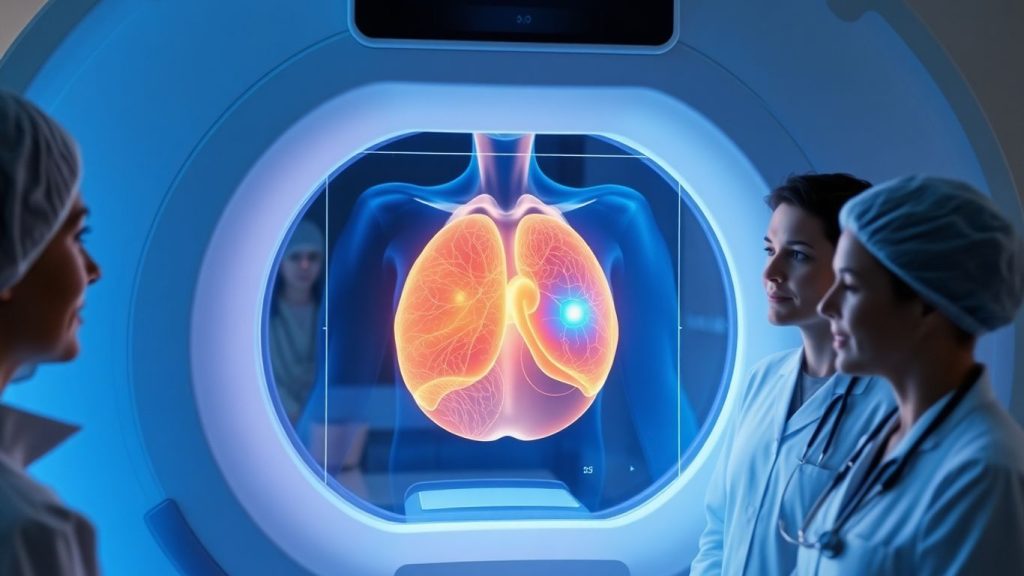
Artificial intelligence is making significant strides in the fight against breast cancer, enhancing early detection methods and accelerating the discovery of new cancer therapies. This technological advancement promises to improve diagnostic accuracy and open new avenues for treatment, offering hope in the ongoing battle against the disease.
Key Takeaways
- AI tools are being tested to assist radiologists in detecting breast cancer earlier and more accurately from mammograms.
- A large-scale randomized trial is underway to evaluate the effectiveness of AI in mammography screening.
- AI models are demonstrating the ability to identify potential new cancer therapy pathways by analyzing complex biological data.
Advancing Breast Cancer Detection
UW Health is participating in the PRISM Trial, a groundbreaking randomized controlled trial in the United States designed to assess how artificial intelligence can aid radiologists in analyzing mammograms. This trial aims to determine if AI can help detect breast cancer earlier and with greater accuracy than current methods. Over the next two years, approximately 50,000 women in Wisconsin will be part of the initial phase, with half receiving AI-assisted analysis and the other half undergoing routine screening. The ultimate goal is to improve diagnostic accuracy, catch cancers at more curable stages, and reduce the rate of missed diagnoses, which can occur due to small tumor sizes or dense breast tissue.
AI’s Role in Oncology Research
Beyond detection, AI is also proving instrumental in oncology research. Google’s Gemma AI model, for instance, has demonstrated the capability to discover new potential cancer therapy pathways. In a recent application, the AI was tasked with identifying a drug that could act as a conditional amplifier, boosting the immune signal specifically in an environment where it was already present but insufficient. The AI identified silmitasertib, a kinase CK2 inhibitor, as a promising candidate. Laboratory tests confirmed that when combined with a low dose of interferon, silmitasertib significantly increased antigen presentation, making tumors more visible to the immune system. This discovery opens a new potential pathway for developing combination therapies to treat previously resistant
Sources
- UW Health testing AI technology for breast cancer detection, WMTV 15 NEWS.
- AI technology helps to improve breast cancer detection rates, WBFF.
- Google’s Gemma AI model helps discover new potential cancer therapy pathway, The Keyword.

Founder Dinis Guarda
IntelligentHQ Your New Business Network.
IntelligentHQ is a Business network and an expert source for finance, capital markets and intelligence for thousands of global business professionals, startups, and companies.
We exist at the point of intersection between technology, social media, finance and innovation.
IntelligentHQ leverages innovation and scale of social digital technology, analytics, news, and distribution to create an unparalleled, full digital medium and social business networks spectrum.
IntelligentHQ is working hard, to become a trusted, and indispensable source of business news and analytics, within financial services and its associated supply chains and ecosystems