The new era of search engine optimization is empowered by machine learning SEO and AI-powered SEO. A progressive SEO Company no longer focuses solely on keywords but instead builds strategies around user intent and meaningful engagement. Modern-day algorithms are driven by artificial intelligence that reads between the lines of every query to understand how the user can benefit from relevant content to satisfy their intent. This shift has automatically introduced a setback for businesses that are still relying on outdated SEO tactics. Those who are adopting AI-driven strategies are acquiring greater organic visibility with a dominating rank.
Current data indicates Google’s infrastructure processes 13.6 billion search queries per day in 2026. The ranking algorithms have transitioned from lexical keyword frequency analysis to multifactorial behavioural analytics incorporating user interaction patterns, query intent classification, and semantic contextual relevance scoring. Every competitive Digital Marketing Agency must operate with data-backed precision to dominate competitors visibility.
Google’s neural network implementations, RankBrain for learning-based ranking refinement, BERT for bidirectional contextual language processing, and MUM for multilingual multitask unified modelling, demonstrate advanced natural language understanding capabilities that function independently of exact-match keyword phrase detection. For marketers and businesses, this evolution brings a fundamental change to the creation and structure of content, further optimizing the content for AI search ranking.
The Evolution of Search Engine Algorithms
Early search algorithms targeted keyword efficiency to reward rankings. However, the search algorithm evolution of the past decade has dramatically reshaped how websites are evaluated. The analysis that relied on counting keywords and their positioning has evolved to algorithms that weight context, its relevance, credibility and meaning. This kind of sophistication was missing in traditional SEO algorithms, and hence, they flooded results with low-quality content, intended only to rank. This imbalance was corrected by today’s AI search algorithms that care about diverse search intent categories.
Early SEO: Keyword Matching Era
Early SEO strategies focused on keyword density and exact matching to rank pages. Considering keyword usage as a primary ranking input gave rise to some of the inefficient SEO strategies on the internet. That highlighted the practice of keyword stuffing, meaning pages are built for crawlers. The content was prepared using repeated phrases following keyword matching, regardless of readability or logical flow. Pages continue to rank just because they contain keywords more often than their competitors. This pushed ranking for manipulative content and eroded visibility for useful content.
Algorithm Updates & Smarter Ranking Systems
As manipulative content began flooding search results, Google introduced new algorithm updates to address the problem. These search algorithm updates focused on semantic search that signals ranking for quality content over quantity. Panda (2011) targeted thin and low-quality content. Penguin (2012) addressed manipulative link schemes. Hummingbird (2013) made semantic search the new foundation, allowing Google to interpret the search relevance rather than matching individual words. The shift to topical authority uses content quality signals as a trusted cue to rank sites.
AI Integration in Search Algorithms
The core transformation is marked by Google’s initiative to integrate machine learning into search algorithm updates. RankBrain (2015) introduced machine learning as a self-learning ranking component that uses the historical pattern of queries to interpret ambiguous searches. BERT (2019) brought bidirectional language understanding. This system enabled Google to grasp the contextual relevance of a query, critical for understanding search relevance. MUM (2021) took this a step further by analyzing text, images, and eventually video across multiple languages at once. This system is recognized by Google as 1000 times more efficient than BERT. Consequently, semantic search capabilities expanded while authentic content quality signals became key ranking indicators.
What Is AI-Powered SEO?
AI-powered SEO is defined as the strategic use of AI and machine learning to optimize content for visibility, ranking, and overall website performance. It works by processing massive datasets via machine learning models. While traditional SEO relied on static checklists, AI SEO assists in automating work by learning from live user interactions. AI SEO automation runs on data insights. Businesses personalize user experiences and adjust Strategies dynamically. Visibility improves, and performance data drives decisions. Predictive analytics guide actions that help Search experiences get better. Queries evolve constantly, and AI adapts continuously. Data -driven insights take the lead, and predictions follow that assist with improved results over time.
What separates traditional SEO from Artificial Intelligence SEO? The approach. Tradition relies on manual analysis and unchanging practices. AI Machine learning predicts trends, identifies behaviour patterns, and automates technical work. Understanding this distinction matters to survive in this Competitive era.
| Feature | Traditional SEO | AI-Assisted SEO |
| Strategy Focus | Manual keyword research | AI-driven semantic analysis |
| Content Goals | Focused on keyword placement | Focused on intent and relevance |
| Adaptability | Static, slow manual updates | Dynamic, real-time adjustments |
How Machine Learning Influences Search Rankings
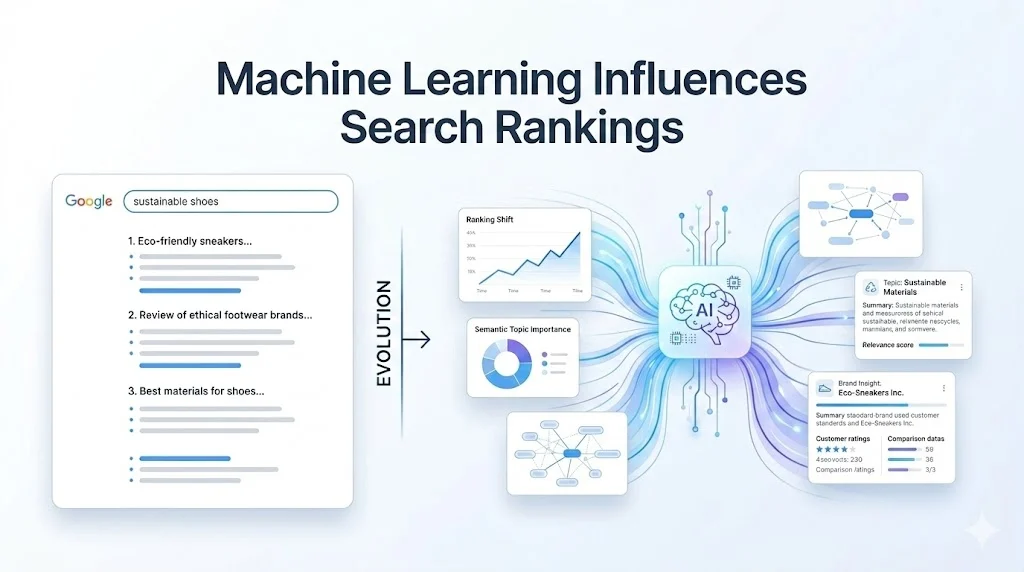
Modern search engines analyze user patterns to improve ranking accuracy. AI SEO relies on a vast amount of search data at a scale that human efforts could not replicate. These AI ranking signals include several behavioural factors that indicate if users are genuinely getting satisfied with their intent. Three key factors shape today’s rankings. First is user behaviour signals, that includes dwell time, clicks, bounce rate and also overall engagement.
These indications help AI systems determine if a page adequately answered the user’s query based on search intent analysis. Second is pattern recognition that enables AI to recognize trends from billions of global queries. Third is adaptive algorithms, in which AI learns from new user data and continuously refines pages for relevancy and rewards the ones that are beneficial to users.
AI and Search Intent Understanding
The core of the AI revolution focuses more on the why factor rather than what is being typed. Machine learning search intent categorizes queries into three distinct types. Starting with information intent, which means displaying relevant answers when the user is looking for knowledge. Next comes navigational intent, where the audience is seeking a specific website or brand page. Third is transactional intent, which means the user is actively looking to make a purchase or take action.
AI SEO technologies decode these subtle differences, using NLP (Natural Language Processing) and contextual analysis to analyze the purpose behind users’ queries. This enables search engines to meet user goals via relevant results. This is termed as intent-driven SEO, and for content creators, it means optimizing the content to match the right intent.
AI-Driven Content Evaluation
AI assists search engines in evaluating the quality of AI SEO content. To pass the standards, AI content optimization needs to analyze whether the content is serving user needs as per search engines. Machine learning content analysis relies on key factors and enables search engines to perform a quality audit of every page they crawl. First is content relevance, which evaluates how accurately the content resolves the user’s query. Second is depth and expertise, which operates on the EEAT (Expertise, Experience, Authoritativeness, and Trustworthiness ) framework, rewarding authoritative content. Finally, there is structure and readability that focuses on clear headings, logical formatting for featured snippets and easy comprehension. AI content scoring systems evaluate originality and engagement of content that helps to maintain top rankings in AI-driven algorithms. Based on these factors, content evaluation by AI ensures that quality pages are displayed on top of search results.
AI-Powered Keyword Research
AI keyword research tools enabled businesses to identify and target relevant search terms. AI keyword research tools enabled businesses to identify and target relevant search terms. AI tools use machine learning keyword analysis to spot trends, decode search intent, and build authority. Semantic SEO drives AI keyword research. Finds intent-based keywords matching user needs, providing expertise to algorithms. Predictive trends identify rising keywords early. Topic clustering takes this further by grouping keywords effectively into meaningful clusters for content planning. AI-driven keyword analysis fundamentally transforms digital strategy. This encourages marketers to prioritize user intent and semantic SEO relevance instead of chasing search volume.
Technical SEO and AI Automation
AI technical SEO works as a smart assistant that checks for problems in a website in just a few hours. Manually, the task may take a longer period with questionable accuracy. AI site audits scan an entire website and quickly spot issues like broken links, slow-loading pages, duplicate content and mobile usability issues. It ranks issues based on how they are impacting your SEO practice. This allows businesses to focus on issues that require immediate attention rather than attending all issues at a time. Further, it suggests effective yet quick ways to fix those issues.
It recommends ways to improve site performance, speed, or add structured data for easy understanding of your content by machine learning SEO. AI makes data-driven decisions that allow it to make informed decisions, which in turn enhance visibility. Overall, AI technical SEO helps in saving a significant amount of time. Manual work took days to perform the same task and often contained errors. AI intervention ensures your site is optimized for search engines without the heavy manual workload.
Future of SEO in the AI Era
The future of AI SEO is shifting from being found to being used by AI. Traditionally, a list of websites is what users had to navigate to seek answers for their intent. Google and Microsoft are using AI to give you direct answers now, pulling information from trusted sources. This means you need to focus on generative search optimization, basically, making content that AI thinks is legit enough to quote. At the same time, machine learning in SEO is customizing search results to match what each person actually needs.
Search algorithms customize results using behavioural data, query patterns, and user preferences. AI -driven SEO optimization requires authentic content production with rapid query resolution. AI systems provide keyword analytics and predictive modelling capabilities; however, human creative cognition remains paramount for content excellence.
Google and Microsoft are using AI to give you direct answers now, pulling information from trusted sources. This means you need to focus on generative search optimization, basically, making content that AI thinks is legit enough to quote. At the same time, machine learning in SEO is customizing search results to match what each person actually needs.
Conclusion
AI SEO and machine learning in SEO are two important tools that are shaping the dynamics of search engines. Rather than understanding keyword efficiency, search engines are now focusing on the purpose behind an intent and how to deliver the most effective outcome to that. For businesses, this means creating content that truly answers user questions. AI-driven SEO offers valuable assistance in improving site performance within hours and works on critical issues immediately. The future of SEO is more about relevance, quality and user satisfaction. Businesses that are adapting to this shift are likely to stay ahead in the competitive era.