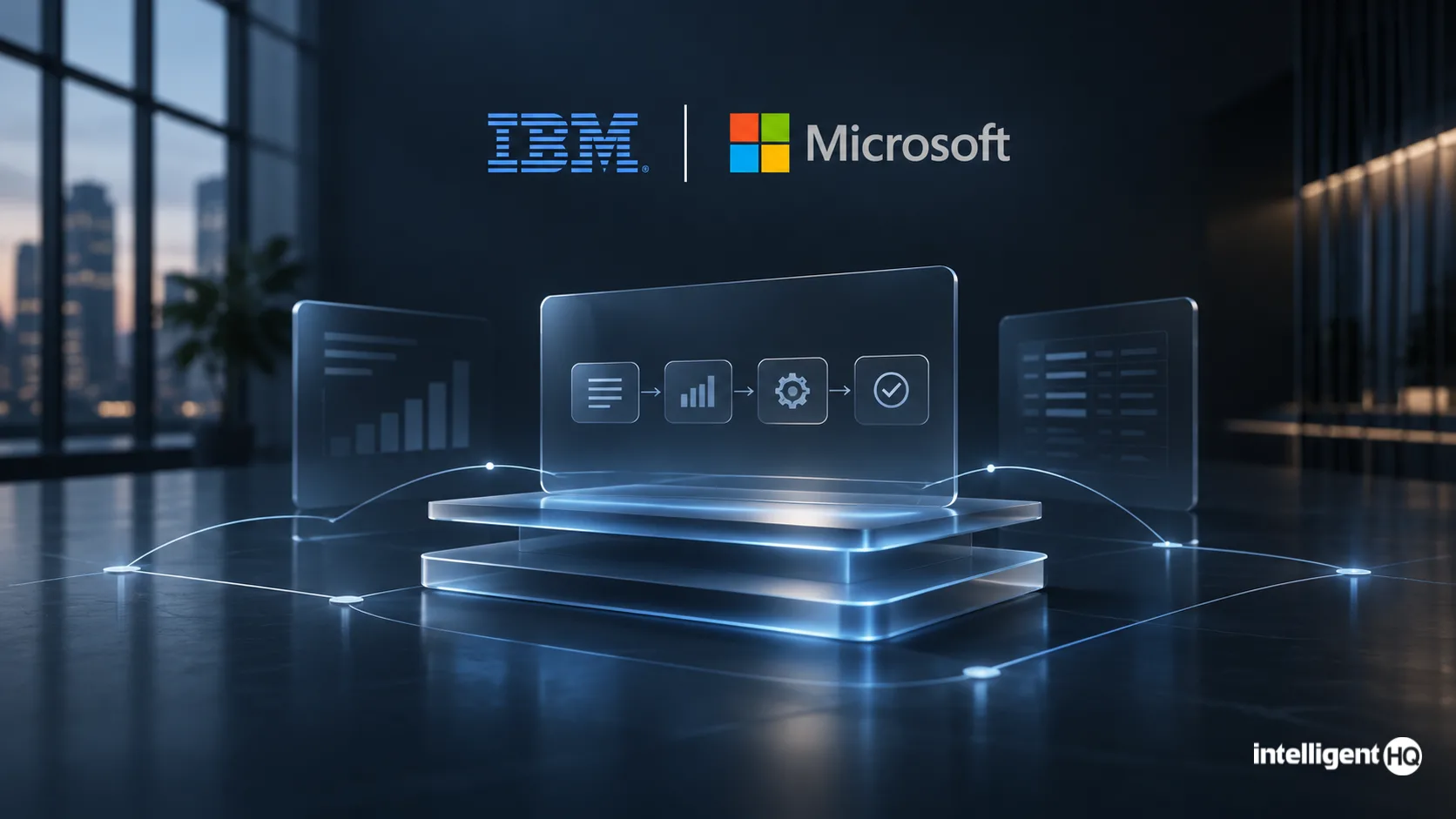
IBM and Microsoft have introduced Imagine Enterprise, combining thousands of prebuilt AI agents and assets with cloud infrastructure, enterprise security, and industry expertise. The partnership targets one of the biggest problems facing corporate AI adoption: turning successful experiments into systems that deliver measurable business results.
IBM and Microsoft announced the launch of Imagine Enterprise on 10 November 2026, a jointly developed platform designed to help organisations build, deploy, and govern artificial intelligence agents across business operations. The platform combines more than 6,000 prebuilt AI agents and related assets from IBM Consulting with Microsoft’s cloud, data, security, and AI technologies.
The announcement comes as companies face growing pressure to demonstrate financial returns from AI investments. Businesses have spent years testing generative AI tools, but integrating those systems into daily operations remains difficult. Imagine Enterprise is designed to address that gap by connecting AI agents with existing business data, applications, and processes.
The companies are initially targeting financial services, insurance, and retail, where operational complexity and regulatory requirements can make AI deployment difficult. IBM Consulting and Microsoft will also provide engineering support for qualifying clients, helping organisations adapt the technology to their operational requirements.
Why Businesses Are Struggling to Scale AI
Enterprise AI adoption is growing, but the transition from experimentation to production remains uneven.
According to McKinsey’s State of AI in 2026, published on 25 August, 40% of respondents from organisations generating more than $1 billion in annual revenue reported scaling AI agents in at least one business function. That compares with 27% in the previous year. Among smaller organisations, the proportion remained at 22%.
The figures suggest that larger enterprises are advancing more quickly, although widespread deployment does not necessarily translate into measurable financial returns.
An IBM Institute for Business Value study, conducted with Oxford Economics and published in February 2026, surveyed 400 global leaders across 17 industries. While 77% said their organisations needed to adopt generative AI quickly to remain competitive, only 25% strongly agreed that their IT infrastructure could support enterprise-wide AI scaling.
The problems frequently extend beyond AI model performance. Corporate information is distributed across databases, internal documents, applications, and departments. AI systems may perform well in controlled demonstrations but struggle when they need to access reliable information, coordinate complex activities, or operate within established security policies.
Imagine Enterprise attempts to address these operational barriers through a combination of prebuilt agents, enterprise integration, and governance capabilities.
Inside Imagine Enterprise: How the Platform Works
The new platform brings together IBM Consulting Advantage, IBM’s AI-powered delivery environment, and Microsoft’s enterprise technology infrastructure.
IBM Consulting contributes a portfolio of more than 6,000 existing AI agents and related assets, alongside industry expertise and implementation services. These resources are intended to help customers adapt established capabilities rather than develop every agent independently.
Microsoft provides the infrastructure for deploying and coordinating agents across enterprise systems. The technology includes Microsoft Foundry, Microsoft Copilot Studio, GitHub Copilot, Microsoft Fabric, Microsoft 365, and Microsoft Azure.
Security and governance capabilities draw on Microsoft Entra for identity management, Microsoft Purview for data governance and compliance, and Microsoft Defender for threat protection.
IBM Consulting Advantage’s Process Studio, Context Studio, and Advantage Core support the design, deployment, and management of tailored AI agents.
The companies also plan to provide forward-deployed engineers who can work directly with qualifying customers. This approach combines software deployment with technical assistance and industry-specific implementation.
The 6,000 figure refers to IBM’s existing portfolio of agents and assets. It should not be interpreted as 6,000 newly created agents or as evidence that every asset can operate independently without configuration.
From Individual Tasks to Connected Business Workflows
Traditional enterprise automation often focuses on individual activities, such as processing documents, generating reports, or routing customer requests.
Agentic systems can potentially coordinate several activities within a larger business process. An authorised agent might retrieve information from multiple systems, assess the next required action, and prepare a task for another system or employee.
IBM has outlined an insurance claims workflow to illustrate this approach.
In the model described by the company, a coordinating system called the Digital Steward assesses incoming claims, identifies potential fraud indicators, checks policy coverage, and routes cases to employees according to their authority and expertise.
Routine claims can be directed to junior adjusters, while more complicated cases involving coverage uncertainty or unusual activity are assigned to senior employees or specialist investigation teams.
The objective is to give employees relevant information, prioritised workloads, and recommended actions before they make decisions.
This is an illustrative workflow presented by IBM, not an independently verified customer deployment with published financial results. Its value lies in demonstrating how multiple specialised agents could work within a governed business process.
SEI Explores Agentic AI for Financial Services
The announcement also highlights SEI, a global provider of financial technology, operations, and asset management services.
According to the joint release, SEI is exploring emerging and agentic technologies with IBM Consulting, supported by Microsoft, as part of its wider enterprise transformation efforts.
The company is examining how these capabilities could improve internal processes and experiences for employees and clients while supporting responsible AI adoption.
SEI’s involvement demonstrates the interest in agentic technology among financial services organisations, where access controls, operational reliability, and accountability are major considerations.
However, IBM and Microsoft have not published specific cost savings, productivity gains, or implementation results from SEI’s exploration in this announcement. Its participation should therefore be understood as an example of ongoing enterprise adoption rather than proof of the new platform’s commercial performance.
Why Governance Is Central to the New Platform
As AI agents become capable of interacting with business applications and executing tasks, companies must consider who is responsible for their actions.
An agent retrieving a document carries different risks from one modifying financial records, accessing customer accounts, or approving transactions.
Imagine Enterprise is designed to provide visibility into agent activity, including execution history, performance, costs, and escalation processes. IBM describes controls that establish which actions agents can perform autonomously and which require human approval.
The platform incorporates Microsoft’s identity, security, and compliance technologies to support these requirements.
For organisations operating in regulated industries, governance is closely connected to deployment decisions. Financial institutions, insurers, and retailers must consider privacy, data protection, cybersecurity, and internal accountability before allowing automated systems to act on sensitive information.
The availability of governance tools is an important part of the platform’s proposition, although individual customers will still need to configure permissions, validate agent behaviour, and assess compliance within their own environments.
Can IBM and Microsoft Solve the AI Pilot Problem?
The partnership reflects a shift in how enterprise technology companies are approaching AI adoption.
For businesses already using Microsoft infrastructure, Imagine Enterprise may provide a way to introduce agents without replacing every existing application. IBM Consulting’s prebuilt assets and technical support could also reduce some of the work involved in designing and integrating new systems.
Yet the platform’s commercial impact remains to be demonstrated.
The companies have announced its capabilities, industry focus, and implementation options, but they have not disclosed independently verified customer-wide financial returns, average deployment times, or comparative performance against competing platforms.
Enterprises evaluating the technology will need to examine whether it can improve established operational measures, including processing time, error rates, employee productivity, customer satisfaction, and total operating costs.
Licensing, implementation expenses, model usage, and ongoing oversight will also influence the financial case.
A platform containing thousands of available components does not automatically produce better business outcomes. Those outcomes depend on how effectively the technology is connected to the organisation’s data, people, and processes.
What Comes Next for Enterprise AI?
Imagine Enterprise is available through IBM Consulting-led deployments, co-innovation engagements, and self-management options.
Its initial frameworks cover financial services, insurance, and retail. IBM and Microsoft intend to develop further applications for industries including manufacturing, energy, the public sector, and mobility.
The partnership also reflects a growing convergence between enterprise software, cloud computing, consulting, and AI governance. Businesses are increasingly looking for technology that can operate within established environments rather than requiring isolated experiments with limited operational reach.
Whether Imagine Enterprise becomes a widely adopted enterprise platform will depend on its performance in real deployments and the evidence customers can provide about productivity, costs, and operational reliability.
For CEOs and technology leaders, the announcement offers another route towards integrating AI into everyday business operations. The broader question remains whether organisations can redesign their workflows, maintain effective oversight, and translate agent capabilities into measurable improvements.
IBM and Microsoft have introduced the infrastructure and implementation approach. The evidence of long-term business value will come from what customers achieve with it.
Sources:
- https://newsroom.ibm.com/2026-11-10-ibm-and-microsoft-announce-a-new-ai-agent-platform-designed-for-industry-specific-transformation
- https://news.microsoft.com/source/2026/11/10/ibm-and-microsoft-announce-a-new-ai-agent-platform-designed-for-industry-specific-transformation/
- https://www.ibm.com/new/announcements/the-digital-workforce-why-the-next-competitive-frontier-isn-t-ai-it-s-how-you-operationalize-it
- https://www.ibm.com/consulting/imagine-enterprise
- https://www.mckinsey.com/capabilities/quantumblack/our-insights/the-state-of-aihttps://www.ibm.com/think/insights/systems-behind-enterprise-ai-adoption-success