Online reviews have become a huge part of how we decide where to spend our money. Whether you’re going to a restaurant, hiring a contractor or using a professional service, many people will look at Google reviews before making a decision.
This can be very beneficial for businesses, but it can also cause issues. Positive reviews can help build trust, while negative reviews can influence potential customers. If reviews are fake, misleading or contain false information, this can create further problems.
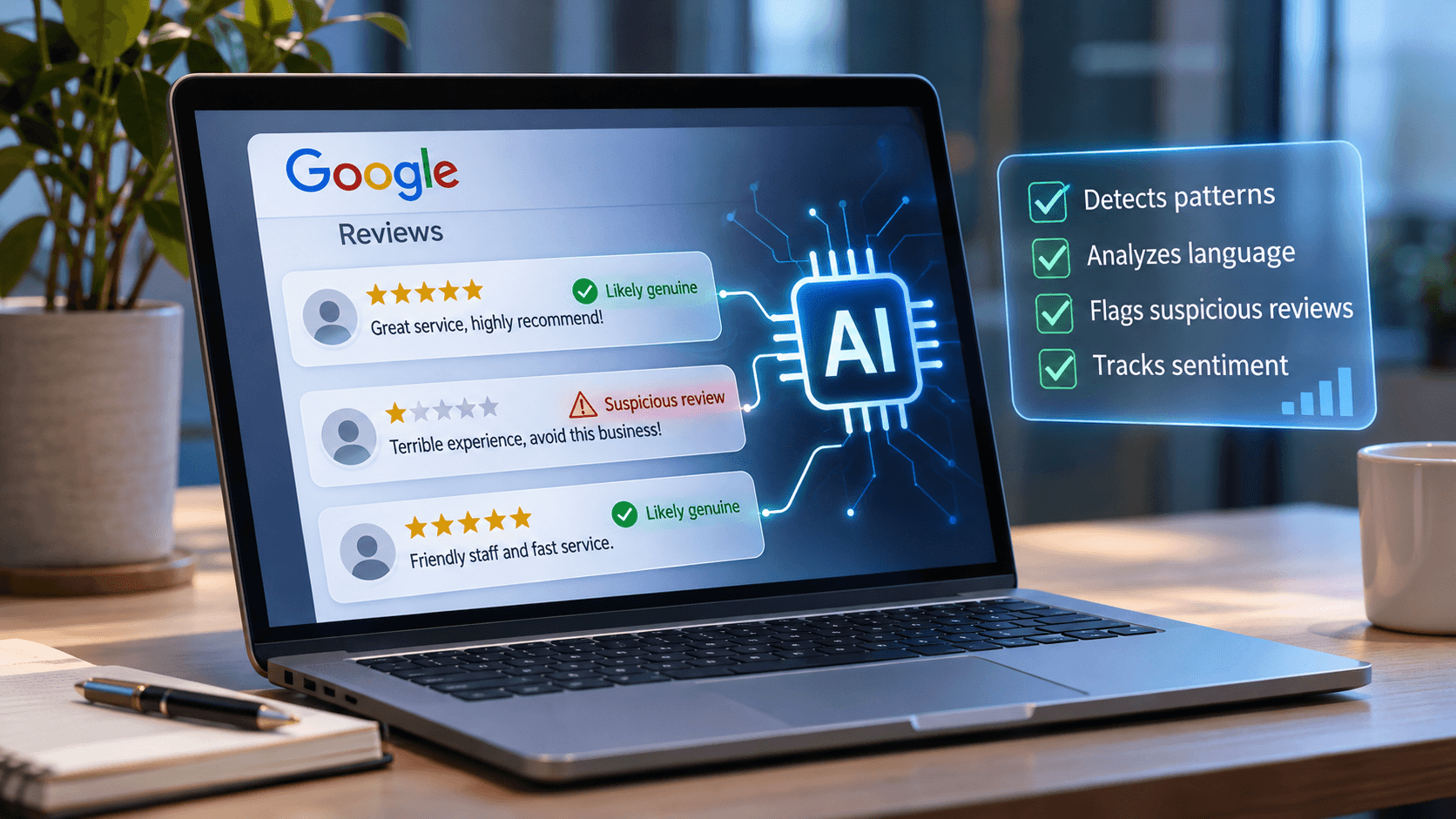
With increasing access to artificial intelligence (AI), businesses have new ways to detect suspicious reviews and maintain their online reputation. However, AI has also made it easier to create realistic fake reviews, making the issue more complicated.
The Issue With Fake Reviews on Google
Google reviews are a powerful tool because they appear in search results and Google Maps. This can have a significant impact on a business.
Even if you have lots of positive reviews, you may start to notice suspicious negative feedback. This could include a sudden increase in one-star reviews, similar allegations appearing repeatedly or descriptions of experiences that don’t match your business records.
Not all unfamiliar reviews are fake. Many people use different names online, and some legitimate reviews may be difficult to verify. However, suspicious patterns may be worth investigating further.
According to research into fake review statistics and platform enforcement, Google reported blocking or removing more than 292 million policy-violating reviews in 2025.
This doesn’t mean all those reviews were fake, but it shows how much work goes into managing online content and maintaining the reliability of review platforms.
As a business, the challenge is identifying which reviews reflect genuine customer experiences and which may violate Google’s policies.
Using AI to Detect Suspicious Reviews
Traditionally, businesses would have to manually examine each review for suspicious language, inconsistencies or unusual patterns.
With AI, reputation management tools can now help automate parts of this process.
Using natural language processing, software can analyse reviews and identify patterns, unusual wording or similarities between different submissions.
If multiple reviews contain almost identical language or make similar allegations, these patterns may be flagged for further investigation.
AI can help businesses detect:
- Sudden spikes in negative reviews
- Repeated complaints using similar language
- Changes in customer sentiment
- Unusual patterns across multiple business locations
- Common mentions of products, services or staff
While these signals don’t guarantee that a review is fake, they can help identify which reviews deserve closer attention.
For businesses operating multiple locations, AI can be particularly useful for monitoring large volumes of feedback.
The Risks of AI-Generated Reviews
While AI can help businesses detect suspicious reviews, it can also be used to create misleading content.
Modern AI tools can generate realistic descriptions of customer experiences using natural language. This means reviews can contain detailed information without obvious repetition or suspicious wording.
Unlike older forms of fake reviews, AI-generated content can include specific descriptions, emotional language and convincing details.
This creates problems because a review sounding realistic doesn’t necessarily mean the experience happened.
Businesses shouldn’t rely solely on AI to identify fake reviews. They should examine the content alongside available business records, customer interactions and the platform’s policies.
Human judgement remains important, especially when reviews contain serious allegations that could damage a business’s reputation.
Understanding Google’s Review Policies
Google has policies in place to help ensure that reviews are reliable and reflect genuine experiences.
These policies prohibit fake engagement, certain conflicts of interest, impersonation and content that doesn’t reflect a genuine experience.
If you believe a review violates these policies, you can report it. However, receiving a negative rating or disagreeing with a customer’s opinion isn’t enough to justify removal.
A legitimate complaint may remain visible even if the business disagrees with how the customer describes the situation.
This is an important distinction when managing an online reputation. Businesses can learn more about identifying and challenging fake Google reviews by examining suspicious patterns, gathering evidence and understanding the relevant reporting procedures.
For example, if a restaurant receives a complaint about slow service, the appropriate response is generally to address the customer’s concerns professionally. However, a coordinated group of reviews from people who have no genuine experience with the business may raise different concerns.
Each situation should be considered carefully before taking action.
When to Use Professional Reputation Management
While AI tools can help identify patterns and organise information, some situations require further investigation.
Businesses may need to examine customer records, identify suspicious activity, determine which policies apply and prepare a report.
This is where professional reputation management services can help.
Canadian businesses dealing with potentially policy-violating feedback can use professional Google review removal services to assess suspicious reviews, prepare supporting information and manage the reporting process.
The purpose isn’t to prevent legitimate customers from sharing negative experiences, but to help businesses address content that may violate Google’s rules.
If a business experiences coordinated review activity, suspected competitor manipulation or repeated suspicious submissions, professional assistance may be useful.
However, no legitimate service can guarantee that Google will remove a specific review, as Google ultimately determines whether its policies have been violated.
Using AI for Sentiment Analysis
Managing your online reputation goes beyond identifying fake reviews.
One of the most useful applications of AI is understanding what customers are actually saying about your business.
Sentiment analysis tools can examine large amounts of feedback and identify common positive and negative themes.
For example, a hotel might discover that customers consistently praise its location but complain about slow check-in times. A moving company might notice repeated concerns about scheduling, while a restaurant could identify regular complaints about service quality.
These insights can help businesses make better operational decisions.
Rather than viewing every negative review as a problem, businesses can use legitimate complaints to identify areas that need improvement.
This creates a more sustainable approach to reputation management.
Creating a Responsible Online Reputation Strategy
Businesses using AI to monitor their reviews should establish clear processes for managing feedback.
Regularly checking your Google Business Profile is a good starting point. Automated alerts can help your team identify new reviews quickly, while sentiment analysis can reveal longer-term issues.
If suspicious content appears, preserve any relevant evidence and consider whether the review violates Google’s policies.
Legitimate complaints should receive thoughtful and professional responses. Reviews that appear to violate platform guidelines can be reported through the appropriate channels.
For businesses unsure where to begin, a practical guide to reporting suspicious Google reviews can help explain how to document concerns, identify relevant policy violations and follow the appropriate reporting steps.
Businesses should also avoid purchasing fake positive reviews or offering incentives to remove negative feedback. These practices can damage customer trust and violate platform rules.
The goal should be to maintain an accurate online reputation that reflects genuine customer experiences.
The Future of AI and Online Reputation Management
AI is likely to become a larger part of how businesses monitor customer feedback and how platforms detect misleading content.
As detection tools improve, businesses may gain access to more advanced technology for identifying unusual review activity, analysing sentiment and managing customer concerns.
However, as AI-generated content becomes more sophisticated, detection and moderation systems will also need to continue improving.
Technology alone won’t solve every problem. Good judgement, transparency and addressing legitimate customer complaints will remain important parts of effective reputation management.
Overall, the most practical approach for businesses is to combine intelligent monitoring tools with careful human review and a clear understanding of platform policies.
With online reputation continuing to influence purchasing decisions, maintaining trustworthy reviews is becoming an essential part of running a successful business.