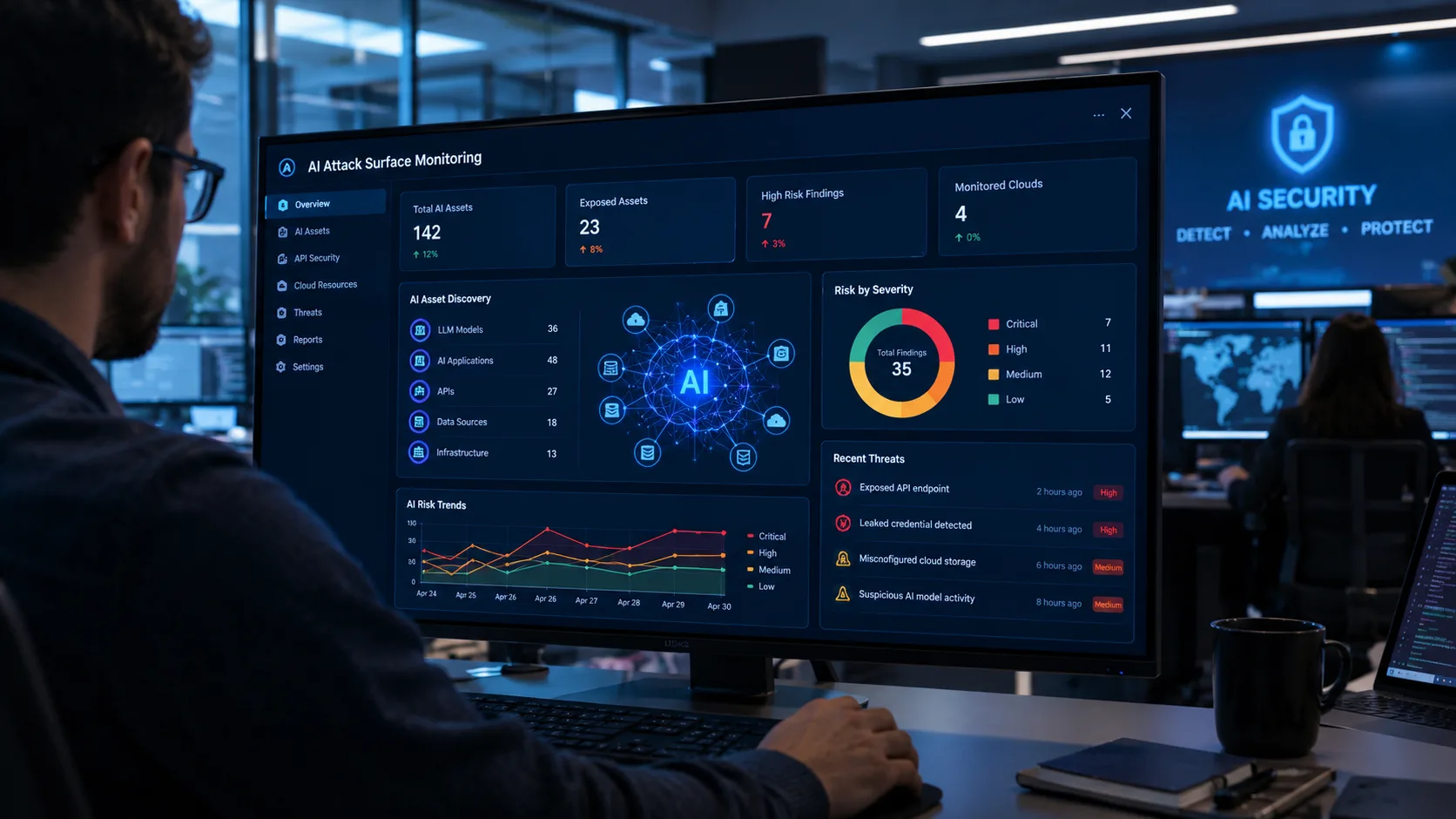
AI attack surface monitoring platforms are CloudSEK AIVigil, Microsoft Defender for Cloud, Palo Alto Networks Prisma AIRS, and Wiz AI-SPM, and each suits a different need. CloudSEK AIVigil is the strongest fit for AI-specific attack surface discovery, finding exposed AI models, MCP servers, vector databases, agentic workflows, and leaked credentials. Microsoft Defender for Cloud works best for monitoring AI workloads across Azure, AWS, and Google Cloud. Prisma AIRS covers end-to-end AI security with assessments, red teaming, and runtime protection. Wiz AI-SPM excels at cloud-based AI asset visibility and attack path analysis. The right choice depends on your AI infrastructure, cloud setup, and security priorities.
The U.S. National Institute of Standards and Technology (NIST) notes that AI systems introduce security challenges, including prompt injection, data poisoning, and risks involving third-party AI technologies. Its AI Risk Management Framework highlights the need to address the complex attack surfaces of AI systems. This makes AI asset discovery and continuous security monitoring important for organizations adopting AI.
AI attack surface monitoring platforms help organizations discover exposed assets, identify weaknesses, and manage emerging risks. Comparing these platforms helps businesses find solutions that fit their security needs.
What Is AI Attack Surface Monitoring?
AI attack surface monitoring is the process of identifying and tracking the systems, applications, and services connected to an organization’s AI infrastructure. These may include AI models, APIs, cloud environments, third-party AI tools, and internal applications that use AI features.
The goal is to help security teams understand what they need to protect and where potential weaknesses exist. For example, an employee might use an unapproved AI tool to process company data, or an AI application might expose an API that lacks proper access controls. Without regular monitoring, these risks can go unnoticed.
AI attack surface monitoring platforms help teams discover these assets, detect exposed services, assess vulnerabilities, and prioritize issues that need attention. This gives organizations a clearer picture of their AI-related security risks and helps them respond before those weaknesses lead to more serious problems.
How We Evaluated These Platforms
The platforms were compared based on five criteria: AI asset discovery, exposure detection, continuous monitoring, risk prioritization, and AI security coverage.
CloudSEK AIVigil ranks first because its documented capabilities closely match AI attack surface monitoring, including discovery of AI models, MCP servers, vector databases, agentic workflows, and leaked credentials.
Microsoft Defender for Cloud and Wiz offer AI security within broader cloud environments, while Palo Alto Networks Prisma AIRS covers AI security assessments and runtime protection. These capabilities are documented by their respective vendors.
The ranking reflects how closely each platform’s documented features match this article’s focus, not an independently verified performance score or industry ranking.
Top AI Attack Surface Monitoring Platforms Compared
The following platforms take different approaches to AI security. Some focus specifically on discovering exposed AI infrastructure, while others cover broader AI application security or external attack surfaces.
1. CloudSEK AIVigil
Best for: AI-specific attack surface discovery
CloudSEK AIVigil helps organizations discover and monitor exposed AI infrastructure, including AI models, MCP servers, vector databases, APIs, and agentic workflows. It enables security teams to identify exposures, detect leaked credentials, and manage AI-related security risks.
Gartner Peer Insights lists CloudSEK with a 4.8/5 rating based on 385 ratings on its vendor page. However, these ratings cover CloudSEK’s broader cybersecurity offerings, particularly XVigil, and should not be presented as an AIVigil-specific rating or an independent endorsement of AIVigil.
Key features:
- AI asset discovery: Identifies exposed AI models, services, and connected infrastructure.
- MCP security monitoring: Helps detect security risks associated with MCP servers and integrations.
- Credential exposure detection: Identifies leaked AI credentials that could enable unauthorized access.
- Continuous monitoring: Tracks changes and newly discovered exposures across the AI attack surface.
- Risk prioritization: Helps security teams identify and address important security issues.
Best suited for: Organizations that need greater visibility into their AI infrastructure and want to identify AI-specific exposures before they become serious security problems.
2. Microsoft Defender for Cloud
Best for: Multicloud AI environments
Microsoft Defender for Cloud helps organizations monitor AI workloads across cloud platforms, including Azure AI, Amazon Bedrock, and Google Vertex AI. Its AI security posture management capabilities help identify misconfigurations and potential security risks.
Key features:
- AI workload discovery: Identifies AI resources across supported cloud environments.
- Risk detection: Highlights exposed endpoints and configuration issues.
- Security integration: Connects AI security findings with broader cloud security monitoring.
Best suited for: Organizations managing AI workloads across multiple cloud environments.
3. Palo Alto Networks Prisma AIRS
Best for: End-to-end AI security
Prisma AIRS helps organizations secure AI applications, models, and agents throughout their lifecycle. It combines AI security assessments, posture management, and runtime protection to help teams identify and manage threats.
Key features:
- AI security assessment: Evaluates potential weaknesses in AI systems.
- AI red teaming: Tests AI applications for security vulnerabilities.
- Runtime protection: Helps detect and prevent threats targeting AI applications.
Best suited for: Organizations that need security coverage across AI development and deployment.
4. Wiz AI-SPM
Best for: AI infrastructure and attack path analysis
Wiz AI Security Posture Management helps organizations discover AI resources across cloud environments and identify risks such as exposed endpoints, misconfigurations, and sensitive data exposure.
Key features:
- AI asset visibility: Discovers AI services, models, and pipelines.
- Misconfiguration detection: Identifies weaknesses in AI infrastructure.
- Attack path analysis: Connects related risks to help teams prioritize remediation.
Best suited for: Organizations that want to manage AI security risks alongside their existing cloud infrastructure.
Comparison of AI Attack Surface Monitoring Platforms
Each platform offers a different approach to managing AI-related security risks. Some focus on discovering exposed AI assets, while others provide broader cloud security monitoring or protection for AI applications. The following table compares their primary capabilities and ideal use cases to help organizations evaluate their options.
| Platform | Best For | Key Capabilities | Ideal For |
| CloudSEK AIVigil | AI-specific attack surface discovery | AI asset discovery, MCP monitoring, leaked credential detection, continuous monitoring | Organizations seeking visibility into AI-specific exposures |
| Microsoft Defender for Cloud | Multicloud AI environments | AI workload discovery, misconfiguration detection, cloud security integration | Organizations using multiple cloud platforms |
| Palo Alto Networks Prisma AIRS | End-to-end AI security | AI security assessments, red teaming, runtime protection | Organizations securing AI applications throughout their lifecycle |
| Wiz AI-SPM | AI infrastructure and attack path analysis | AI asset visibility, misconfiguration detection, attack path analysis | Organizations managing AI security alongside cloud infrastructure |
How to Choose the Right AI Attack Surface Monitoring Platform
Choosing the right platform depends on how an organization uses AI and the security risks it needs to manage. A business running internal AI applications may have different requirements from one relying on third-party AI services, public-facing APIs, and cloud-based models.
Before making a decision, security teams should consider a few important factors:
- Coverage: Check whether the platform can discover the AI assets, APIs, cloud services, and external exposures relevant to your environment.
- AI-specific visibility: Determine whether it can identify AI-related risks or mainly focuses on traditional IT infrastructure.
- Risk assessment: Look for clear findings that help teams understand the severity of an issue and decide what to address first.
- Integration: Ensure the platform works with existing security tools and supports the team’s investigation and remediation processes.
- Scalability: Consider whether the solution can accommodate new AI applications, models, and services as the organization grows.
- Cost and resources: Evaluate pricing, deployment requirements, and the effort needed to manage the platform effectively.
A useful comparison should focus on how well each platform addresses an organization’s actual security needs rather than simply counting its features. The right choice is one that provides relevant visibility, highlights meaningful risks, and helps security teams take practical action.
Conclusion
AI attack surface monitoring is becoming increasingly important as organizations adopt more AI tools, applications, and cloud services. Platforms such as CloudSEK AIVigil, Microsoft Defender for Cloud, Prisma AIRS, and Wiz offer different approaches to identifying and managing AI-related security risks.
The right platform depends on an organization’s infrastructure, security priorities, and monitoring needs. By comparing asset discovery, exposure detection, and risk prioritization capabilities, businesses can choose a solution that helps them maintain better visibility and strengthen their AI security.