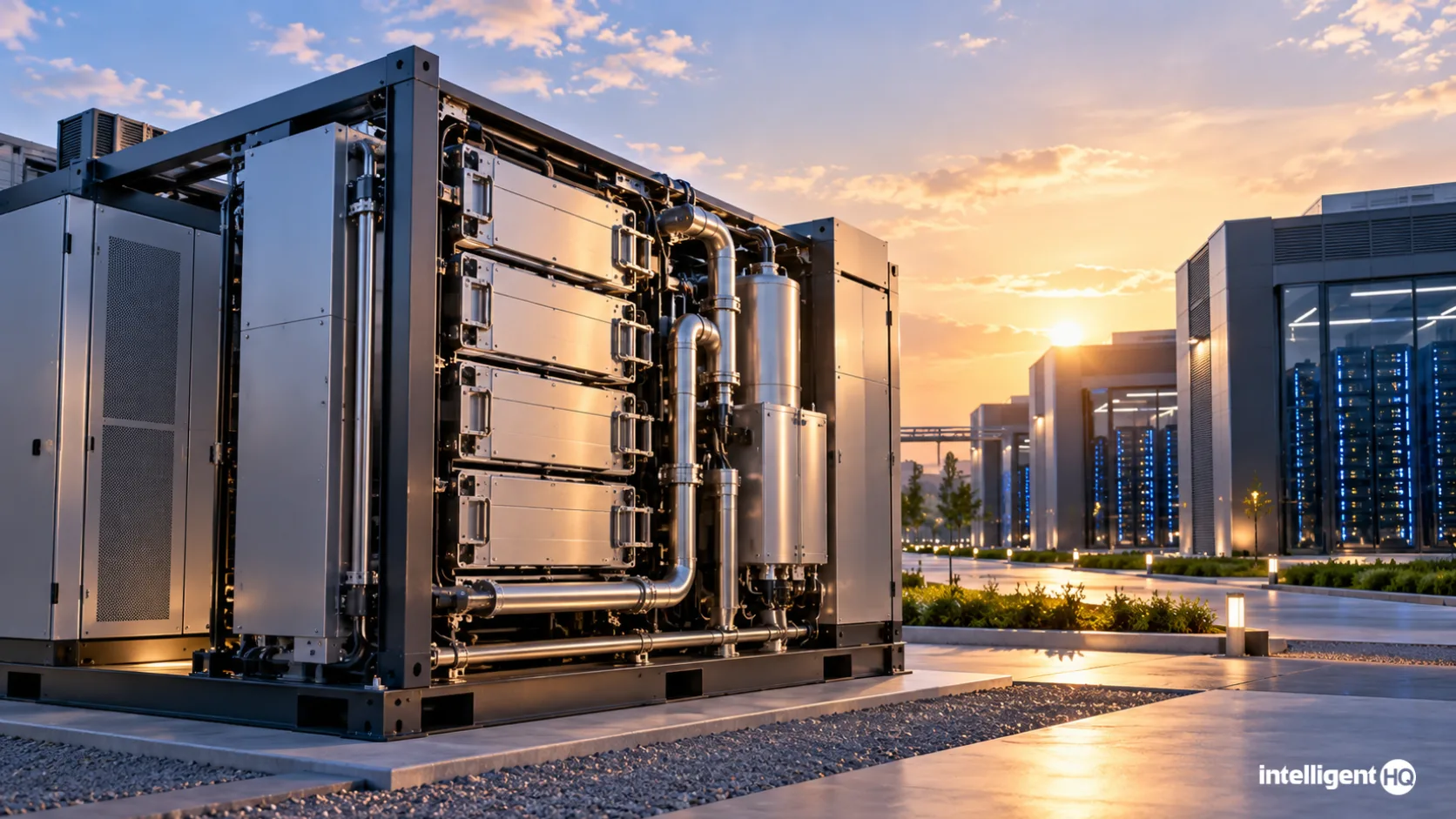
A 72kW/1.4MWh aluminum-air module has successfully completed a key stage of testing with the Net Zero Innovation Hub for Data Centers, moving the technology closer to full-scale validation and commercial deployment.
12 October 2026 — Madison, Wisconsin — Phinergy and the Net Zero Innovation Hub for Data Centers have completed a major validation milestone for a scaled-up 72kW/1.4MWh Aluminum-Air Generator (AAG) Module, bringing the technology a step closer to deployment as a clean alternative to diesel backup power in large data centers.
The module was operated on 9 October at a partner facility near Madison, Wisconsin, in front of representatives from the Hub and technical experts from Microsoft, Danfoss, Schneider Electric and Vertiv. The test demonstrated the functionality of the module’s subsystems and confirmed the next stages of the scale-up programme.
The 72kW unit is designed as the building block for a much larger 500kW/10MWh First-of-a-Kind system, which Phinergy says is already under assembly.
Aluminum-air moves closer to real data center deployment
The test is part of a broader collaboration between Phinergy and the Net Zero Innovation Hub, which began in 2025.
The Hub selected Phinergy’s aluminum-air technology from more than 70 submissions during a search for low-carbon alternatives to conventional diesel backup generators. The programme is designed to assess whether emerging technologies can meet the technical and operational requirements of large cloud and AI data centers.
Phinergy CEO Emmanuel Levy said reaching the scaled module stage represents an important step in the company’s commercialisation roadmap.
“The AAG Module design has now demonstrated, through a formal validation process endorsed by hyperscalers and leading data center operators, that it meets the technical standards required for data center operation.”
The next objective is to validate the complete 500kW/10MWh system and continue moving toward deployment.
How aluminum-air backup power works
Phinergy’s technology uses aluminum as an energy carrier.
Rather than storing electrical energy in the same way as a conventional battery, the system generates electricity through an electrochemical reaction involving aluminum and air.
The company positions the technology as a long-duration, zero-emission onsite backup power source for data centers and other critical infrastructure.
For operators, the attraction is not simply lower emissions.
Diesel backup generators require fuel storage, periodic testing, maintenance and permitting, while also producing local noise and exhaust emissions. Phinergy says its aluminum-air approach is designed to reduce those operational burdens while providing power over extended periods.
The company also says aluminum fuel can be stored without degrading in the same way as conventional batteries or diesel fuel, making it potentially useful for backup applications that may sit unused for long periods before being needed.
AI data centers are intensifying the backup power challenge
The timing is significant.
AI infrastructure is driving rapid growth in data center electricity demand, making access to reliable grid capacity one of the industry’s most important constraints.
Backup systems traditionally exist to keep operations running during grid failures, but Phinergy and the Hub are also exploring a broader role.
The AAG could potentially allow data centers to reduce their dependence on the grid during constrained peak periods while continuing to operate onsite. That could help operators manage power availability in markets where new grid connections are delayed or capacity is limited.
Phinergy has previously described the system as a way to improve both grid resilience and speed-to-power for new data center developments.
The 500kW system is the next test
The current 72kW/1.4MWh module is not the final commercial-scale product.
It serves as a scaled building block for the planned 500kW/10MWh First-of-a-Kind AAG system.
That larger system is intended to test how the technology performs at a scale closer to real data center requirements.
The validation process matters because backup power infrastructure must meet strict reliability standards. Data centers cannot adopt a lower-emission technology simply because it is cleaner; it also has to demonstrate that it can provide predictable, dependable power during critical events.
The involvement of operators and technology companies in the Hub is intended to ensure those requirements are incorporated during development rather than after the technology reaches market.
A collaborative model for data center innovation
The Net Zero Innovation Hub for Data Centers brings together data center operators, technology providers and energy companies to test technologies that could support the industry’s transition toward net-zero operations.
Its members and partners include companies such as Google, Microsoft, Data4, Danfoss, Schneider Electric and Vertiv.
Rather than evaluating technologies independently, participants define requirements collectively and provide technical resources during validation.
Alberto Ravagni, CEO of the Net Zero Innovation Hub for Data Centers, said the latest test confirms aluminum-air as a promising clean backup pathway and demonstrates how collaboration can accelerate new technologies toward deployment.
The Hub’s broader objective is to reduce the technical, commercial and regulatory barriers that can prevent promising infrastructure technologies from reaching large-scale use.
Moving beyond diesel
Diesel generators remain deeply embedded in data center resilience strategies because they are proven, scalable and capable of supplying power for extended periods.
Replacing them therefore represents a difficult engineering challenge.
Battery systems can provide fast response but may become costly for very long backup durations. Hydrogen and other emerging technologies offer different advantages but also face infrastructure and supply constraints.
Aluminum-air represents another option within that mix.
The technology’s potential value will ultimately depend on reliability, lifecycle costs, availability of aluminum fuel, operational complexity and how easily systems can be integrated with existing data center power architecture.
The latest test does not mean the technology has completed commercial validation. It does, however, provide evidence that the scaled module can operate against requirements defined by major data center industry participants.
What happens next
With the module stage completed, attention now shifts toward assembly and testing of the full 500kW/10MWh system.
If that validation is successful, the programme could move closer to commercial deployment in operating data centers.
For Phinergy, the opportunity is significant because AI and cloud growth are increasing both the number of data centers and the amount of power each facility requires.
For the industry, the challenge is equally clear: expanding digital infrastructure without allowing backup power systems to undermine decarbonisation goals.
Aluminum-air will now have to prove that it can satisfy both sides of that equation — cleaner energy and the uncompromising reliability required by critical digital infrastructure.
About Phinergy
Phinergy (TASE: PNRG) is a clean-energy technology company developing metal-air systems for data centers and critical infrastructure.
Its aluminum-air technology is designed to provide long-duration onsite reserve power using recyclable aluminum as an energy carrier.
About the Net Zero Innovation Hub for Data Centers
The Net Zero Innovation Hub for Data Centers is an industry collaboration focused on identifying, testing and accelerating technologies that can reduce the environmental impact of data center infrastructure.
Its work includes programmes around clean backup power, energy efficiency and technologies intended to support the transition toward net-zero data center operations.