Passive investing has dominated headlines globally, with more money moving into index-tracking funds than actively managed ones across many major markets. But that trend does not tell the whole story everywhere. In more volatile and less efficient markets, such as emerging markets and Asia Pacific ex-Japan, actively managed funds beat their passive counterparts 63% and 65% of the time respectively during the first half of 2026, according to a recent global fund performance study. For UAE investors navigating regional market swings, geopolitical headlines, and shifting interest rate expectations, that difference matters. A growing number are choosing actively managed investment funds that adjust positioning as conditions change, rather than funds that simply track an index regardless of what is happening in the world. This blog looks at why UAE investors are leaning into active management and what to consider before choosing an actively managed fund.
Active vs passive: a quick refresher
An actively managed fund is run by a fund manager or investment team who decide what to buy, hold, or sell based on research, market conditions, and a defined strategy. A passive fund, by comparison, simply tracks an index, holding the same securities in the same proportions regardless of what is happening in the world.
Neither approach is universally better. Passive funds tend to win on cost and simplicity, while active funds aim to earn their higher fees back through better positioning, particularly in markets that move quickly or unevenly.
Why the passive wave has not reached every market equally
Globally, passive funds have been pulling in far more new money than active ones for several years, largely because many actively managed funds in large, efficient markets like US large-cap equities have struggled to consistently beat their benchmarks. But performance data tells a different story in markets that are less efficient or more prone to sudden shocks, where active managers have more room to add value through timely positioning.
Take this example
- A passively managed global fund holds fixed weights across sectors regardless of news
- During a spike in regional tensions in mid-2026, energy and shipping-linked stocks became more volatile within days
- An actively managed multi-asset fund following CIO house views had already trimmed some equity exposure and added defensive assets weeks earlier
- When volatility picked up, the actively managed fund had less ground to make up because its positioning had already adjusted
Why UAE investors are choosing actively managed funds
- Expert positioning during volatile periods
UAE investors are more exposed than most to regional headlines, oil price swings, and shifting global trade dynamics. An actively managed fund can reduce exposure to riskier assets ahead of anticipated volatility instead of waiting for a correction to happen first.
- Diversification across several asset classes, not just stocks
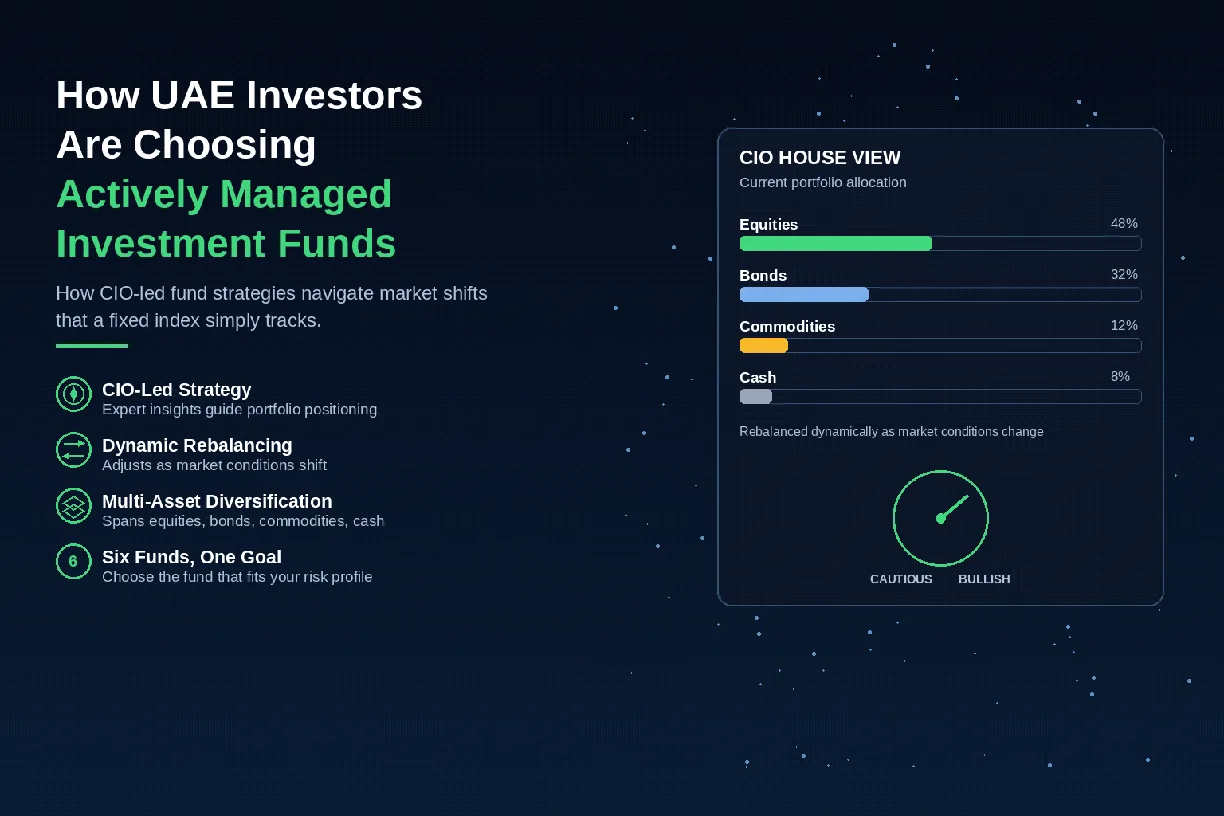
Many actively managed multi-asset funds spread investments across global equities, bonds, commodities, liquid alternatives, and cash within a single fund, rather than requiring investors to build that mix themselves.
- Rebalancing handled without investor action
As market views shift, actively managed funds are rebalanced by the fund manager rather than requiring the investor to sell and buy positions themselves.
Here is an example
- An investor holds AED 80,000 in an actively managed multi-asset fund
- The fund’s house view turns more cautious as interest rate expectations shift
- The fund manager reduces equity allocation from 55% to 48% and increases bond allocation from 25% to 32% within the same fund
- The investor’s AED 80,000 stays invested throughout, with the rebalancing happening inside the fund rather than through manual trades
- Access to institutional-style strategy without picking individual assets
Actively managed funds give investors access to research and portfolio construction normally associated with institutional investing, without needing to select individual stocks, bonds, or commodities themselves.
Active vs passive investing: a quick comparison
Choosing between the two often comes down to how much control you want to hand over, and how much you are willing to pay for it.
| Factor | Actively Managed Funds | Passive Index Funds |
| Goal | Aims to outperform a benchmark or house view | Aims to match the performance of an index |
| Decision making | Fund managers adjust holdings as conditions change | Holdings simply track the index, unchanged |
| Cost | Generally higher management fees | Typically lower fees |
| Flexibility in volatility | Can reduce or add exposure ahead of market shifts | Stays fully invested regardless of conditions |
| Best suited for | Investors who want expert positioning built in | Investors who want low-cost, broad market exposure |
Things to check before choosing an actively managed fund
- Compare the management fee against the fund’s track record, not just its stated strategy
- Check whether the fund’s risk profile matches your own investment horizon and comfort with volatility
- Look at how often and how clearly the fund communicates changes in its positioning
- Decide whether you need income distribution or long-term capital growth, since fund objectives differ
- Review the underlying asset classes the fund invests in, not just its overall label
A more hands-on approach to portfolio building
Passive investing still has a clear place in many portfolios, particularly for investors focused on low costs and broad market exposure. But for UAE investors dealing with a region that moves on its own set of headlines, actively managed, expert-led strategies can offer a level of responsiveness that a fixed index simply cannot.
Standard Chartered’s Signature CIO Funds give UAE investors access to this kind of actively managed, multi-asset strategy, including:
- A choice of six Signature CIO Funds built around different risk profiles and objectives
- Diversified portfolios spanning global equities, global bonds, commodities, liquid alternatives, and cash
- Dynamic rebalancing based on Standard Chartered’s CIO house views
- Developed in partnership with Standard Chartered’s CIO team, Amundi, and Aditum
- Start with a lumpsum from USD 1,000 or a Smart Savings Plan from USD 200 a month
- Signature CIO Islamic Funds also available for Shariah-compliant investing
Choosing between active and passive investing does not have to be all or nothing. For UAE investors who want expert positioning built into their portfolio, actively managed funds offer a way to stay invested without having to react to every headline themselves.