Manufacturers are aiming to produce more with less, reducing waste, consuming fewer materials and achieving consistently high standards. This has created a renewed focus on manufacturing efficiency, and the role of robotics, digital controls and automated inspection in supporting it. Laser technology is another area in which manufacturers are seeking to transform individual processes.
Lasers can be utilised for cutting and marking, engraving, welding and surface treatment in a variety of industrial applications. Their digitally controlled nature makes them ideal for modern, automated production environments in which machinery needs to carry out repeatable processes. Organisations looking to explore these options can consult a range of providers including Hispeedlaser when researching laser manufacturing.
Precision Can Reduce Material Waste
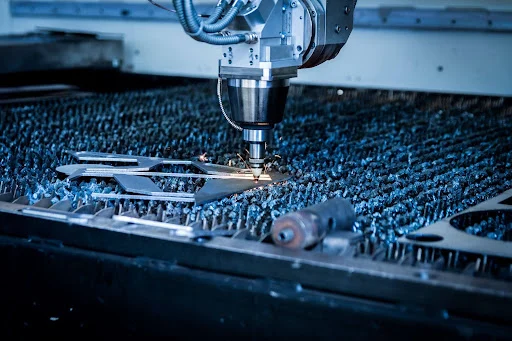
One of the primary ways in which lasers can help in production is through their ability to create highly focused beams which can be manipulated to cut and mark with a high degree of accuracy. This can enable manufacturers to avoid the wastage which might be generated by applying an even force across a large surface area.
This can be especially valuable when working with precious metals, electrical components, plastics and other materials or where close tolerances are critical. By utilising a computer programming to define how the beam moves, it may also be possible to reduce the amount of wasted material, depending on the nature of the material, machinery, cutting speeds and manufacturing design.
Where Efficiency Gains Can Come From
Laser-based manufacturing can influence efficiency in several areas:
- Reduced tooling requirements: Digital processing can eliminate the need for certain dedicated mechanical tools.
- Less manual handling: Automated laser systems can perform repetitive operations with limited operator involvement.
- Consistent processing: Programmed parameters can help maintain uniform results between batches.
- Faster changeovers: Digital designs can be changed without physically replacing conventional tooling.
- Better material utilisation: Optimised cutting paths can help reduce unnecessary scrap.
- Process integration: Laser equipment can be combined with robotics, sensors, and manufacturing software.
Faster Production Without Sacrificing Control
There is little point in achieving faster production rates if this leads to an unacceptable rise in defects and the need for rework. This is where lasers can create value, by enabling a quicker process which still maintains highly accurate digital control over the energy being applied.
This dual benefit can be extremely valuable when producing large volumes of a particular item: once the best process has been developed, it can be readily replicated to give higher consistency and reduce operator dependency. Manufacturers can find that the combination of speed and precision enables them to achieve more efficient production.
Understanding the Numbers Behind Laser Efficiency
The exact performance of a laser system depends heavily on the application. Material type, thickness, laser power, beam characteristics, cutting geometry, and machine configuration can all influence results. However, some typical figures help illustrate the scale at which laser processing can operate.
| Manufacturing Factor | Typical Figure | Why It Matters |
| Marking speed | Up to several thousand mm/s | Supports high-throughput production |
| Identification types | 5+ common formats | Enables text, codes, logos and graphics |
| Contact with workpiece | 0 physical contact | Reduces mechanical wear on marking tools |
| Marking consistency | 100% digitally repeatable process | Helps maintain uniform identification |
| Production batches | 100–10,000+ parts | Suitable for both smaller and larger production runs |
| Data fields per product | 1–10+ variable fields | Allows unique serialisation and traceability |
These figures should be treated as general industry reference points rather than specifications for one particular machine. Real-world performance must always be evaluated according to the material and the required manufacturing process.
Automation Makes Laser Processing More Flexible
The modern manufacturing environment is increasingly one in which production machinery is linked together with robotic handling, automated sensors and manufacturing software. Laser technology can play a part in this ecosystem because of the way it can be digitally programmed and automated. A robotic arm can place an item under a laser processing head, for example, while software defines the design or parameters of the cut being made. A vision system can then verify that the process has worked correctly before the item is moved to the next process stage. The use of multiple automated elements like this can enable quicker production with fewer manual handling steps.
Supporting Different Production Requirements
Greater manufacturing flexibility is as valuable as speed when it comes to laser processing. Manufacturers will often want to produce multiple variants of an item or react to smaller customer orders. Laser technology can support this in a number of ways. Programmable design and parameters can be used to facilitate a range of different production.
This is useful for applications such as:
- Customised product identification
- Different component sizes and geometries
- Small-batch manufacturing
- Serialised production
- Rapid product revisions
- Multiple materials and surface finishes
Improving Quality Through Consistent Processes
It is important to remember that manufacturing efficiency is not simply about achieving higher production rates, it also means reducing scrap and rework. The ability of a laser process to be digitally programmed can enable manufacturers to achieve more consistent results, minimising the risk of errors and defects which require rework. Laser marking provides just one example of how this can be valuable.
Rather than manually engraving a mark onto a component, a machine can be programmed to apply the same design, font, code or other details. Combined with automated vision inspection or digital record-keeping of serial numbers, this can help manufacturers identify and isolate any defective items at a later stage.
The Future of Efficient Laser Manufacturing
As industries continue to embrace the connected factory, laser technology is set to become a key part of smart manufacturing. It can offer a combination of highly accurate and focused energy delivery, together with automation, robotics and flexible digital programming. These attributes can enable manufacturers to become more efficient, without compromising on product quality.
As manufacturing becomes more highly automated and data-driven, the combination of robotics, machine vision, laser processing and automated material handling will become even more valuable. This will create fully integrated production cells, capable of delivering highly flexible manufacture with minimal manual handling. When applied to the right application, laser technology can therefore support the most efficient manufacturing process.