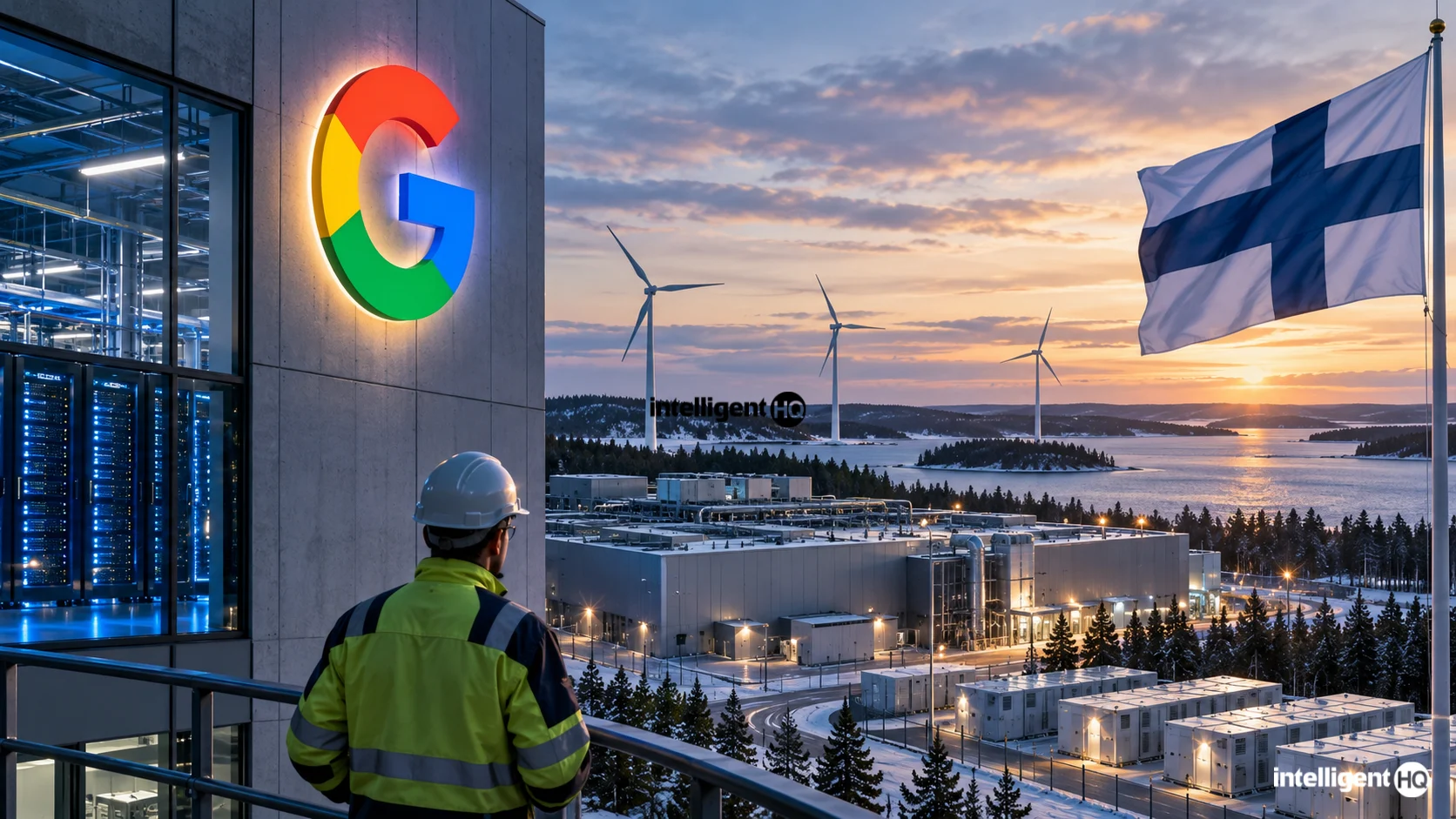
Google’s largest single investment in Europe will expand digital infrastructure, energy capacity and workforce skills in Finland, strengthening the country’s role in the next phase of AI development.
16 September 2026 — Google has announced a €13 billion investment in Finland over the next two years, covering digital infrastructure, clean energy projects and economic partnerships as demand grows for services including Search, Maps and Gemini.
The company described the commitment as its largest single investment in Europe. According to figures cited in the announcement, the initial construction phase across 2027 and 2028 is expected to support more than 37,000 jobs and contribute around €3.6 billion annually to Finland’s GDP.
The scale of the programme highlights how AI infrastructure is becoming inseparable from energy policy, regional development and workforce planning. Large-scale compute expansion is no longer simply about building data centres; it increasingly requires access to stable electricity, grid flexibility, skilled workers and long-term partnerships with local communities.
Finland becomes a strategic AI infrastructure hub
Google has operated in Finland for 15 years, centred around its data centre in Hamina, where the company converted a former paper mill into a large-scale digital infrastructure site.
Between 2023 and 2025, Google said its presence supported an ecosystem of more than 600 Finnish suppliers across construction, operations and network fibre. It has also worked with more than 40 social and community organisations in the Hamina region.
The new investment significantly expands that footprint. While Google did not disclose how much of the €13 billion will be allocated specifically to data centres, energy infrastructure or other initiatives, the company made clear that growing demand for AI services is a major part of the rationale.
As Gemini and other AI-powered products require more computing capacity, Finland’s combination of energy availability, infrastructure, engineering expertise and relatively cool climate is becoming increasingly attractive.
Energy supply becomes part of the AI strategy
One of the most significant parts of Google’s Finland programme is the link between computing infrastructure and electricity supply.
The company has signed a 22-year agreement supporting the life extension of the Loviisa nuclear power plant, while also planning new onshore wind capacity. In addition, Google will contract a new 94MW battery system intended to support grid stability during periods when wind generation is low.
These measures show how AI infrastructure investment is beginning to reshape energy strategy.
Data centres require large amounts of reliable electricity, and the growing demand associated with AI is increasing pressure on operators to secure long-term supply while managing grid constraints. Rather than treating power as a secondary issue, Google is integrating energy planning directly into its expansion strategy.
That approach could become increasingly common as hyperscalers compete for access to reliable, lower-carbon electricity across Europe.
AI infrastructure is becoming a regional development policy
The investment also extends beyond computing and energy.
Google is committing €31 million to communities including Hamina, Kajaani, Muhos and Vaala over the next four years. The programme will support education and economic development, including AI upskilling for more than 4,400 workers and training opportunities for 100 Finnish students preparing for careers in data centres.
The company expects the new facilities to create thousands of permanent roles once fully operational, including positions in engineering, security, operations and catering.
This matters because the economic effect of AI infrastructure increasingly depends on the local ecosystem around it. Data centres may bring significant capital investment, but long-term value depends on whether regions can build the skills, supply chains and services needed to support them.
Finland’s strategy appears to be moving in that direction.
Environmental infrastructure becomes part of the model
Google has also connected the programme to environmental and community projects around its Finnish sites.
The company plans to fund the regeneration of native forests and wetlands, as well as recreational facilities including trails, public saunas and fishing piers.
Its existing Hamina data centre already uses seawater-based cooling, and Google has developed an offsite heat-recovery system that distributes recovered heat to local homes and businesses.
These projects reflect a broader shift in how large data centre investments are being positioned.
As public concern grows around electricity use, water consumption and the environmental footprint of AI, technology companies are under increasing pressure to show that infrastructure expansion can coexist with local environmental and social benefits.
Europe’s AI ambitions are becoming more physical
The announcement also underlines a wider change in Europe’s AI strategy.
Much of the debate around artificial intelligence has focused on models, regulation and software. However, the competitive foundation of AI increasingly rests on physical infrastructure: data centres, chips, electricity, cooling systems and network capacity.
That makes large infrastructure commitments strategically important.
Google’s expansion in Finland comes as European governments and companies are trying to strengthen domestic AI capacity and reduce dependence on infrastructure concentrated elsewhere.
The challenge is that building sovereign or regionally resilient AI capacity requires more than supporting local startups. It also requires access to the physical systems that allow advanced models to be trained, deployed and scaled.
Sovereign AI is attracting more capital
The Finland announcement comes alongside growing investment in European AI companies and infrastructure providers.
Mistral’s latest fundraising, highlighted in the same Techerati update, reflects increasing investor interest in sovereign AI and the development of European alternatives to US-based AI platforms.
The two developments are different in scale and structure, but they point in the same direction.
Europe is attempting to strengthen both the software and infrastructure layers of its AI economy. On one side, companies such as Mistral are building models and AI platforms. On the other, hyperscalers such as Google are expanding the computing and energy infrastructure required to support rapidly increasing demand.
The interaction between those layers will help shape Europe’s competitiveness over the next decade.
Finland’s advantage extends beyond data centres
Finland’s role in this emerging market is not limited to physical infrastructure.
The country has strengths in engineering, telecommunications, energy systems and digital public services, creating a broader environment in which AI infrastructure can be developed alongside research and industrial capability.
Prime Minister Petteri Orpo said the value of the data economy extends beyond direct investment and can contribute to innovation, research and development.
That is an important distinction.
The economic impact of AI infrastructure will depend partly on whether countries can convert data centre investment into broader productivity gains, new businesses, technical expertise and local innovation.
AI infrastructure becomes a strategic asset
Google’s €13 billion commitment shows how quickly AI infrastructure is moving from a back-end technical issue to a strategic economic asset.
The next phase of AI competition will depend not only on which companies build the most capable models, but also on which regions can support the power, compute, talent and physical infrastructure needed to operate them at scale.
Finland is increasingly positioning itself as one of those regions.
For Google, the investment creates additional capacity for its expanding AI and digital services. For Finland, it represents a long-term bet that data infrastructure, energy systems and AI skills can reinforce one another.
The result is a model that could become increasingly important across Europe: AI infrastructure planned not as an isolated technology project, but as part of a wider energy, industrial and regional development strategy.
About Techerati
Techerati is a technology news and events platform covering cloud computing, artificial intelligence, cybersecurity, data centres and digital transformation.
The report on Google’s Finland investment was written by Rebecca Uffindell and published as part of Techerati’s coverage of European AI infrastructure and technology strategy.