Video content is one of the most resource-intensive assets a marketing or product team produces — and one of the most repetitive in structure. Ads, UGC-style clips, product demos, and social content all follow recognizable patterns: a goal, a set of source assets, constraints on length and resolution, and a bar for what counts as “good enough.” That repeatability is exactly what makes video production a strong candidate for AI Agent automation. This article looks at how an AI Agent can take on that work end-to-end, using the Seedance 2.5 API as the underlying generation service, and how teams can keep costs under control as the workflow scales.
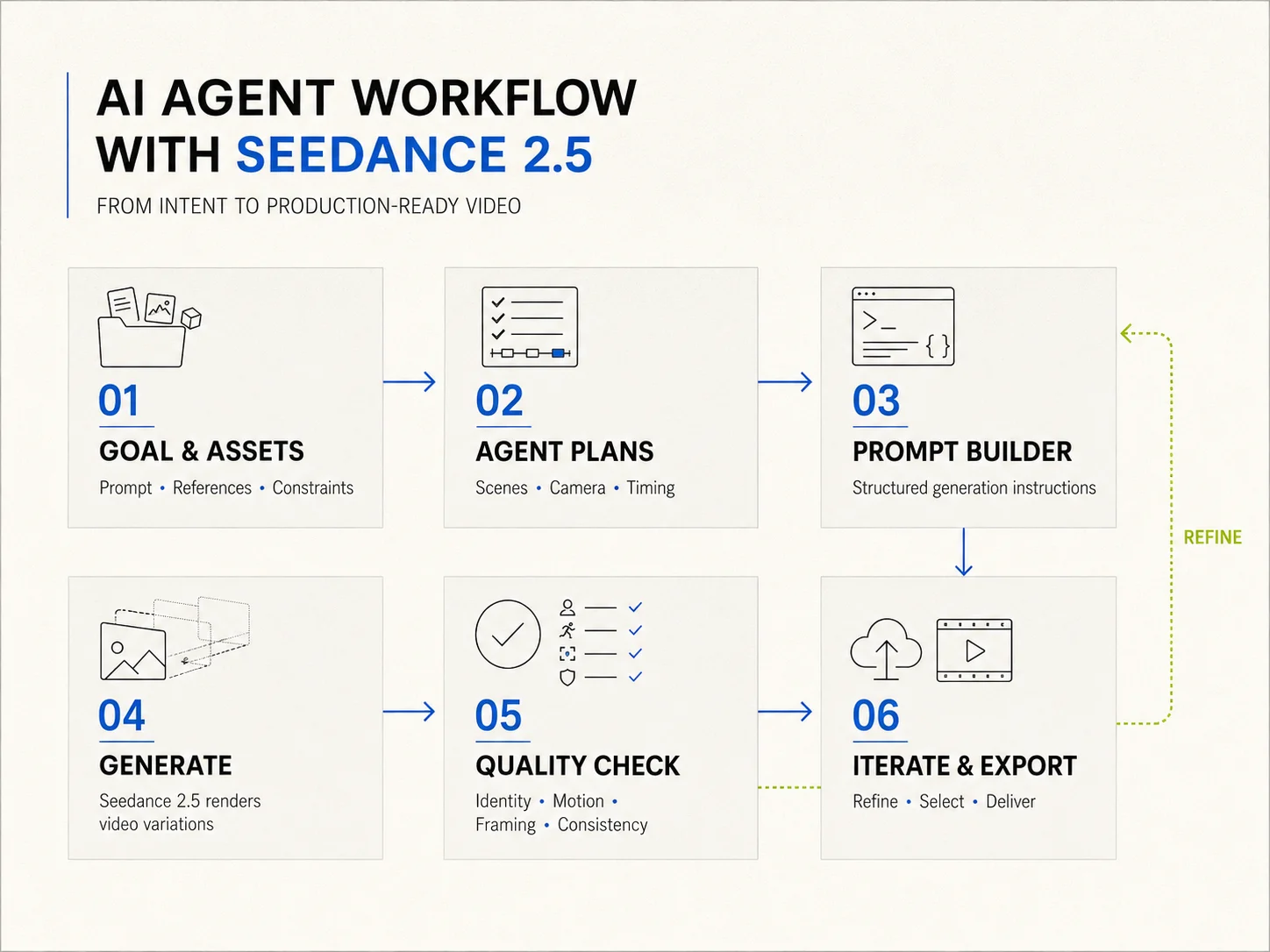
Giving the Agent a well-defined brief
The quality of an automated video workflow starts with how the task is framed for the Agent. A usable brief typically includes:
- The video goal — what the video is for (a product demo, an ad variant, a social clip) and what it needs to communicate.
- Source assets — any existing footage, images, or reference video the Agent should build from, if the task isn’t a pure text-to-video generation.
- Duration and resolution — explicit constraints, not left to the Agent’s discretion, since these directly affect both output fit-for-purpose and cost.
- Acceptance criteria — what “done” looks like, so the Agent (and the human reviewing its output) have a shared bar for success.
Teams that skip the acceptance-criteria step tend to end up with Agents that produce technically valid videos that still miss the brief — the wrong pacing, the wrong framing, or a resolution that doesn’t fit the intended placement. Being explicit here up front saves review cycles later.
How the Agent connects to the video-generation service
Once the brief is in hand, the Agent’s job is to translate it into a concrete generation request. This involves choosing between two underlying modes:
- Text-to-Video, when the brief is descriptive and there’s no existing footage to build from.
- Reference-to-Video, when the brief includes source video that should inform or anchor the output.
The Agent organizes the request accordingly — assembling the prompt or reference asset, setting duration and resolution to match the brief — and submits it to the Seedance 2.5 API, which is the service layer that actually performs the generation. From there, the Agent’s role shifts from composing the request to managing it: tracking the resulting task, monitoring its status until completion, and handling whatever comes back — success or failure — appropriately.
This is the point where a well-designed Agent workflow differentiates itself from a simple scripted pipeline: rather than firing off a request and passively waiting, the Agent stays in the loop, ready to interpret outcomes and make decisions about what happens next.
Monitoring status and handling failures
Video generation tasks don’t resolve instantly, so the Agent needs a way to track progress and know when a result is ready or when something has gone wrong. This typically means checking task status until the job resolves, then branching based on the outcome.
When a task fails, the more valuable behavior isn’t just retrying blindly — it’s identifying why it failed and deciding accordingly:
- If the failure looks like a transient or infrastructure-level issue, a retry is often reasonable.
- If the failure traces back to the request itself — a malformed reference asset, an unrealistic prompt, a constraint mismatch — retrying the same request will likely fail again, and the Agent should instead flag the issue or attempt a modified request.
This distinction matters for scalability. An Agent that retries indiscriminately on every failure will waste both time and budget on jobs that were never going to succeed; one that can triage failures intelligently keeps the pipeline efficient as volume grows.
Returning results for human review
Even in a highly automated pipeline, most teams keep a human checkpoint before a video ships — reviewing brand fit, message accuracy, and overall quality. The Agent’s job here is to package the completed video along with enough context (the original brief, the mode used, duration and resolution, and any relevant notes from the generation process) so the reviewer can evaluate it quickly without having to reconstruct what was asked for. A tight feedback loop here — where reviewer notes can be fed back into a revised brief for regeneration — is often what separates a workflow that scales smoothly from one that just shifts the bottleneck from production to review.
Where this fits: advertising, UGC, product demos, and social content
The same Agent-driven pattern applies across several common use cases:
- Advertising — generating multiple creative variants of an ad concept for testing, without a full production cycle for each variant.
- UGC-style content — producing content that mirrors the look and feel of user-generated video for campaigns that benefit from that aesthetic.
- Product demonstrations — turning product assets into short explainer or showcase clips at a pace that keeps up with a fast-moving product catalog.
- Marketing and social-media content — producing shorter, platform-specific clips where speed and volume matter more than a single polished hero asset.
In each case, the underlying Agent workflow — brief in, request out, monitor, review, ship — stays largely the same. What changes is the brief itself: the goal, the source assets, and the acceptance criteria shift with the use case, but the orchestration logic doesn’t need to be rebuilt each time.
Controlling production costs across multiple videos, resolutions, and iterations
Scaling a video workflow means scaling its cost exposure too, so budget control needs to be part of the Agent’s decision-making, not an afterthought handled manually after the fact. The Seedance 2.5 API price structure is a useful lever here, because it varies meaningfully by mode and resolution
Text-to-Video, billed by output duration:
480p: USD 0.138 per output second
720p: USD 0.296 per output second
Reference-to-Video, when a video reference is used, billed by input plus output duration:
480p: USD 0.084 per input + output second
720p: USD 0.180 per input + output second
The practical implication for a scaled workflow: T2V costs scale purely with how long the output needs to be, while R2V costs also grow with the length of the reference footage being processed — a longer source clip means more billed seconds even before accounting for output length. For teams running many videos through the pipeline, a few cost-control practices go a long way:
- Default to the lowest resolution that meets the acceptance criteria, rather than defaulting to the highest available — the per-second difference between 480p and 720p compounds quickly across volume.
- Cap iteration counts on any single brief, so a request that keeps missing acceptance criteria doesn’t quietly consume unbounded budget through repeated regeneration.
- Track cost per completed (accepted) video, not just per generated video, so the real cost of revisions and rejected attempts is visible rather than hidden inside an aggregate spend number.
Building these guardrails into the Agent’s decision logic — rather than relying on after-the-fact spend reviews — is what allows a video workflow to scale from a handful of pilot videos to a production-volume pipeline without cost becoming the limiting factor.
The bigger picture
Treating video generation as an Agent-managed workflow — rather than a manual, one-off production task — is what makes it viable to scale across advertising, UGC, product demos, and social content simultaneously. The pattern is straightforward: a clear brief, a request the Agent can compose and submit, status monitoring that can distinguish real failures from transient ones, a human review step with enough context to be fast, and cost controls that are built into the Agent’s decisions rather than bolted on afterward. Teams that get these pieces right find that the bottleneck shifts from “how much video can we produce” to “how fast can we review and ship it” — which is a much better problem to have.