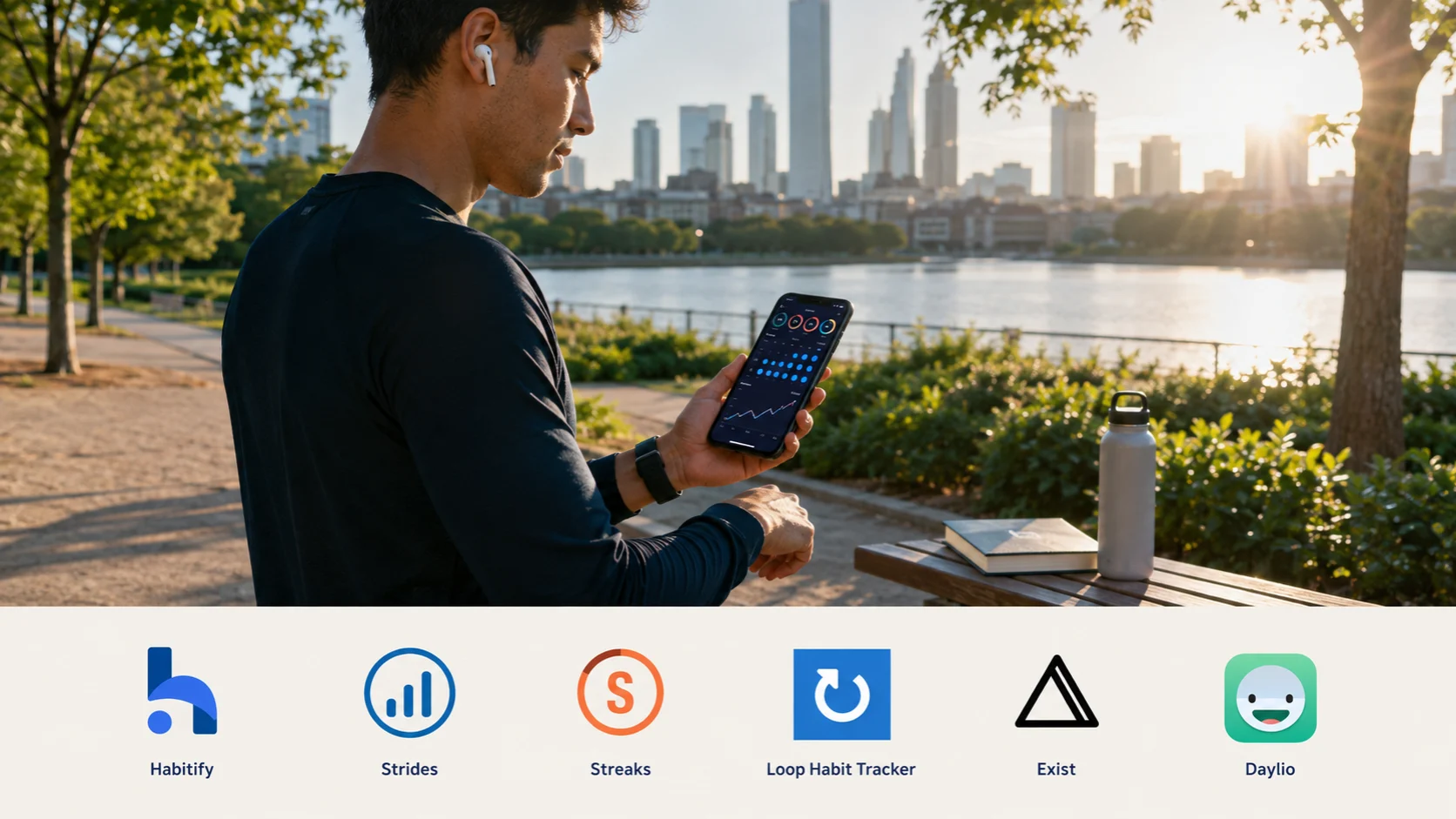
Self-improvement trackers can reveal whether daily intentions are becoming consistent actions. The best tools do more than count streaks: they distinguish habits from projects, measure progress against targets and help users review what is—or is not—working.
This guide compares six trackers for routines, personal goals, behavioural patterns and reflective progress. It complements IntelligentHQ’s broader guide to the best apps and online tools for self-improvement.
Key takeaways
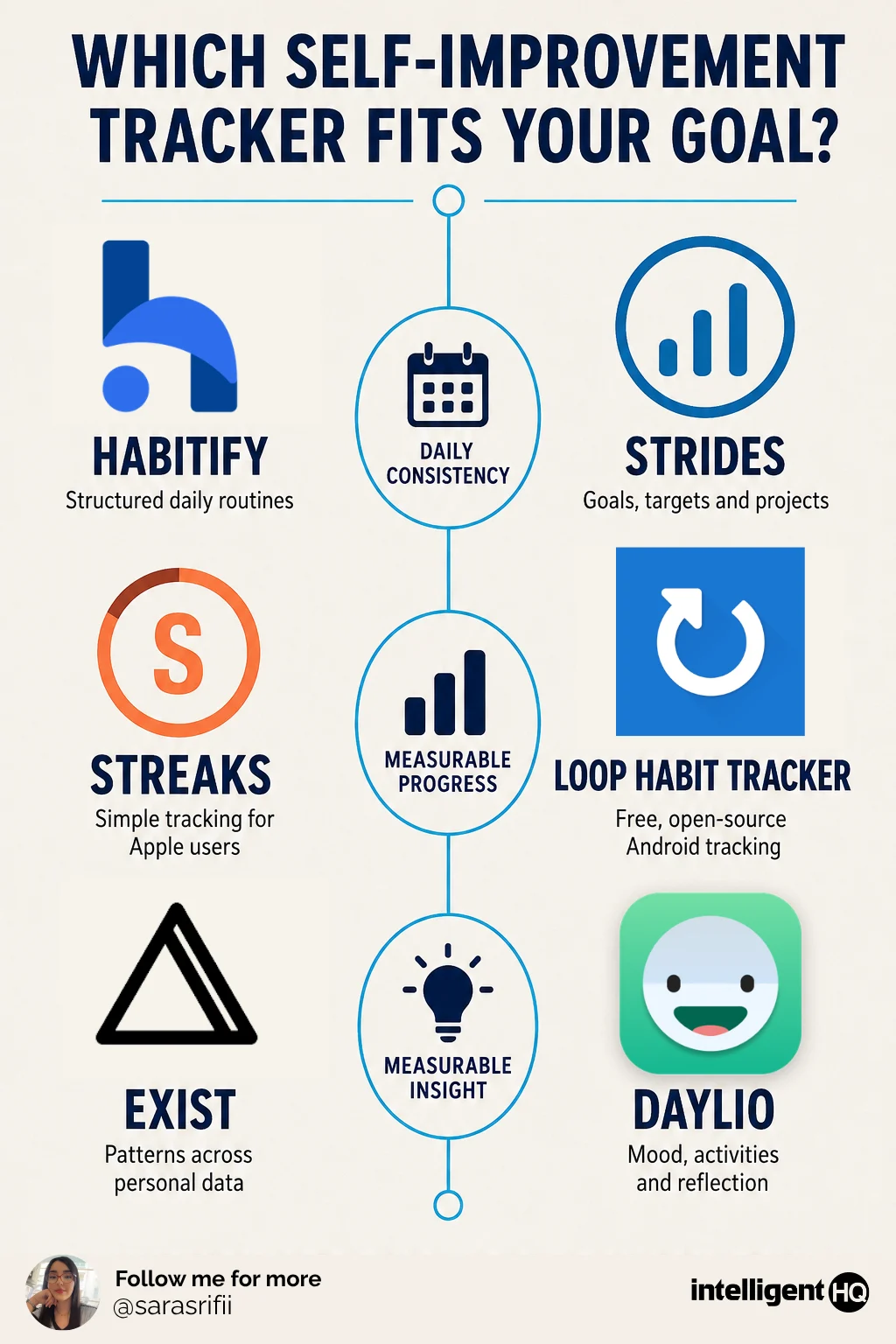
- Habitify is the strongest cross-platform option for structured routines.
- Strides offers the most flexible system for habits, targets and projects.
- Streaks provides a focused experience for Apple users.
- Loop Habit Tracker is the best free, open-source Android option.
- Exist is designed for discovering relationships across personal data.
- Daylio connects habits and activities with mood.
- Tracking is useful only when it changes a decision or behaviour.
Best self-improvement trackers compared
| Tracker | Best for | What it measures | Main limitation |
|---|---|---|---|
| Habitify | Structured daily routines | Completion, streaks, time and mood | Advanced tracking may require a paid plan |
| Strides | Goals and measurable targets | Habits, values, averages and projects | Currently centred on Apple devices |
| Streaks | Simple Apple-based habit tracking | Completed and missed routines | Less suitable for complex goals |
| Loop Habit Tracker | Free Android habit tracking | Frequency, streaks and habit strength | Limited project and goal-planning features |
| Exist | Personal analytics | Trends and relationships across datasets | Requires regular data and interpretation |
| Daylio | Mood-aware self-improvement | Mood, activities, goals and correlations | Better for reflection than project management |
How we selected these trackers
The comparison considers five practical questions:
- Can the tool measure the type of progress it claims to support?
- Is daily logging quick enough to sustain?
- Can users review trends beyond a current streak?
- Does the platform support export, integrations or data control?
- Does the information lead to a useful decision?
Features were checked against the platforms’ official product and privacy information. Availability and pricing can change, so users should verify current terms before subscribing.
1. Habitify: Best overall habit tracker
Habitify combines routine scheduling with progress statistics across web, iOS, Android, macOS and wearable devices.
Users can organise habits by time of day, set reminders, record notes and use a timer for activities requiring a measured duration. The platform also offers mood tracking and connections with services including Apple Health, Google Fit, Zapier and IFTTT.
Its strongest feature is structure. A morning routine, exercise programme and evening shutdown ritual can be separated without turning the daily screen into an unmanageable list.
Best for: users who want a polished habit system across several devices.
Watch for: tracking too many routines can create administrative work without improving behaviour. Begin with three to five habits.
2. Strides: Best for goals and measurable targets
Strides is more flexible than a conventional yes-or-no habit tracker. It provides four tracker formats:
- Habit: whether an action was completed.
- Target: progress towards a numerical value by a specified date.
- Average: performance across a period or rolling average.
- Project: milestones, checklists and percentage completion.
This makes Strides useful for combining behaviours and outcomes. A user could track the habit of writing each weekday, a target of completing 50,000 words and the milestones of a larger publishing project.
Its reports include pace lines, success rates, streaks, calendars and longer-term charts.
Best for: people managing habits, measurable goals and personal projects together.
Watch for: Strides is currently focused on Apple platforms, while its official site directs Android users to a waitlist.
For tools centred more heavily on scheduling and execution, compare IntelligentHQ’s best productivity apps for personal growth.
3. Streaks: Best for a simple Apple experience
Streaks presents habit tracking as a focused daily to-do list. Users complete recurring actions and maintain a visible chain over time.
It supports positive routines and behaviours users want to reduce. Compatible activities can also be recorded through Apple Health, reducing the need to log every workout or health metric manually.
The restrained design is valuable for people who abandon complex trackers. However, it is better suited to repeated behaviours than multi-stage projects or sophisticated goal analysis.
Best for: Apple users who want a fast, visually clear habit tracker.
Watch for: protecting a streak can become more important than the purpose behind the habit. A short walk may preserve an exercise streak without meaningfully advancing a fitness goal.
4. Loop Habit Tracker: Best free Android option
Loop is a free, open-source habit tracker for Android. It supports reminders, detailed charts and statistics without requiring an account.
The app uses a habit score intended to reflect longer-term consistency rather than treating one missed day as the destruction of all previous progress. That makes it useful for users who find rigid streak systems discouraging.
Its open-source model and offline approach will also appeal to people who prefer a simpler tool with less dependence on a commercial cloud platform.
Best for: Android users seeking private, straightforward habit tracking.
Watch for: Loop focuses on repeated habits. It is not a complete system for project milestones, life planning or coaching.
5. Exist: Best for understanding behavioural patterns
Exist is a personal-analytics platform rather than a basic checklist.
It can combine manually recorded information with data from services such as Apple Health, Fitbit, Garmin, Oura, Strava, RescueTime, Todoist, calendars and weather sources. Users can then examine trends and possible relationships between variables.
For example, Exist may help investigate whether sleep, exercise, social activity or work patterns are associated with changes in mood or productivity.
This makes it valuable for self-experimentation, but correlation should not be mistaken for causation. Two variables may move together because of another factor the tracker does not record.
Best for: data-oriented users who want to investigate what influences their behaviour.
Watch for: meaningful analysis requires consistent data over time. More data does not automatically produce a reliable conclusion.
6. Daylio: Best for connecting habits with mood
Daylio combines a mood diary, activity tracker and goal system.
A basic entry can be completed by selecting a mood and recording activities. The platform then presents calendars, charts and correlations that may help users notice patterns between behaviour and how they feel.
It also supports written notes, photographs, voice memos, recurring goals and data export. Daylio states that diary entries remain in the app’s private directories and are not sent to its servers, while backups can be stored through the user’s cloud service.
Best for: users who want to understand how routines relate to mood and wellbeing.
Watch for: mood data is subjective and can be influenced by sleep, health, relationships and environmental conditions. The app should support reflection, not medical diagnosis.
What should a self-improvement tracker measure?
Different objectives require different evidence.
Habits
Track whether a repeated behaviour occurred under defined conditions.
Instead of recording “read more”, measure “read for 20 minutes after dinner on weekdays”.
Goals
Track movement towards a specific result.
For example, a language learner could monitor completed lessons, practice time and assessment scores rather than relying only on app activity.
Readers developing a new skill can explore IntelligentHQ’s comparison of the best learning apps for adults.
Projects
Track milestones, dependencies and completed outputs.
A project such as publishing a portfolio requires stages and deadlines—not an indefinite daily streak.
Wellbeing
Track context as well as behaviour. Sleep, energy, workload and mood may explain why consistency changes.
Sensitive health information should be handled carefully, and personal tracking should not replace qualified medical advice.
The IntelligentHQ evidence ladder
Not all progress signals are equally meaningful. Use this five-level framework:
- Intention: “I plan to exercise.”
- Check-in: “I marked exercise as complete.”
- Behaviour: “I exercised for 30 minutes.”
- Output: “I completed three planned sessions this week.”
- Outcome: “My tested strength or endurance improved.”
Most habit apps are strongest at levels two and three. They record actions but cannot always prove the desired outcome.
A meditation streak does not establish lower stress. A reading streak does not prove understanding. A focus timer does not demonstrate valuable work.
For controlling the environment in which progress happens, see IntelligentHQ’s guide to the best focus apps for protecting deep work.
How to use a tracker without becoming obsessed with tracking
Start with one outcome
Define what should be different after six or twelve weeks.
Track the smallest useful set
Choose one behaviour, one output and—where possible—one outcome. Additional measurements should earn their place by informing a decision.
Establish a baseline
Record normal behaviour for a week before setting an aggressive target. This reduces the risk of building plans around unrealistic assumptions.
Review weekly
Ask:
- What improved?
- Where did consistency break?
- Was the target realistic?
- What obstacle appeared repeatedly?
- What should change next week?
Change the system, not the historical record
Do not edit missed days simply to preserve an attractive streak. A missed action is information about workload, motivation, environment or the design of the habit.
Stop tracking when it no longer helps
A routine that has become stable may no longer require daily logging. Tracking should support behaviour—not become the behaviour.
Privacy questions to ask before choosing an app
Self-improvement data can reveal health conditions, emotional patterns, locations and daily routines. Before using a tracker, check:
- Where the data is stored
- Whether an account is required
- Whether information is used for advertising or AI training
- Which connected services can access it
- Whether data can be exported
- Whether individual records can be corrected or deleted
- What happens after cancelling a subscription
Users should be particularly careful when combining information from multiple health, productivity and location services.
Final verdict
Habitify is the strongest general-purpose option for structured routines across several platforms. Strides is better when personal development includes numerical targets and projects, while Streaks offers a simpler Apple-focused experience.
Loop is the leading choice for users wanting a free, open-source Android tracker. Exist provides deeper personal analytics, and Daylio is more useful when mood and reflection matter as much as task completion.
The best self-improvement tracker is not the one that produces the most statistics. It is the one that makes progress visible, exposes a useful pattern and helps the user decide what to do next.
Frequently asked questions
What is the best app for tracking habits and goals?
Habitify is a strong cross-platform habit tracker, while Strides is more flexible for combining routines, numerical targets and projects.
Are streaks a reliable measure of progress?
Streaks measure consistency, not necessarily improvement. Pair them with an output or outcome relevant to the actual goal.
What is the best free habit tracker?
Loop Habit Tracker is a strong free, open-source choice for Android users.
Can a habit tracker improve motivation?
A tracker can provide reminders and visible feedback, but it cannot replace a realistic goal, supportive environment or meaningful reason to act.
How many habits should a beginner track?
Three to five are usually enough to reveal patterns without creating excessive logging. Starting with one important behaviour may be even more effective.
Sources
- Habitify: Official product information
- Strides: Goal and habit-tracking features
- Streaks: Official habit tracker
- Loop Habit Tracker: Official website
- Exist: Personal analytics and connected data
- Daylio: Mood, activity and goal tracking
- American Psychological Association: Does Monitoring Goal Progress Promote Goal Attainment?